United States Army
BluebeardThe United States Army is both an institution of wartime service and one of the first large communities Rabo Karabekian claims as family. It accepts him during the Great Depression, places him among artist-soldiers trained in camouflage, and sends his platoon into combat near the end of World War II. His service ends with the loss of his left eye, but it also provides the operation that restores his appearance; in retrospect, he remembers the Army as a family he chose not to leave behind through promotion.
Recruitment and a New Family
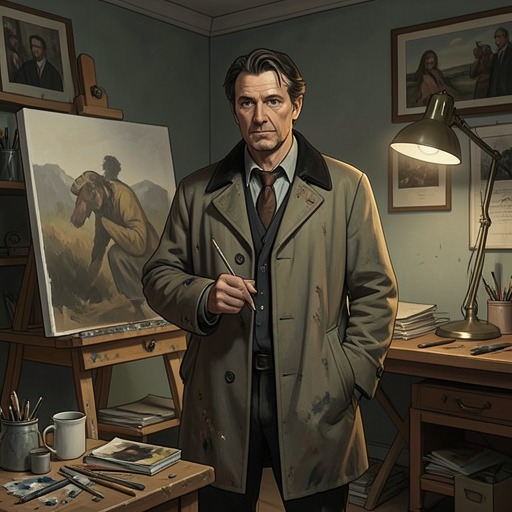
Karabekian joins the regular Army during the Great Depression, after losing his New York agency job amid the upheavals of war in Europe. The recruiting sergeant suggests that he might become a more attractive prospective recruit if he legally changed his name to Robert King. The Army instead adopts him under his own name. A reason soon emerges: Major General Daniel Whitehall wants an oil portrait of himself, and believes an artist with a foreign-sounding name may be best suited to paint it. As a regular Army soldier, Karabekian must make the portrait without pay, though Whitehall buys the costly materials.
The episode sets the Army’s institutional welcome beside the pressure to make an immigrant name more American. The portrait commission, given during basic training, introduces Karabekian to military service through the skill he already possesses, even as his later wartime work will make a different use of artistic vision. His recollection also places the Army within a larger search for belonging: far from the biological extended family his Armenian parents had known, he comes to regard the Officer Corps in wartime as one of two artificial extended families in which he finds a place. The other is the postwar Abstract Expressionist school.
The Camouflage Platoon
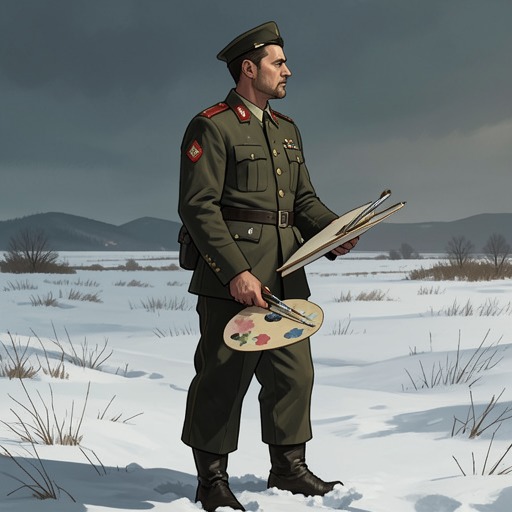
The Army forms Karabekian’s platoon from artists because someone in the military believes their civilian training might make them especially capable of camouflage. The unit proves effective at misleading German forces about what lies behind Allied lines. Its achievement is not simply concealment: the artists create false impressions of what is dangerous and what is not, turning visual invention into a direct military instrument.
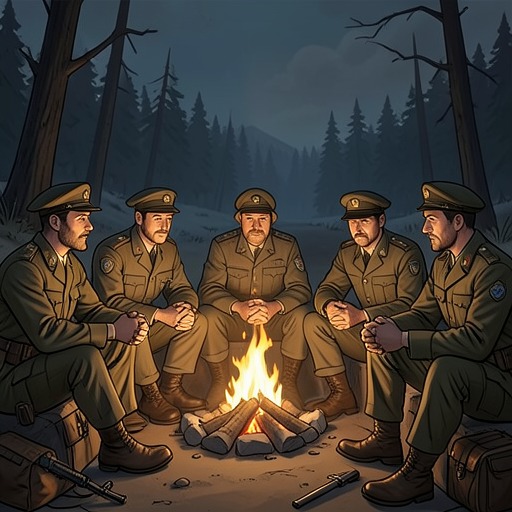
The platoon’s unusual position reinforces its distinct identity. It is not attached to an ordinary division or corps; orders come directly from the Supreme Headquarters of the Allied Expeditionary Force, which temporarily assigns the men to generals who have heard of their deceptions. Those generals serve as short-term patrons, permissive toward the artists’ disregard for conventional dress and military courtesy, and ultimately grateful for their work. The men repeatedly move on to another assignment, a mobile existence that differs from the stable structure of a conventional unit.
Karabekian refuses promotions beyond captain, although his length of service might have brought him at least to lieutenant colonel by the end of the war. He makes that choice in order to remain with his thirty-six men. He describes this as his first experience of a family on that scale. The refusal makes rank less important to him than the company and continuity of the platoon, and gives his military career a personal measure of success that differs from advancement through the hierarchy.
Combat, Capture, and Medical Care
Near the end of World War II, the platoon is ordered into combat to help contain the last major German breakthrough. Although the men had been organized as camouflage specialists, they must fight for their lives as ordinary infantry. In Luxembourg, Karabekian loses his left eye and is taken prisoner. He later recalls little about the moment of injury itself: his memory holds the approach of a white German tank and German soldiers in white crossing a snow-covered meadow. He is unconscious when captured, receives morphine, and wakes in a German military hospital located in a church across the border in Germany. Once his wound heals, he is sent to a prisoner camp.
Karabekian describes the injury as having caused little pain and healing quickly. That comparatively limited physical suffering becomes part of a disagreement about whether he can claim the same kind of survivor’s burden as his father. Yet the injury remains an unmistakable consequence of his service, and his one-eyed appearance becomes a recurring fact through which others understand him. He insists on the reality of his own ordeal even while acknowledging that the circumstances of his wound differed from the prolonged suffering he associates with his father’s experience.
At the end of the war, the United States pays for cosmetic surgery at Fort Benjamin Harrison, outside Indianapolis, on the place where Karabekian’s eye used to be. He remembers this provision not as an act by an individual benefactor but as care from his country, personified as Uncle Sam. The Army’s role therefore extends beyond recruitment and combat: it also provides postwar medical treatment. That institutional care does not undo the injury or settle Karabekian’s complicated relation to survival, but it marks a concrete obligation fulfilled at the close of his service.
After Service and Lasting Meaning
Military belonging contrasts sharply with Karabekian’s return to civilian life. He says that he and his fellow veteran Fred Jones had nothing to come home to, and that he felt blank rather than bitter. The contrast helps explain why his recollection of the Army emphasizes not only combat but also the platoon as a chosen family. Years later, after his first wife and two sons leave him, he gives up painting and seeks solitude for eight years; that later isolation stands against the communal life he had protected by staying with his men.
The Army also supplies an enduring point of pride. When Circe Berman tells him he is modest to the point that others might think him good at nothing, Karabekian answers that she is forgetting camouflage. He recalls the platoon’s Presidential Unit Citation and boasts that some of the things its members hid from the enemy have never been found. The remark carries the military achievement into his later life, where camouflage remains a measure of competence even as his paintings have drawn ridicule.
In the novel’s account, Army camouflage and Karabekian’s artistic practice are connected by the work of directing vision: his platoon makes military deception from images, while his later life as a painter and keeper of a major private collection repeatedly confronts questions about what pictures show and what they mean. The connection is grounded in his own service rather than presented as a formal Army doctrine. The institution’s importance to him lies in this combination of practical work, a chosen community, injury, and care—and in the fact that its wartime family is one of the few affiliations he remembers as wholly his own.