Candide's killings in Lisbon
CandideCandide's killings in Lisbon mark a sudden passage from vulnerability to lethal action: after being whipped under the authority of the Inquisition, he kills Don Issachar and then the Grand Inquisitor of Portugal. The immediate result is not safety but flight. With Cunegonde and the Old Woman, he leaves the city by night, and the episode converts the danger surrounding their relationship into a new stage of their journey.
Causes and Circumstances
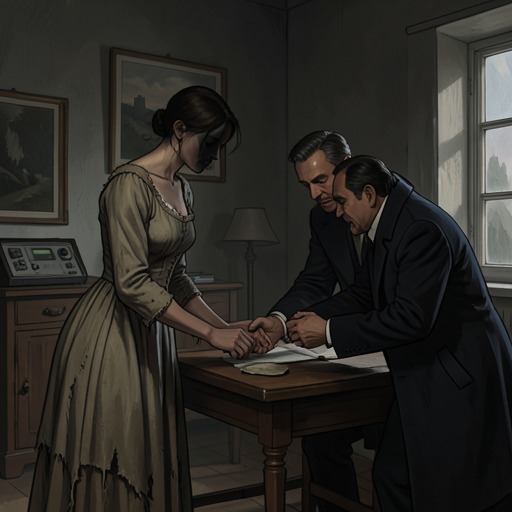
The first confrontation takes place in Cunegonde’s apartment. Don Issachar arrives carrying a poniard and objects to sharing her with the Inquisitor. Candide, who has received a sword from the Old Woman along with a change of clothes, is armed when Don Issachar attacks. Though characterized as gentle, Candide draws the sword and kills him. The confrontation is driven by the rivalry over Cunegonde, but it also follows the violence and danger that have already shaped the characters’ lives in Lisbon.
The scene’s second crisis arrives shortly afterward. It is past midnight, at the beginning of Sunday, and the Grand Inquisitor enters the apartment on the day assigned to him. He finds Candide holding a sword, Don Issachar dead, Cunegonde terrified, and the Old Woman offering counsel. The Inquisitor’s arrival makes the consequences of the first killing immediate: the person with authority to punish Candide is now present, and Cunegonde may also be exposed to punishment.
Candide’s reasoning is presented as rapid and practical rather than as a considered change in principle. He believes the Inquisitor will have him burned if he summons help, fears Cunegonde may suffer the same fate, and recognizes the Inquisitor as his rival and as the cause of his whipping. Having already killed once, he decides that hesitation will not help him. He then kills the Inquisitor before the latter can recover from his surprise. The sequence places a threatened act of punishment, a personal rivalry, and Candide’s newly demonstrated capacity for violence in the same instant.
The Two Killings and Their Contrast
The deaths occur in succession, but the circumstances of each are distinct. Don Issachar initiates the first confrontation with a weapon, while Candide’s response to the Inquisitor follows his fear of renewed punishment and his judgment that the danger is immediate. The episode thus does not present the second killing as a simple continuation of the first: Candide interprets the Inquisitor’s authority, prior treatment of him, and connection to Cunegonde as reasons not to wait.
Cunegonde reacts with alarm at the paired deaths and at the peril they create for the three fugitives. Her response emphasizes the reversal in Candide’s conduct: the gentle young man she knows has killed two men within minutes. Candide explains his actions through the combined pressures of love, jealousy, and having been whipped by the Inquisition. The explanation makes his conduct legible within the scene without turning it into a general defense of violence.
Escape and Immediate Aftermath
The Old Woman converts the crisis into an escape plan. She points to three Andalusian horses in the stable, notes that Cunegonde has money and jewels, and proposes that they set out for Cadiz during the cool of the night. Candide saddles all three horses, and he, Cunegonde, and the Old Woman travel thirty miles at a stretch. Their departure is therefore organized quickly around available transport and resources rather than around any attempt to remain and answer for the killings.
After they leave, the Holy Brotherhood enters the house. The two dead men receive sharply different treatment: the Grand Inquisitor is buried in a handsome church, while Don Issachar’s body is thrown on a dunghill. The contrast gives the aftermath a social and institutional dimension; the same event produces an official burial for one victim and disgrace for the other. Meanwhile, the fugitives reach Avacena, a small town in the mountains of the Sierra Morena, where the narrative resumes with them speaking at a public inn.
Narrative and Thematic Significance
The episode subjects claims of order and justice to the same satirical pressure that shapes the larger work. The Grand Inquisitor is not encountered as an abstract office: he enters the apartment after Candide has been whipped, and Candide sees him as both a source of that punishment and a rival. The ensuing danger is concrete, while the escape is equally practical—horses, money, jewels, and a rapid journey. The scene’s reversals are compressed into a chain of arrival, killing, counsel, and departure.
That compression belongs to a book whose attack on optimism depends on testing philosophical explanations against abrupt events. Pangloss’s teaching presents the world as ordered for the best, but Candide’s experience in Lisbon includes whipping, fear of execution, two killings, and flight. The killings do not settle the philosophical argument or restore security; they lead directly to another precarious journey. In this way, the episode makes the violence of the surrounding institutions and the consequences of Candide’s own actions part of the same unsettled world.