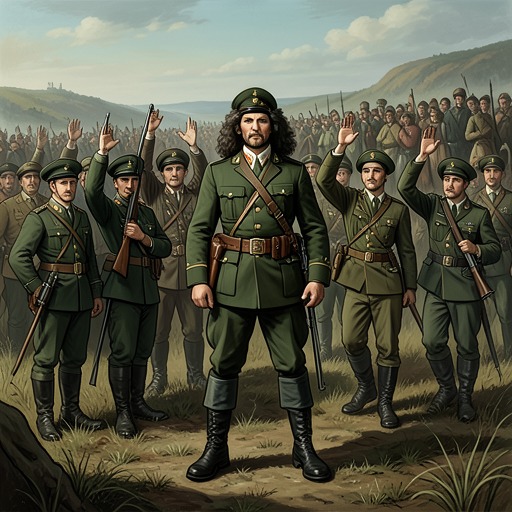
Execution of Admiral Byng
CandideThe Execution of Admiral Byng is a public killing witnessed by Candide in Portsmouth, where an admiral is executed for failing to inflict enough damage on an opposing fleet. Its stark justification—that one admiral is killed to encourage others—reduces a military judgment to an example made through punishment. The episode makes the machinery of war visible not only on the battlefield but also in the state’s treatment of its own commanders.
The Scene at Portsmouth
As Candide and Martin reach Portsmouth, they find the coast lined with spectators watching a man kneel, blindfolded, aboard a warship in the harbor. Four soldiers fire at him, and the crowd disperses, apparently satisfied. The execution is conducted in public and with ceremony; the people gathered to observe it leave as though the punishment has settled the matter.
Candide asks who the man was and why he had been killed. He learns that the dead man was an admiral, punished because he had fought a French admiral but had not come close enough to him. Candide points out that the French admiral had been just as far away. The answer he receives does not resolve that asymmetry: the execution is said to be considered useful from time to time as a warning to other admirals.
Military Judgment and Public Example
The account presents the admiral’s alleged failure as a question of proximity in battle, then shows that the corresponding judgment is not applied equally to both commanders. Candide’s objection exposes the imbalance, while the explanation he receives makes deterrence—not a balanced comparison of the two admirals’ conduct—the stated purpose of the execution. The punishment is thus represented as a calculated public example, not as a conclusion that satisfies Candide’s demand for consistency.
The scene follows Martin’s remark that England and France are fighting over a few acres of snow in Canada, at a cost greater than the territory is worth. That context links the execution to the absurdities of war: a conflict Martin portrays as disproportionate in its stakes is followed by the killing of a commander for not having pursued it aggressively enough. The episode does not supply a fuller account of the admiral’s military decisions; instead, it gives Candide the official rationale and lets his challenge reveal its contradiction.
Candide’s Response and the Episode’s Function
Candide is shocked and bewildered by what he sees and hears. He refuses to set foot on shore and bargains with a Dutch skipper to take him promptly to Venice, even though he recognizes the possibility that the skipper might rob him as the Surinam captain had. The execution therefore has an immediate consequence for his journey: rather than enter England, he leaves by sea.
The scene also sharpens the contrast between abstract explanations and human consequences that recurs throughout Candide’s travels. Pangloss’s teaching that effects follow causes and that events belong to the best possible arrangement is tested against violence on a massive scale in the Bulgarian-Abarian battle; Martin, by contrast, describes a world shaped by organized killing and the powerful preying on the weak. At Portsmouth, the admiral’s death is given a neat institutional explanation, but Candide’s bewildered response registers the gap between the explanation and the act it is meant to justify. The episode carries that tension from the battlefield into public authority, where violence is framed as a lesson for those who remain.