Discovery of El Dorado
CandideThe discovery of Eldorado is both the most vivid encounter with an apparently just society in Candide and a turning point that exposes the limits of its appeal. Candide and Cacambo reach a country where gold and jewels are treated as road pebbles, public hospitality costs nothing, and the institutions Candide expects to find—courts and prisons—are absent. Yet after a month of welcome and wonder, they decide to leave. Their departure makes Eldorado more than a satirical contrast with the societies they have endured: it tests whether an ideal place can hold people whose deepest hopes still point beyond it.
Arrival Through the Mountains
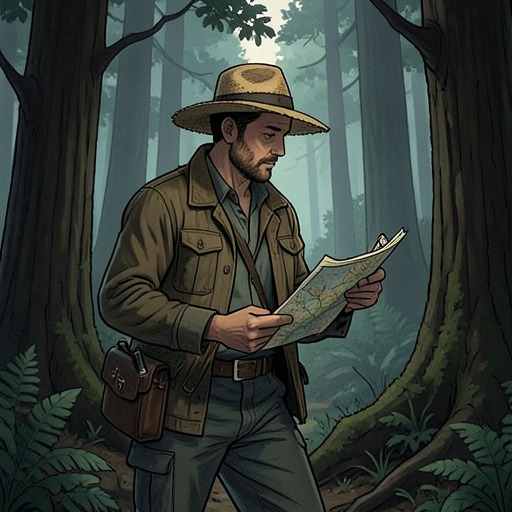
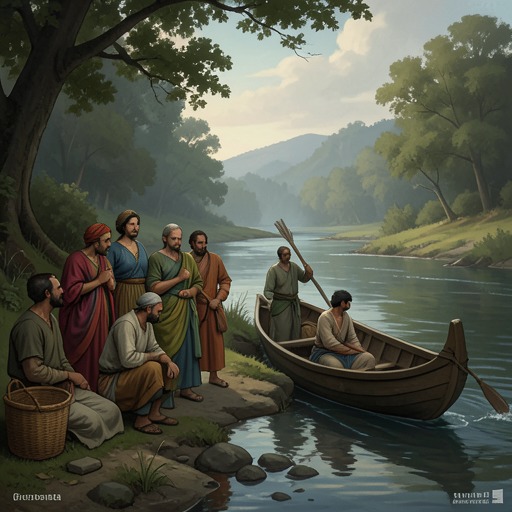
Candide and Cacambo entrust themselves to a river whose banks alternate between flowered and barren stretches, smooth water and rugged ground. The stream widens, then plunges beneath an arch of immense rocks. After twenty-four hours in the darkness and noise of the passage, their canoe is smashed against the rocks. They scramble from rock to rock for a league before reaching a plain enclosed by inaccessible mountains. The approach makes entry into Eldorado a physical ordeal, but the country beyond reverses the desolation of the passage: its land is cultivated for pleasure as well as necessity, and the useful is also beautiful.
On the roads, glittering carriages carry strikingly beautiful people, drawn by large red sheep faster than the finest coursers known to the travelers. Candide immediately judges the country superior to Westphalia. At the edge of a village, he and Cacambo watch children playing quoits with large, brightly colored disks. The disks gleam because they are gold, emeralds, and rubies; even the smallest would be an ornament worthy of the Mogul’s throne. The children’s indifference to such riches overturns the travelers’ assumptions about value before they have even entered a house.
A Society That Reverses Their Expectations
Cacambo can speak with the inhabitants because he understands their language, which is also his mother tongue. He was born in a village where it was the only language spoken, and the knowledge makes him the travelers’ interpreter. At the village house, they are welcomed to a table with an elaborate meal: soups garnished with young parrots, a boiled condor weighing two hundred pounds, roasted monkeys, hundreds of hummingbirds and fly-birds, pastries, and drinks distilled from sugar cane. The abundance is striking, but the more consequential surprise comes when they try to pay.
The landlord explains that the shining stones the travelers offer are merely pebbles from the roads. They need no local money: the government pays for inns established to serve commerce. He calls the village poor, adding that they will receive an even better welcome elsewhere. Cacambo translates the explanation, leaving both travelers astonished. Their encounter gives their suspicion a name: this may be the country where all is well, the place that Pangloss’s doctrine seemed to require, though Candide recalls that life in Westphalia often went badly.
The capital expands the contrast. Its public buildings rise to great heights; market places are lined with columns, and fountains dispense spring water, rose water, and sugar-cane liqueurs into spacious squares paved with fragrant precious stone. When Candide asks for a court of justice and a parliament, he is told there are none because the people are strangers to lawsuits. He asks about prisons and learns that there are none. The palace of sciences, with a gallery two thousand feet long filled with instruments for mathematics and physics, surprises and delights him more than the city’s other marvels. At the royal table, the King’s wit also survives translation: Cacambo explains his remarks, and Candide finds them witty even at second hand.
Welcome, Choice, and Departure
Candide and Cacambo spend a month in this hospitable country. The stay does not extinguish their attachment to the lives and ambitions they left behind. Candide compares the castle where he was born unfavorably with Eldorado, but points out that Cunegonde is not there; he also supposes that Cacambo has a beloved in Europe. He imagines that remaining would leave them merely on an equal footing with everyone else, whereas returning with twelve sheep loaded with Eldorado’s stones would make them richer than Europe’s kings. He also hopes that such wealth will help him recover Cunegonde and free him from fear of inquisitors. Cacambo agrees, and the travelers ask the King for permission to depart.
The King laughs at their desire for what he regards as yellow clay and lets them take as much as they like. He then orders engineers to build a machine to lift them out of the kingdom. Three thousand mathematicians complete it in fifteen days, at a cost of twenty million sterling in Eldorado’s currency. The preparations provide a concrete measure of the country’s resources: the travelers are supplied with two red sheep to ride beyond the mountains, twenty pack-sheep carrying provisions, thirty carrying curiosities as gifts, and fifty carrying gold, diamonds, and precious stones. The King embraces them tenderly before they leave.
Their passage over the mountains, with the travelers and their sheep raised by the ingenious machine, is described as a splendid spectacle. The mathematicians accompany them to a place of safety and take their leave. Once outside Eldorado, Candide’s aim is to present his sheep to Cunegonde. He and Cacambo plan to journey toward Cayenne and embark, while Candide expects the wealth to let them pay the Governor of Buenos Ayres if Cunegonde can be ransomed. The country they have found is not simply lost; they actively exchange its welcome and security for the possibility of recovering someone absent from it.
Narrative and Thematic Significance
Eldorado turns the argument first embodied by Pangloss into a place with observable customs and institutions. In Westphalia, Pangloss reasons that things must be arranged for the best: noses were made for spectacles, stones for castles, and pigs for eating. In Eldorado, the travelers instead encounter a society whose apparent order is conveyed through free public inns, the absence of prisons and lawsuits, scientific instruments, and a population that does not prize the stones scattered on its roads. Candide’s recognition that his earlier world had gone badly gives the discovery force as a contrast, not proof that his former teacher’s explanations were sound.
The contrast does not resolve into a simple lesson that the travelers are foolish to leave. Candide has specific attachments and purposes: Cunegonde is elsewhere, and he hopes that wealth will help him reach her. Yet his expectation that conspicuous riches will make him superior in Europe sits uneasily beside a country where the same riches are dismissed as yellow clay. The discovery thus reveals a conflict between a society that appears to have escaped scarcity and rivalry over precious objects and travelers who still imagine happiness through reunion, wealth, and status.
The episode also fits the book’s rapid philosophical travel. The introduction describes Candide as a short work written in three days in 1759 to ridicule the claim that this is the best of all possible worlds; Eldorado gives that claim a striking, temporary counter-image before the plot carries its travelers onward. At the conclusion, Candide’s answer to the question of how to live is practical work: he says they must cultivate the garden. That ending does not restore Eldorado or explain away the choice to leave it. Instead, the discovery remains a brilliant alternative the travelers encounter and relinquish, while the novel’s final emphasis falls on the more limited task of making life tolerable through work.