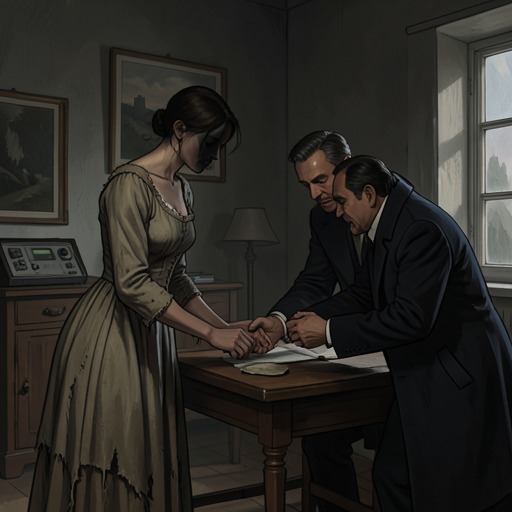
Cultivating the garden
CandideCultivating the garden is the closing collective action of Candide and its decisive alternative to endless philosophical explanation. After a Turkish farmer describes how work sustains his household, Candide and his companions adopt practical labor as a common undertaking. Their plot produces plentiful crops, and the conclusion places the value of work not in a proof about the universe but in the tangible means by which this small society makes life more bearable.
Background and Recognition
The garden’s importance emerges from the contrast between Pangloss’s early teaching and the experience accumulated across the narrative. Pangloss had argued that everything is arranged for the best, using such examples as noses made to bear spectacles and stones made to build castles. His confidence in universal design gave Candide a ready-made explanation for the world; the travels and misfortunes that follow repeatedly put that explanation under pressure.
Near the end, Candide visits a Turkish farmer whose household cultivates twenty acres. The farmer says that their labor preserves them from weariness, vice, and want. On the way home, Candide reflects on this account and judges the farmer’s situation preferable to that of the six kings with whom the travelers had supped. The comparison shifts attention from rank and grandeur to the conditions of ordinary life: the farmer’s small holding is valuable not for its size or status, but because work there provides a practical defense against several forms of misery.
This recognition does not arrive as a new abstract system. Candide does not offer a comprehensive account of why suffering exists or claim that cultivation removes every hardship. Instead, the farmer’s example gives him a concrete standard by which to assess a life. The concluding choice grows out of what the travelers have seen and out of a contrast between speculative assurance and a household’s daily means of subsistence.
Decision and Disagreement
Returning from the farmer, Candide states, "I know also," said Candide, "that we must cultivate our garden." The remark answers the problem of how to live without resolving every disagreement about why the world is as it is. Martin makes the practical emphasis still clearer: "Let us work," said Martin, "without disputing; it is the only way to render life tolerable." His formulation does not promise perfect happiness. It proposes work as a way to make life tolerable, and it turns the group away from argument as an end in itself.
Pangloss, however, continues to interpret their circumstances through a chain of causes. He connects Candide’s expulsion from a castle for love of Cunegonde, his punishment by the Inquisition, his journey across America, his stabbing of The Baron, and the loss of his sheep from Eldorado to the present moment of eating preserved citrons and pistachio-nuts. In Pangloss’s account, every reversal belongs to a sequence that has ultimately brought them to their current meal. The list is pointedly specific: even the pleasant food at hand becomes evidence in a retrospective argument that the whole sequence was necessary.
Candide does not try to disprove each link in that chain. His answer—"All that is very well," answered Candide, "but let us cultivate our garden."—recognizes Pangloss’s explanation without allowing it to displace the group’s chosen task. The repeated call to cultivate is therefore both a practical decision and a limit placed on speculation. The event’s turn is not from suffering to a claim that suffering never mattered, but from interpreting every event to doing useful work in the present.
The Work and Its Results
The entire little society joins the undertaking according to its different abilities. Their small plot yields plentiful crops, giving the decision a visible material consequence rather than leaving it as a maxim. The ending specifies several contributions: Cunegonde, though very ugly, becomes an excellent pastry cook; Paquette works at embroidery; and the Old Woman looks after the linen. Friar Giroflée also proves useful, becoming a good joiner and an honest man.
These roles are not interchangeable, and the conclusion makes their variety part of the household’s practical arrangement. The garden’s harvest is one result of the group’s labor; cooking, embroidery, care of linen, and joinery show how service extends beyond tending the plot itself. The account does not present a single heroic worker or a return to the status distinctions that once organized life in the Baron’s household. It describes a small community in which each person contributes through a different capacity, and in which usefulness is demonstrated by work actually done.
The farmer’s example is thus taken up collectively rather than copied as a claim that the travelers possess his exact circumstances. His household cultivates twenty acres; their own plot is described as little, yet it produces plentiful crops. The contrast keeps the ending grounded in scale: the group does not acquire a grand estate or a new position of power. Its improvement consists in making its limited land productive and organizing its members’ abilities around shared work.
Ending and Significance
The conclusion brings the novel’s recurring philosophical dispute to a practical close without giving Pangloss the last word. He still reads the past as a concatenation of events culminating in the present. Candide’s repeated answer does not erase the history he names; it redirects attention from the supposed necessity of every misfortune to an action the group can undertake together. The narrative ends not with a final demonstration about providence, but with a cultivated plot, crops, and a household whose members have found distinct forms of useful labor.
That ending also gives the phrase about cultivating the garden a meaning larger than gardening alone while keeping it attached to the concrete work described. The group’s labor protects against idleness and want in a way that resembles the Turkish farmer’s account, and Martin explicitly associates working with making life tolerable. Yet the text does not claim that their arrangement settles the philosophical problem or makes the world just. Its resolution is narrower and more immediate: rather than continue disputing the total meaning of events, the companions cultivate what is theirs and sustain one another through their different abilities.
The action therefore closes the story’s movement from Pangloss’s early confidence in universal design to Candide’s insistence on practical responsibility. The opening doctrine tried to make every feature of the world confirm that all was for the best; the conclusion leaves the grand explanation in circulation but gives the group a different priority. Their garden is productive, their labor is shared, and the final refrain returns Candide from Pangloss’s expansive causal account to the limited, continuing task before them.