Battle of the Bulgarians and Abares
CandideThe Battle of the Bulgarians and Abares turns the pageantry of war into a measure of its human cost. As two armies make music and their kings order thanksgiving hymns, Candide hides from a battle that kills tens of thousands; when he flees, the destruction extends beyond the battlefield into villages burned by each side in turn.
The Battle and Its Toll
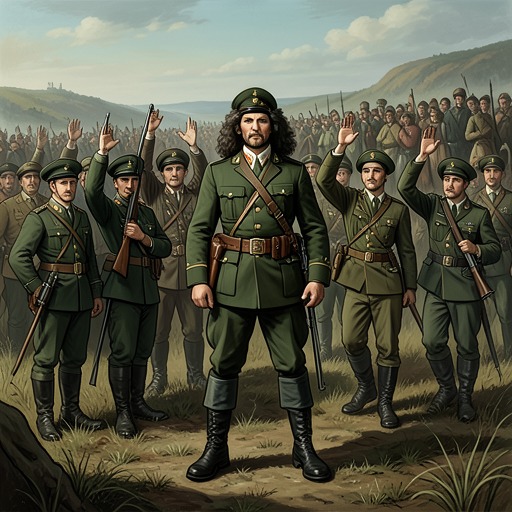
The opposing armies are introduced through a deliberately splendid inventory: trumpets, fifes, hautboys, drums, and cannon accompany troops described as polished and gallant. That ceremonial brightness is immediately contradicted by the toll. Cannon fire kills about six thousand men on each side; muskets kill another nine or ten thousand, and bayonets account for several thousand more. The narrator estimates the total at roughly thirty thousand people.
Candide does not join the fighting. He trembles and hides as best he can, while the account’s contrast between military display and mass death makes the battle’s supposed heroism an object of irony rather than admiration.
From the Camps to the Villages
The battle’s ritual does not end with the killing. Each king has a Te Deum sung in his own camp, and Candide chooses that moment to leave, seeking elsewhere to consider causes and effects. His route passes over the dead and dying before he reaches a neighboring village, which the Bulgarians have burned.
The village’s inhabitants have suffered the consequences of the army’s passage, and the settlement lies in ruins. Candide then hurries to another village, this one Bulgarian, which the Abares have treated in the same way. The reciprocal destruction shows that the civilian cost is not confined to one side: the armies’ violence reaches communities beyond their immediate confrontation.
Candide’s Flight and the Event’s Meaning
Candide continues across ruined ground until he is beyond the seat of war. He has only a few provisions in his knapsack, and Cunegonde remains in his thoughts. When his food runs out in Holland, he expects that a Christian country whose people are said to be rich will treat him as he was treated before his expulsion from the Baron’s castle. Instead, several grave-looking people threaten to send him to a house of correction if he persists in begging.
The episode thus connects the battle’s spectacular violence to the hardship that follows for a displaced survivor. The kings’ hymns and the armies’ music cannot reconcile the claims of ceremony with the destruction of people and homes; Candide’s passage from the battlefield to the burned villages makes that contradiction the event’s defining judgment.