1755 Lisbon earthquake
CandideThe 1755 Lisbon earthquake is a catastrophic event in Candide that turns abstract arguments about cause, providence, and the best possible world into an immediate test of survival. It kills about 30,000 inhabitants, devastates Lisbon, and leaves Candide injured amid the ruins. The responses that follow—from neighbors’ relief efforts to an auto-da-fé intended to stop further earthquakes—make the disaster both a human calamity and a satirical examination of how people explain and govern suffering.
Setting and the Earthquake
The earthquake strikes after Candide and Pangloss have reached Lisbon, following a storm and shipwreck in which James the Anabaptist, their benefactor, drowned. The preceding disaster and the city’s destruction are separate calamities, but their closeness leaves little time for the survivors to recover: Candide and Pangloss arrive lamenting James’s death, with some money remaining to keep them from starvation, and then the earth begins to shake beneath them.
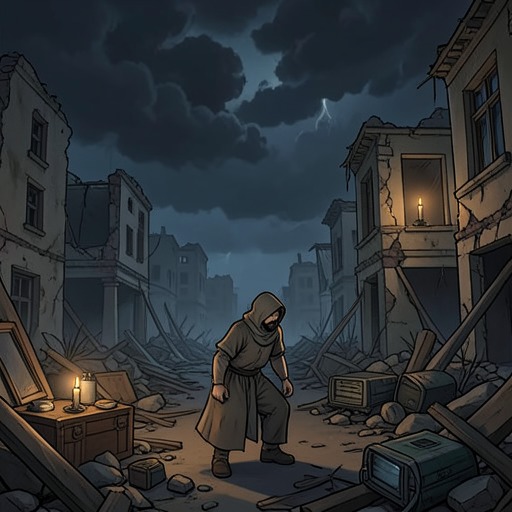
The narrative describes a city transformed by the quake. The sea rises and foams in the harbor, breaking vessels at anchor; fire and ash sweep through streets and public spaces; houses collapse, roofs fall onto the pavements, and the pavements themselves are scattered. About 30,000 people of different ages and sexes are crushed beneath the ruins. Elsewhere, the scale of the destruction is described as three-fourths of Lisbon. A footnote identifies the historical disaster as having occurred on November 1, 1755, anchoring the episode’s fictional events in a specific date.
Candide is among the injured. Struck by falling stones, he lies in the street beneath debris and asks Pangloss for wine and oil because he believes he is dying. His urgent need for care contrasts with Pangloss’s impulse to explain the disaster: when Candide asks for help, the philosopher instead argues that an underground line of sulphur connects Lima in America to Lisbon and accounts for both cities’ earthquakes. Candide accepts that explanation as plausible but again asks for immediate aid; Pangloss insists that the theory can be demonstrated. The exchange sets physical need against a system of reasoning that can keep proceeding while the person beside its advocate is hurt.
Responses to Suffering
The catastrophe briefly produces practical cooperation. After Candide faints, Pangloss fetches water from a nearby fountain. The next day, the two search among the ruins, find provisions, and regain enough strength to join others in helping survivors. People they have assisted offer them what dinner they can. The meal is marked by grief: those gathered moisten their bread with tears. Pangloss, however, comforts them by insisting that events could not have happened otherwise and that everything is for the best.
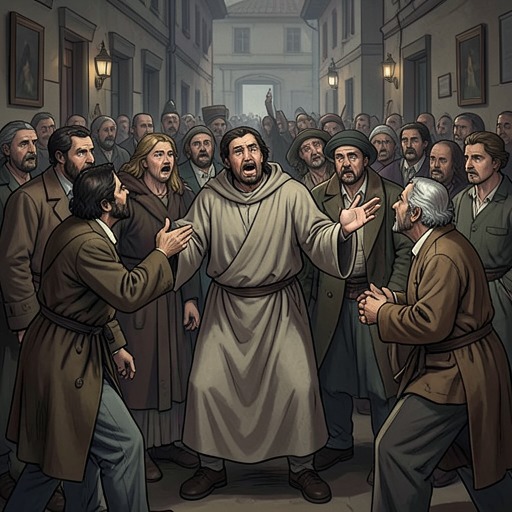
The narrative places that reassurance beside the visible consequences of the earthquake rather than allowing it to stand alone. The survivors’ loss and their efforts to aid one another are concrete; Pangloss’s account turns destruction into a necessary part of a complete order. A Familiar of the Inquisition challenges the implication of this reasoning, asking whether a world in which everything is for the best leaves any place for original sin or punishment. The exchange brings theological questions into the disaster’s aftermath without resolving the divide between a system’s explanations and the lives those explanations are meant to account for.
Not everyone responds to the ruins with assistance or grief. The sailor who survived the shipwreck searches the damaged city for money, drinks after finding it, and disregards Pangloss’s rebuke. His conduct supplies a sharply different response to the same emergency: where Candide and Pangloss later join relief efforts, the sailor treats the disorder as an opportunity for personal gain. The contrast makes the earthquake a setting in which conduct, not merely philosophical assertion, is exposed.
The Auto-da-fé and the Recurring Shock
Lisbon’s authorities respond to the earthquake with an auto-da-fé, presenting religious punishment as a way to prevent another disaster. The decision follows a decree by the University of Coimbra, whose sages declare that burning people alive slowly and ceremonially is an infallible means of stopping the earth from shaking. The ceremony therefore converts a natural catastrophe into a rationale for punishing people accused of religious or social offenses. Its asserted preventive purpose is especially consequential: the prescribed ritual does not avert another tremor.
Candide and Pangloss are among those seized. Pangloss is arrested for speaking his mind, while Candide is taken for having listened with apparent approval. After eight days in separate, cold rooms, they are dressed in san-benitos and paper mitres and led in procession. Candide is publicly whipped; Pangloss is hanged, though hanging is not the customary punishment. Others are burned. On the same day, the earth shakes violently again. The sequence undercuts the authorities’ claim to have discovered a remedy: the ceremony imposes suffering but fails on its own stated terms.
A footnote adds that the auto-da-fé took place on June 20, 1756, some months after the earthquake. That historical detail distinguishes the disaster from the later ceremony while confirming that the punitive response is tied to an actual Lisbon event. In the novel’s account, the renewed tremor following the ceremony further sharpens the gap between institutional certainty and what happens.
Narrative and Philosophical Significance
The earthquake subjects Pangloss’s teaching to a crisis more immediate than debate. Earlier, he had presented causal necessity as evidence that this is the best of all possible worlds. In Lisbon, he continues to affirm that everything is right even as the city lies devastated, Candide needs help, and survivors grieve over their meal. The episode does not merely place a counterexample before Pangloss; it shows his explanations recurring under pressure, including when practical assistance is needed and when a proposed religious remedy fails.
Candide’s responses register the strain between inherited optimism and witnessed disaster. During the quake he cries that it is the Last Day; after the later ceremony and renewed shock, the remembered deaths of Pangloss, James the Anabaptist, and Cunegonde’s apparent fate weigh against the proposition that the world’s arrangements are best. The earthquake is thus a decisive stage in his exposure to suffering, though the novel does not make the event a simple conversion to a settled opposing doctrine. It remains one episode in a sequence of disasters that repeatedly confront philosophical explanations with human consequences.
The earthquake also links natural catastrophe to human choices about blame and remedy. The ground’s convulsions destroy homes and lives; the attempted response turns fear into organized punishment; and survivors’ efforts to share food and help the injured offer a smaller, practical answer to immediate need. By setting these responses side by side, the episode makes the disaster central not only for its scale but for the competing ways its survivors explain it, exploit it, endure it, and respond to one another.