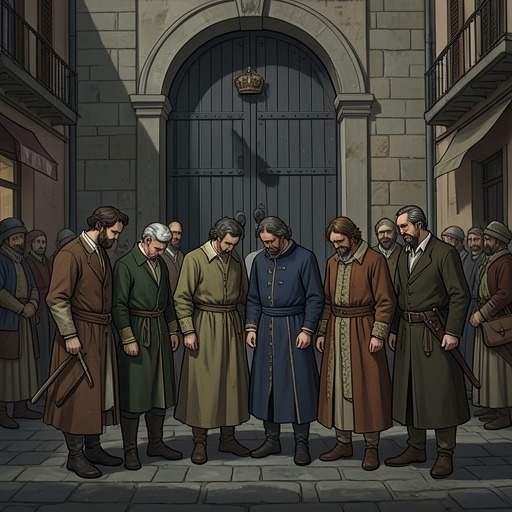
The meeting of the six deposed kings
CandideThe meeting of the six deposed kings gathers displaced rulers around a supper in Candide, transforming historical chronology into comic material. Its impossibility is part of its point: a note identifies the monarchs and observes that five could have met without an anachronism, but all six could not. The episode makes political grandeur look less like a secure condition than a temporary station from which even kings can be expelled.
The Gathering and Its Historical Frame
The narrative refers to the rulers as the six kings with whom Candide and his companions had supped. A note identifies them as Achmet III, Ivan VI, Charles Edward Stuart, Auguste III, Stanislaus, and Theodore of Corsica. They are not presented as an historically possible assembly: the note explicitly says it would have been impossible for all six to meet, although five could have been brought together without anachronism.
The dates make the discrepancy concrete. Achmet III, born in 1673 and dead in 1739, was dethroned in 1730; Ivan VI, born in 1740 and dead in 1762, was dethroned in 1741. Charles Edward Stuart lived from 1720 to 1788, Auguste III from 1696 to 1763, Stanislaus from 1682 to 1766, and Theodore of Corsica from 1690 to 1755. The note supplies these particulars not to reconcile the gathering, but to expose its deliberate compression of political history.
Displacement and the Meaning of Grandeur
The kings’ shared condition is dispossession. Their titles recall the authority they once held, while their appearance together makes that authority look precarious: a throne does not protect its occupant from being dethroned, nor does royal rank guarantee lasting security. The episode turns a collection of distinct historical careers into a single, pointed image of fortune’s reversals.
Later, Candide contrasts an honest Turk’s situation favorably with that of the six kings. Pangloss answers by listing rulers whose fates include assassination, hanging, killing, and captivity, arguing through historical examples that grandeur is dangerous. The exchange extends the supper’s contrast between rank and security: the kings’ former elevation is less persuasive than the ordinary man’s comparatively stable life.
Place in the Satirical Design
The gathering belongs to the rapid, philosophic tale Voltaire wrote in 1759. Rather than pause to construct a historically plausible summit, the narrative brings improbable figures into contact and lets their accumulated reversals test claims about the world. The meeting’s chronological impossibility is therefore not a defect to be repaired; it sharpens the satire by making the instability of political power visible at a glance.
The episode also sits within a larger movement away from abstract defenses of the world and toward practical life. After Pangloss turns the kings’ histories into an argument about dangerous grandeur, Candide insists that they must cultivate the garden, and Martin urges work without disputation as the way to make life tolerable. The royal supper does not itself resolve the book’s philosophical questions, but its parade of fallen rulers helps establish why inherited rank and grand theories offer no dependable refuge.