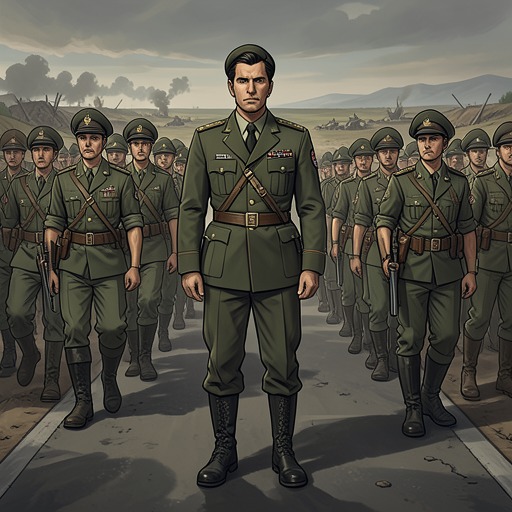
« Faire semblant » dans l’armée
Cherry« Faire semblant » dans l’armée names the narrator’s recurring sense that military life is built from performances: recruiters perform their roles, recruits perform soldierhood, and training rehearses emergencies through artificial bodies. The conceit first appears as comic skepticism toward the institution, but later scenes expose its limits: the gestures can be simulated, while injury, death, and responsibility cannot.
Recruitment and the enlistment bargain
The narrator encounters military authority first as a recruiting performance. A senior sergeant, dressed in a black sweater, green trousers, and polished leather shoes, has a deathlike face and a drawer full of urine cups; he directs the narrator to the latrines. After the narrator’s urine test comes back clean, Kelly presents government-car privileges, housing allowance, and health coverage as remarkable benefits. The recruiter’s pitch makes enlistment sound like a practical exchange, while the narrator’s account turns the recruitment office into a place where institutional routine and salesmanship blur.
The physical screening is another small audition. The narrator must demonstrate twenty push-ups, twenty sit-ups, and the ability to run two kilometers on a treadmill. Wearing Vans and trousers that keep slipping down, he manages well enough; a practice test places him in the 85th percentile. Kelly is visibly pleased. In the first week of 2005, as news reports describe young recruits being killed or maimed and recruiters struggle to attract enough applicants, the narrator’s willingness to enlist quickly becomes a recruiting success. He says he wants to become a 91W combat medic and leave as soon as possible, giving Kelly an unusually convenient answer to the Army’s staffing problem.
Training and the limits of make-believe
At medic training, simulation gives the performance a literal form. The recruits crawl from one mannequin to another while a superior reads out emergencies: falling blood pressure, vomiting, a chest wound, a collapsed lung, and severe facial burns. The equipment ranges from rubber lungs and protruding rubber bones to mannequins that spurt false blood, including cherub-faced infant models. The trainees act out imagined interventions—fluids for an invented patient, a recovery position and cleared airway, an occlusive dressing, needle decompression, or a cricothyrotomy. The sequence is deliberately artificial, but its procedures rehearse the bodily crises the medics may later confront.
The boundary between exercise and reality is not absolute. After treating the mannequins, the trainees insert real 14-gauge catheters into one another’s veins and draw actual blood with butterfly devices. The narrator draws blood from Harlow, who trembles because she dislikes needles. That small reversal—an imagined casualty followed by a real puncture—captures the tension in the idea of pretending: training can stage the emergency, but the body does not pretend when it is injured.
In Iraq, the distinction becomes morally consequential when the narrator is expected to treat a wounded man after soldiers shoot him. He packs the abdominal wound with gauze, covers it with plastic secured on three sides, and asks Sullivan to hold the dressing while he searches for an exit wound. He cannot find one and is unsure where the bullet has lodged. Looking back, he believes he should have packed the wound more completely and placed the man on his injured side; instead, he admits that he did not know what to do. His training has supplied gestures and procedures, but no simulation can guarantee that he will recognize the right action in the confusion of an actual casualty.
The cost extends beyond the treatment itself. After the man dies, the narrator puts the body into a mortuary bag as the dead man’s family cries out and tries to reach it. Gunfire breaks the scene apart; later, Sullivan tells the narrator that he saw the old woman killed by their own fire. The earlier rehearsal of bodies and procedures now stands against a death, a grieving family, and a consequence the narrator cannot reduce to a drill. The performance has not simply failed to imitate reality: it has left him with responsibility for what happened inside it.
When the Performance Breaks
The narrator’s first experience of military make-believe is not confined to training scenarios. At the rifle range, he explains that he is red-green color-blind, a condition that had not disqualified him from becoming a 91W medic because, as the Army’s rationale goes, medics already know what color blood is. A sergeant bends a brass rifle-cleaning rod and uses it to hit the narrator on the head; his helmet prevents injury. After leaving the range, the narrator is searched under the rule that no brass means no ammunition, while recruiter Cole strikes him in the groin for no apparent reason. The recruits endure it because, in the narrator’s formulation, the recruiters are only pretending to be recruiters, the recruits are pretending to be soldiers, and the Army is pretending to be the Army. The joke makes institutional authority seem staged, but the blows are real.
That distinction returns during the final night of Ashura. A man tries to slip into the compound behind the police station, and Sergeant Bautista fires a tracer round into his buttocks. The man escapes. The soldiers could have killed him with live ammunition without being held responsible, the narrator reflects, but they refrain, treating the encounter as another instance of make-believe. Here the conceit is not simply about rehearsing a role: it describes the gap between the lethal power the soldiers possess and the restraint they perform. Their refusal to shoot is consequential precisely because the danger is real.
The narrator’s account of command conflict shows how the same language of performance can also distort responsibility. After a lieutenant is surprised by the narrator’s outburst, the narrator accuses him of repeatedly ignoring warnings, including advice not to enter a soft field where the vehicles would become stuck. He says that four soldiers were killed and that the lieutenant killed his friends. Almost immediately, however, he qualifies the accusation: the men were acquaintances rather than friends, and the lieutenant did not kill them; the narrator believes that, had they not become stuck, the soldiers themselves would have been killed. The spoken charge and the correction that follows expose the pressure of telling events in a war where actions, outcomes, and accountability resist a clean account. Make-believe can describe the Army’s routines, but it cannot settle what the soldiers owe one another after those routines turn deadly.
Assignment and the Cost of Choosing
The narrator’s preferred postings reveal how enlistment was also a wager on staying near home. He ranked Walter Reed Army Medical Center first, Aberdeen Proving Ground second, and Brooke Army Medical Center third, with Fort Drum as a fallback. Fort Drum was widely regarded as an undesirable assignment, but its proximity to Elba mattered because it would keep him near Emily. He was told that most recruits received one of their top three choices, making a return to the vicinity of Ohio seem likely. The prospect of a $300,000 life-insurance benefit, if he elected the additional payment, sat beside that practical hope. When he explained his plans to his parents, they thought the Army was a foolish choice but accepted that it was his decision; their recently purchased, spacious house represented a settled home life he did not want to join.
The reality of assignment narrowed that imagined bargain. At Fort Hood, which the narrator describes as a landscape engineered to instill fatalism in young people, the 4th Infantry Division placed him in an armored battalion whose companies combined armor, infantry, mechanics, support, and command functions. He first joined the medical section within Headquarters and Headquarters Company. Its older personnel used technical language he did not understand, and he disliked the prospect of remaining in first aid rather than going where combat occurred. He asked to join a combat company and was assigned to Echo Company. The choice carried him from the medical service he had trained for into the infantry: the role he had imagined as a medic would be tested not in a recruiting pitch or a mannequin exercise, but inside the unit’s operational life.