The Great Romance of Junkies
CherryThe Great Romance of Junkies is the title of a section that renders heroin use as a seductive, ordinary-seeming way of life while exposing the debt, sickness, and mistrust underneath it. The narrator and Emily live together in days described as bright, but their means of staying housed and supplied are precarious: student aid and veterans’ education benefits can be redirected toward drugs, and marijuana grown in the basement helps pay the rent. The romance in the title is therefore not a promise of lasting happiness. It names the intoxicating appeal of a life whose costs are already visible, and whose routines lead directly into a late-night search for heroin.
Brightness and Its Price
The section opens with a deliberately extreme measure of beauty: being young and under heroin is presented as unsurpassed. The narrator and Emily live together, and the days seem bright. Yet this brightness is set beside a practical catalogue of limited prospects. There are no jobs to worry about because there are no jobs; college becomes valuable not primarily as study, but as access to financial aid, loans, and scholarships. The narrator also describes the GI Bill as covering tuition, freeing other money for drugs. Educational support, normally associated with future opportunity, becomes part of the financing for immediate consumption.
The same conversion governs the couple’s home. They grow high-quality marijuana in the basement and use it to pay rent, joining the domestic fact of having somewhere to live to an illicit source of income. The arrangement offers a way to continue, but not a secure future. The narrator acknowledges accumulating debt, constant sickness, and constipation. The people around them are described as hostile: new acquaintances might take a spoon or twenty dollars, while old friends keep their distance. These details make the bright days feel conditional. Heroin can make things seem manageable, but the conditions that produce the need for that relief remain in place.
The narrator says that taking more heroin can usually stabilize the situation and stresses that, at twenty-five, there is still time to pretend. That formulation makes the section’s central tension unusually plain. The drug is not represented as solving the underlying problems; it permits a temporary performance of stability while debt, illness, and estrangement continue. Youth functions as another temporary resource, something that allows the narrator to postpone recognition of the future without removing it. The repeated insistence on beauty thus carries its own contradiction: the more emphatically life is called beautiful, the more clearly the account shows what that description must cover.
The Search for Heroin
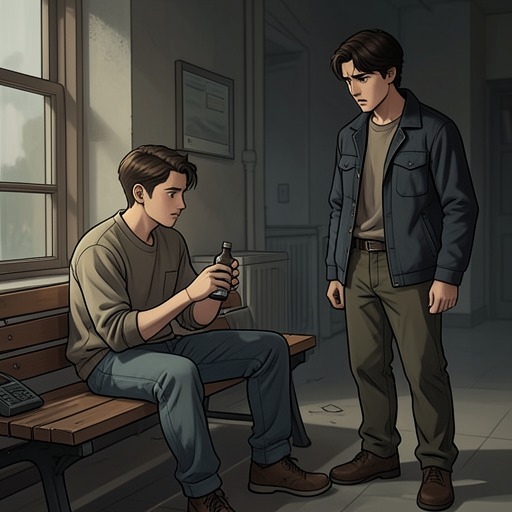
The next scene translates that broad account into a specific transaction. At around ten at night, Ari calls back, and the narrator goes to a meeting arranged off Fleet Avenue. After leaving the highway, the narrator turns several times and parks on the street. The house smells of cat urine. It belongs to Gary, not Ari; the narrator knows Ari only from 1980s-themed parties and the Shaker neighborhood, and admits not really knowing him either. The narrator is there because access to heroin matters more than familiarity with the person arranging the sale.
The narrator can obtain Oxy at roughly fifty cents per milligram, but wants actual heroin. This distinction makes the scene part of the section’s larger account of dependence: the narrator is not simply looking for any available drug, but for a particular substance. Ari has said Gary will arrive, and the two wait in the living room while Shelley watches television. Shelley refuses to change the channel; her short hair in front and long hair down her back, rough voice, and despairing sound of speech receive the narrator’s harsh, dismissive attention. That judgment belongs to the narrator’s perspective, while the scene itself places Shelley as an observer of what follows.
The Deal and the Ritual
Gary arrives with the heroin. The narrator is surprised that Gary has achondroplasia, a detail Ari had not mentioned. Gary takes the supply from a small metal box with a magnet on it and displays it: there are only two grams. He reports that his own source described it as powerful. The narrator pays $140 for one gram, considers the price very bad, and would rather pay $100. Still, the narrator accepts the stated price, with quality treated as a factor that has to be considered. The purchase is a negotiation, but the narrator’s need limits the practical force of that reluctance.
The three men inject the heroin around the kitchen sink: Gary, Ari, and the narrator. The kitchen is filthy, and Shelley watches them shoot up. The scene compresses the section’s wider pattern into one domestic interior: money changes hands, a small quantity is assessed, and heroin is used in a shared but transactional setting. The basement cultivation that helps pay rent and the injection at the kitchen sink are distinct parts of the same economy of continued use. In the first, drug production helps maintain a home; in the second, the home becomes a place where the purchased drug is consumed.
The Title’s Irony
The title gives this account a romantic register, but the evidence complicates any suggestion of a conventional love story. The narrator and Emily share a household, yet the passage focuses on the economic and bodily circumstances of their heroin use rather than on scenes of courtship or reconciliation. Its language of brightness and beauty is shadowed by debt, illness, unreliable acquaintances, and the need to locate a supplier. Intimacy exists within that precarious life, but the section does not present it as protection from the damage surrounding it.
The title’s force lies in the gap between exaltation and routine. The narrator’s affirmation of youthful beauty sits beside student loans redirected toward dope; the hope of feeling stable sits beside a $140 purchase the narrator considers overpriced; and the domestic scene of shared life gives way to a dirty kitchen where Shelley watches three men inject heroin. The section neither erases the attraction nor mistakes it for security. It shows how the romance persists through practical arrangements and temporary relief, even as each concrete detail reveals the costs that its language of beauty cannot make disappear.