The IED War
CherryThe IED War is the recurring struggle in which improvised explosive devices dominate movement, patrols, and the soldiers’ sense of what combat in Iraq will bring. Rather than presenting the bombs as isolated set pieces, the narrative returns to them as a force that shapes ordinary routines: a buried charge can fail because a vehicle crushes its battery, devastate a soldier at a checkpoint, or turn a convoy’s attempt to reach a base into a casualty evacuation. The repeated threat sits alongside the narrator’s dry, often disconcerting observations, exposing a war in which elaborate operations and protective rules coexist with sudden violence and confused response.
A Roadside Threat That Reshapes Routine
On the return to base under Evans’s command, the narrator realizes that he is alone in the armored vehicle for the first time since leaving Fort Hood. After sleeping, he wakes to find the vehicle stopped and asks the gunner why. The vehicle has run over an improvised explosive device, but it has not detonated: the armored vehicle crushed the battery, preventing the bomb from firing. A bomb-disposal team is taking it apart with a robot. The narrator then learns that the device contains three 155-millimeter shells. The scene moves abruptly from private, mundane actions inside the vehicle to the knowledge that a large explosive charge was beneath it. The battery’s accidental destruction is the difference between an uneventful return and a blast; survival here depends not on a deliberate maneuver but on the mechanics of what the vehicle happened to crush.
The threat also punctures the distinction between major operations and repetitive daily work. The narrator recalls that operations had grand names intended to mark their importance, yet he could no longer remember which operation was underway when Grace and Carranza were hit north of Checkpoint 9. In his account, the recurring sequence was simpler and more legible: improvised bombs, doors forced open, and then more bombs and doors. The contrast makes the IED War feel less like a series of exceptional missions than a grinding pattern that swallows their official labels.
Route Martha and Jimenez’s Wounds
At dawn, Jimenez leaves with a fire team to establish a roadblock on Route Martha. The team has departed while it is still dark, has not properly surveyed the location, and does not know that an enemy combatant has buried a 155-millimeter shell beneath the road. The road has only a thin surface, making it easy to conceal a charge underneath. The person who planted it watches Jimenez standing at the mined spot. The danger is not simply that the road is unsafe; the team occupies a position selected and prepared in advance by someone observing them.
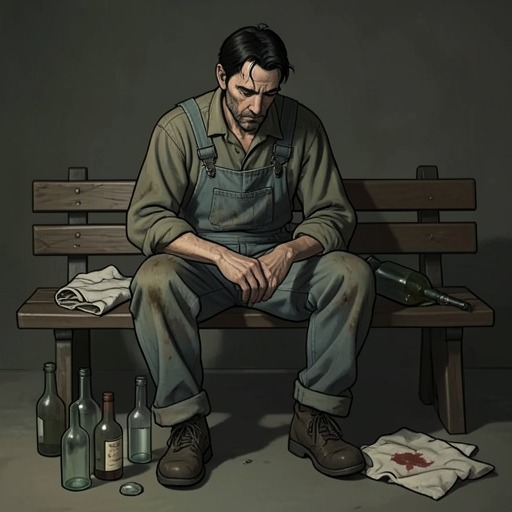
The blast takes both of Jimenez’s legs and nearly tears off one arm, yet he remains conscious and understands what has happened. He screams. Members of the fire team exchange shots with two attackers, but the attackers escape north through a palm grove. The team does not pursue them, because leaving Jimenez alone in that condition is not an option. The bomb therefore creates an immediate tactical choice: the men can chase those responsible or stay with their gravely wounded comrade. The account keeps the human cost and the limits imposed on the team in the same frame, rather than letting the attackers’ escape become the only measure of what happened.
Grace, Carranza, and the Kevlar Flaps
Grace, a gunner in a Bradley fighting vehicle, and Carranza, its driver, are friends whom the narrator knows from Fort Hood, although they serve in Delta Company and usually work in a different area. Their vehicle strikes an improvised explosive device north of Checkpoint 9 during an operation the narrator cannot identify among the many similar missions. Carranza is badly injured, blind, and trapped in a burning vehicle. Even so, he lowers the ramp so the other soldiers in the vehicle can get out quickly. Grace then pulls Carranza out through the driver’s hatch. The sequence turns a routine detail of their roles into a moment of action: Carranza helps open the way out despite his injuries, and Grace gets him clear.
Grace is struck by shrapnel, but a Kevlar protective flap attached to his body armor stops the fragments, leaving him uninjured. The protection matters precisely because the soldiers dislike wearing it. The battalion has had to repeat the order to wear the flaps; they interfere with shouldering a rifle, tangle with pack straps, add discomfort in the heat, and make the soldiers feel foolish. The narrator also describes the bitterly practical limits of the equipment: it can stop fragments that might cause a comparatively minor wound, but not the more destructive threats. In Grace’s case, however, the disliked flap intercepts the shrapnel and prevents an injury. The incident gives the rule a concrete consequence: a piece of equipment regarded as cumbersome and ridiculous proves effective at the moment it is needed.
The Convoy Blast and the Confusion Around It
Another attack targets the Delta patrol base. Its only access road runs beside the west bank of the river, and the attackers have placed a bomb on that route as a contingency: if firing on the base does not cause casualties, a rapid-reaction force may strike the charge while approaching. The first armored vehicle passes the trigger, as does the narrator’s Humvee. The charge spans the remaining pavement in a stretch of road already damaged by earlier bombs, but the destruction also makes it possible for a driver to pass around it. Evans’s armored vehicle, third in the sequence, sets it off. The blast is absorbed from below. Perez, in the turret, calls out that an explosive device has been struck.
The narrator takes his first-aid bag and starts to leave the Humvee, but Sullivan accelerates again, throwing him against the metal interior. He recovers and runs toward the damaged vehicle with Hueso-Santiago, who is already checking its front. Everyone is safe except the driver, Miller, whose deep wound is in his left thigh. Hueso-Santiago helps him out through the hatch. The narrator packs gauze into the wound, bandages the thigh to maintain pressure, and gives Miller intravenous morphine. He asks Hueso-Santiago to request a medical helicopter and specify emergency surgery, following advice he had received from Shoo to ask for emergency treatment even when it might not be necessary. Miller’s injury is serious but not immediately catastrophic: the fragment has missed an artery, and the narrator expects him to survive.
The second rapid-reaction group, the bomb-disposal team, and a recovery vehicle take a long time to arrive. The reported explanation is that the forward base is overwhelmed, but the narrator later learns that the trouble there began with mistaken identification and friendly fire. Battalion snipers have climbed the power-station scaffolding; a soldier mistakes them for enemy fighters and fires without hitting them. The bullets fall near Echo Company’s tactical operations center, whose personnel believe the shots came from the scaffolding and return fire. Delta Company then mistakes the snipers for enemy fighters and fires as well, leaving American infantry companies shooting toward one another with the snipers caught between them. During the confusion, an interpreter plants an explosive device in the gym. There are no serious injuries from that incident. The IED War thus extends beyond the instant of detonation: uncertainty and misdirected fire complicate rescue and recovery, while another planted device exploits the disorder. Across these episodes, the danger is at once material and procedural—a bomb beneath a road, a protective flap that may or may not stop fragments, and the confusion that can turn a response into another threat.