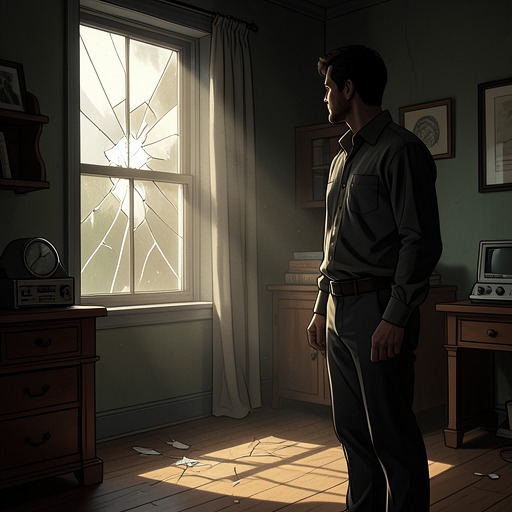
La beauté au milieu de la violence
CherryLa beauté au milieu de la violence names a recurring tension in the narrator’s experience: beauty reaches him with unusual force even when danger, guilt, or distance should command his attention. It does not offer rescue or reconciliation. A stretch of grass, birds disputing discarded food, bare trees, or a procession seen from a barricade can briefly make the world feel intensely present; the moment may then be interrupted by the practical demands of escape or fade from memory. Across these scenes, beauty is both an emotional opening and something the narrator cannot hold onto.
A Sensibility Drawn to Beauty
The narrator considers whether he has wasted his youth, then distinguishes that question from an inability to feel. Beautiful things do affect him: their force is so great that he describes being nearly undone by them. What he cannot explain is an inward impulse that has always pulled him away. This self-assessment sets the concept’s central terms. The narrator is not simply indifferent to ordinary life, nor does aesthetic feeling erase his isolation. He can be intensely receptive and still remain unable to account for his own withdrawal.
That contradiction shapes the later scenes. Beauty does not arrive in a protected space, separated from the narrator’s choices or circumstances. It catches him while he is moving through danger, or appears alongside the pressures of a relationship and an impending departure. The experiences are therefore not uncomplicated celebrations of nature or spectacle. Their emotional force depends on the friction between what draws his attention and what demands it.
The Street During an Escape
After a bank robbery, the narrator leaves a parking lot with a loaded gun hidden in his cap and money protruding from his pockets. The concealment is makeshift: he covers the gun with a scarf as he walks, aware that the cash could fall and that police are coming along Mayfield Road. He tries to look like someone merely heading somewhere. In this setting, the ordinary street is also the route of a precarious escape.
Against that immediate danger, he notices the grass, the porches, and a group of starlings fighting over a bag of garbage. One bird frightens the others and gains access to the discarded food. The detail matters because the scene does not become beautiful by ceasing to be ordinary. The birds’ scramble remains a small, self-contained contest, while the narrator’s attention turns it into an event worth watching. His response is not detached: he wishes he could lie in the grass and relax. But he cannot. The gun in his cap, the cash in his pockets, and the sirens make stillness impossible, keeping beauty in direct contact with the consequences of his actions.
A brief encounter with an older passerby extends this contrast into human behavior. They exchange greetings; the man gives no visible sign of suspicion, and the narrator continues on. The scene offers no assurance that he is safe or forgiven. Instead, an ordinary courtesy passes through a moment shaped by flight. The narrator’s attention moves between the sirens and the street’s small beauties, and neither cancels the other.
Autumn, Longing, and Departure
In another scene, the narrator sings while the sky is burning with evening light. The bodily pressure in his heart accompanies a sudden desire to be kind to someone. He calls Madison Kowalski, tells her that he misses her, and asks what she is doing. The sequence links the surrounding sky to an impulse toward connection, without suggesting that the feeling solves whatever has drawn him away from others. Beauty here is not only something he observes; it coincides with a brief wish to turn outward.
The autumn weekend in Elba with Emily gives that emotional pattern a shared and more consequential setting. Rain keeps them indoors for much of the weekend, lying down and sleeping; in the evenings they drive. The season registers in the bare trees, dark sky, and streetlights, and the narrator experiences the scene’s beauty as heartbreak. The landscape accompanies a turning point in their relationship: they had met two years earlier, had both saved money and established jobs, and believed themselves mature enough to marry before his departure for Iraq. Emily proposes marriage on practical grounds, including his pay and her access to his health insurance. She also anticipates divorce; he agrees. The beauty of the autumn does not conceal this uncertainty. It makes their closeness and the approaching separation feel sharper at once.
Witnessing and the Limits of Memory
In Iraq, the narrator watches an Ashura procession from atop a barricade. The scene gathers several elements into one act of witness: verses broadcast from a minaret, slow percussion, synchronized movement, a sea of black clothing, and clouds of dust that rise and disappear. He recalls being told that the mosque stood where an imam had been martyred a thousand years earlier and bore his name. The ritual’s scale and repeated gestures place the present moment within a history the narrator can observe but does not claim as his own.
That distance becomes explicit when he later tries to remember the sound of the verses and the rhythm of the percussion. He can describe what happened and what it looked like, but cannot recover the sensations; he remains, in his account, an outsider. He had not carried a camera, partly because he imagined that if he were captured alive he would not want to be filmed. That circumstance frames the episode without turning it into a simple refusal to witness: he was present, and the scene remained in his account, yet neither memory nor recording could make the experience fully available afterward.
Across these settings, beauty appears as an interruption rather than an escape from reality. Starlings and porches share a street with a concealed gun and approaching sirens; autumn’s light accompanies both intimacy and a planned departure; the procession is vivid in remembered outline but inaccessible in remembered sensation. The recurring idea rests on that unresolved difference between being moved by a moment and being able to keep it. Beauty makes the narrator feel more intensely, but it does not remove danger, settle his relationships, or overcome the distance between witnessing and remembering.