Devenir un pourri
CherryDevenir un pourri names the narrator’s account of becoming morally compromised under the pressure of debt, drug dependence, and desperation. The idea is tested in concrete choices: he prepares for a robbery while focused on avoiding witnesses, then later recognizes that he has pretended to care about Raul for his own purposes. The concept is not presented as a simple distinction between good and bad people; it is a gradual degradation in which need narrows the narrator’s priorities and his self-judgment becomes both an accusation and a defense.
The Meaning of Degradation
The narrator frames the question of how a person becomes rotten as a question about circumstance and conduct. He attributes his own transformation to needing money and spending too much time with dealers. That explanation does not erase his agency: it places his actions in a world of debts, drug access, and compromised relationships, while still making him responsible for what he chooses to do within it. His account resists the idea that criminality follows automatically from being a bad person. Instead, the decisive condition is degradation: a person becomes sufficiently debased, he argues, that robbery begins to seem possible.
The distinction matters because it separates moral character from the threshold of action. In the narrator’s view, many thoroughly vicious people will never rob anything, while a desperate person may cross that line when the circumstances have worn away restraint. The formulation is bleak rather than exculpatory. It does not claim that hardship makes robbery inevitable; it identifies desperation and humiliation as conditions under which a previously unattempted act can become thinkable. The narrator’s own story supplies the test case, not a general proof that every desperate person will do the same.
Need and the Robbery Plan
The chapter places the theory beside a night of criminal planning. The narrator, Raul, and Rider drive around looking for a particular car, intending to rob its owner; they fail to find the car and go to the owner’s home. The search establishes that the plan is not a sudden abstract temptation but part of an ongoing effort to obtain money through crime. Later, the narrator waits outside a business with Raul, prepared to act when it is empty. The immediate practical concern is avoiding other people: he does not want anyone in the way.
The objects and preparations make the intended crossing unusually tangible. The narrator wears a hooded sweatshirt and a knit cap supplied by Raul. He carries bear spray that belongs to Emily, taken without asking; she had acquired it during a time in the forests of Washington State. The narrator has never robbed a bank before, and he does not know what to expect, though he feels reasonably at ease. His unease is directed less toward the act itself than toward the possibility of people being present. That imbalance gives the plan its moral force: unfamiliarity does not stop him, and practical precautions begin to take the place of reconsidering the act.
The financial pressure is inseparable from heroin dependence. The narrator owes dealers money, but says that Black and Black’s money do not matter to him; what he fears is losing access to heroin. He describes himself as never more than twelve hours away from total collapse. The phrase makes the plan legible as an attempt to manage an immediate bodily and psychological crisis, not merely to acquire money. It also reveals the narrowing of his priorities: the danger of robbery recedes beside the prospect of being unable to obtain the drug. Desperation, in this account, is not a vague mood but a condition organized around debt, time, and the threatened loss of heroin.
Self-Condemnation and Moral Accounting
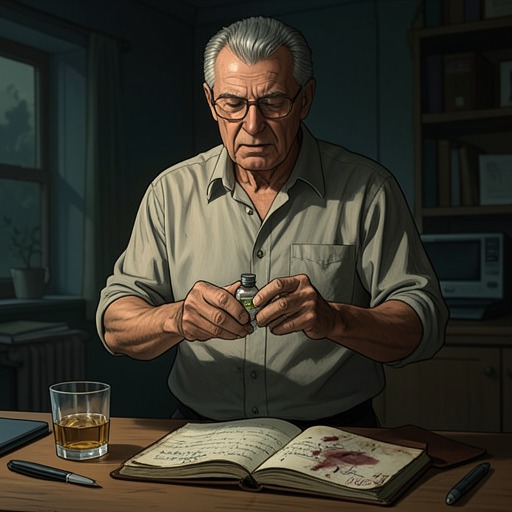
The narrator’s self-understanding hardens into a theory of deserved misfortune. He believes that he is scum and that bad things happening to him are what he deserves; when asked whether he is bitter, the answer is that he is, at least somewhat. This belief can sound like moral reckoning, but it also risks turning every injury into confirmation of an identity already settled in advance. If he is rotten, then suffering seems fitting; if suffering is fitting, there may be little reason to expect a different life from himself.
His response to loss complicates that fatalism. A loss, he observes, cannot be recovered in the sense of undoing the injury, even if the money is eventually returned. His proposed way forward is to write it off and refuse to care. He links this stance to the humiliation of being involved in a foolish scheme over fourteen grams of freeze-dried mash, and to the practical urgency of impending nausea as morning approaches. The scene’s temporal pressure—nearly midnight, with the morning and its sickness ahead—makes indifference feel less like peace than a tactic for continuing to act. Not caring does not restore what is lost or repair the choices that led there; it allows the narrator to treat those consequences as manageable enough to proceed.
Raul and the Recognition of Complicity
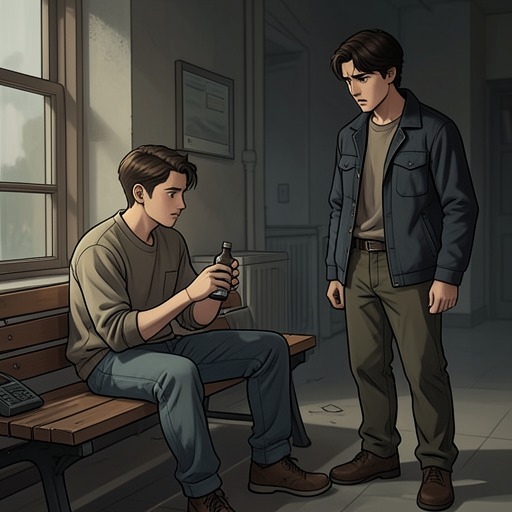
The most direct moral test comes after the narrator visits people connected to Raul. A man weighs out a gram; the narrator thanks him, returns to his car, and leaves. On the way, he revisits his theory of himself and admits that he had presented himself as worried about Raul when, in truth, he did not care about him. He had offered concern to people who knew that he would not have helped Raul if their positions were reversed. The recognition is specific: his performance of care is not merely insincere in the abstract but part of an encounter in which he wants to appear concerned while remaining emotionally detached.
Yet the narrator does not reduce the scene to his own guilt. He also sees something wrong in the way the others behaved: they treated the situation as though it were his fault. He judges their accusation partly right and partly wrong, observing a reciprocal pattern in which people who have bled or cheated one another still resent being treated as the deceiver. That tension gives Devenir un pourri its sharper meaning. The narrator can recognize his own dishonesty without claiming that everyone else is innocent, and he can acknowledge shared injury without converting it into absolution. Becoming rotten is shown as both conduct and a damaged moral vocabulary: he knows how to name his selfishness, but the world around him offers no clean account of blame, repair, or escape from the cycle of mutual harm.