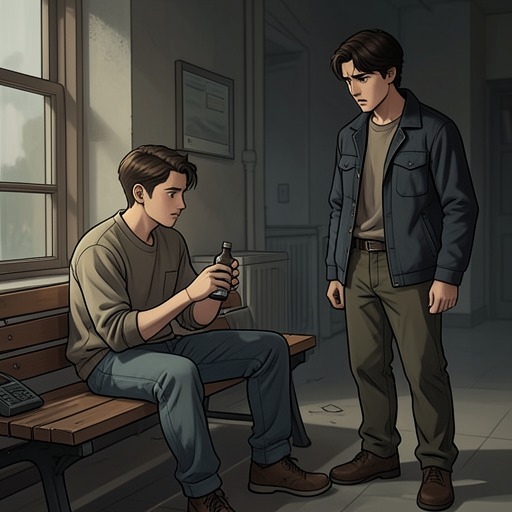
Le piège de la dépendance à l’héroïne
CherryLe piège de la dépendance à l’héroïne is the cycle that governs the narrator and Emily’s life together: drugs briefly suppress withdrawal, but the relief fades quickly, leaving them to find more money and drugs or face a renewed collapse. The trap is not simply that they want to stop and cannot; it is that each postponement has a practical-sounding reason, while their shared addiction turns intimacy into mutual reinforcement and makes ordinary obligations secondary to securing the next reprieve.
The Mechanics of the Cycle
The account makes dependence measurable through the shrinking usefulness of each dose. Earlier in the day, the narrator and Emily each injected 20 milligrams of OxyContin. A dose of that size might work for someone who was not deeply dependent, but after their continuous use it did almost nothing and lasted only a few hours. By then, they felt that anything below forty-five dollars’ worth of drugs apiece was scarcely worth injecting. Even that larger expenditure offered only a short interval before withdrawal returned. Relief therefore did not resolve the crisis: it set the clock running again.
The cost is described in terms of both money and time. The pair need to keep finding drugs, but the reprieve they buy is so brief that ordinary plans cannot easily accommodate a period of detoxification. The narrator recognizes the contradiction: they are spending their lives maintaining the addiction, yet imagine that stopping would require a stretch of time they cannot spare. Their dependence becomes a schedule organized around avoiding the next descent into sickness.
A later episode makes the exchange still more stark. Feeling unbearably ill, the narrator and Emily dissolve two pills and each injects an eighty-milligram dose. They feel better afterward, and the ninety dollars spent buys them a night. But the relief already contains its sequel: the next day, another ninety dollars will be needed just to get out of bed. The amount, the dose, and the short duration turn dependence from an abstract condition into a repeated transaction, one that purchases temporary function rather than recovery.
The Shared Trap
The narrator and Emily are not suffering in isolation. The narrator describes their relationship as a joint process of destroying their lives: separately, either might perhaps have managed, but together they cannot get off drugs. This is not presented as a firm claim about what either would have done alone. Its force lies in the contrast between that imagined possibility and the reality of their partnership, where each remains entangled in the other’s continued use.
They can name the situation plainly. The narrator agrees that they are in serious trouble and apologizes, but immediately explains why they cannot stop now: they are constantly occupied, and he cannot see when they could find a month to withdraw. Emily insists that they have to quit. He agrees in principle, then asks to wait longer and promises that they will do it later. That exchange reveals how awareness coexists with delay. The future commitment does not undo the present dependence; it gives the next postponement a language of hope.
The domestic routine confirms the pattern. After they become sick, they inject again, watch television, and fall asleep late; Emily curls up beside the narrator. The closeness is real, but it takes place after a dose has made the night bearable, not after the underlying problem has changed. Their tenderness and their drug use occupy the same narrow stretch of reprieve, so intimacy does not provide an exit from the cycle.
Withdrawal and Repeated Deferral
The imagined attempt to quit exposes how the cycle recruits both partners. The narrator pictures them deciding to use a weekend to withdraw, then enduring fever, vomiting, and the desire to die until Sunday evening. At that point, one of them proposes a small reward for having done so well, and the other readily agrees. The scene is framed as a recurring pattern rather than a successful attempt: the anticipated ordeal gives way to a justification for using again. The promise of a reward turns endurance into a temporary test, not a break with dependence.
That imagined weekend echoes the couple’s direct conversation about not having time to withdraw. Together, the two accounts show different forms of the same barrier. In one, a month seems impossible to find amid constant demands; in the other, even a weekend’s suffering culminates in a reason to resume. The trap operates through logistics and through the moment when relief becomes emotionally persuasive again. Neither partner needs to deny the damage for the cycle to continue.
Money, Priorities, and Consequences
The demands of obtaining drugs shape the narrator’s ordinary choices. Emily is attending college and working as a teaching assistant, while the narrator repeatedly skips his classes to look for drugs. He considers her coursework more important because she is the intelligent one of the two and imagines that others would notice if she failed to appear in her academic role. His judgment does not lead him away from the addiction: instead, it helps arrange their lives around her continued attendance while he takes on the work of finding drugs for them.
That search depends on uncertain plans and unreliable suppliers. The narrator has come up empty, is waiting to hear from Big about an OxyContin plan, and is also hoping that an arrangement with Gary will produce drugs. Gary eventually arrives without anything, despite having said he did. The failed promise leaves the need unresolved; dependence exposes the couple to the time and vulnerability involved in chasing supplies, without guaranteeing that the effort will succeed.
The financial pressure also enters their arguments. Emily resents the narrator for losing six hundred dollars in a cocaine deal arranged through Manny, after he believed he could obtain twenty-eight grams cheaply and resell them at a profit. His expectation of quick money collapses, leaving him with the loss and Emily with another reason to blame him. This episode concerns cocaine rather than the couple’s OxyContin use, but it belongs to the wider economy of their drug-seeking life: the hope of obtaining money or drugs easily gives way to loss, conflict, and renewed pressure.
That pressure reaches beyond arguments and failed deals. Before a bank robbery, the narrator says that he owes money to dealers but is not afraid of the debt itself. What he fears is being unable to obtain heroin; he is never more than twelve hours from total collapse and describes himself as compromised by desperation. The account links dependence to criminal risk without treating the robbery as a cure or a clean solution. The immediate danger, in his own assessment, is not simply owing money but losing access to the drug that holds withdrawal at bay.
The trap’s decisive feature is therefore repetition with accumulating consequences. A dose buys a few hours or a night, a plan to quit is postponed, and the next need arrives with fresh financial and relational costs. The narrator and Emily can recognize that their life together is damaging them, and the narrator can imagine a point at which stopping might still be possible. Recognition, however, does not interrupt the cycle: for now, each reprieve merely makes the next payment necessary.