Warrior Medic
Cherry“Warrior Medic” names the military medic as both caregiver and combat soldier, a hybrid identity the Army insists upon even when its trainees find the language ridiculous. The phrase begins as an institutional label in a fourteen-week training course and becomes a compulsory company chant; later, the narrator’s experience treating wounded people in Iraq gives the title a grave practical meaning that its slogans cannot guarantee.
Identity and Institutional Meaning
At the recruitment stage, the narrator chooses the medical specialty, designated 91W, and is told that strong test results could let him select the work he wants. His color blindness does not disqualify him: 91W is one of the few specialties open to color-blind recruits, a fact explained through the grim assurance that blood’s color is already known. The qualification makes the medic role seem unusually accessible, but it also foreshadows the tension built into the title: a person may be admitted to a life-saving specialty by meeting a narrow eligibility rule, while still having to learn what care demands under pressure.
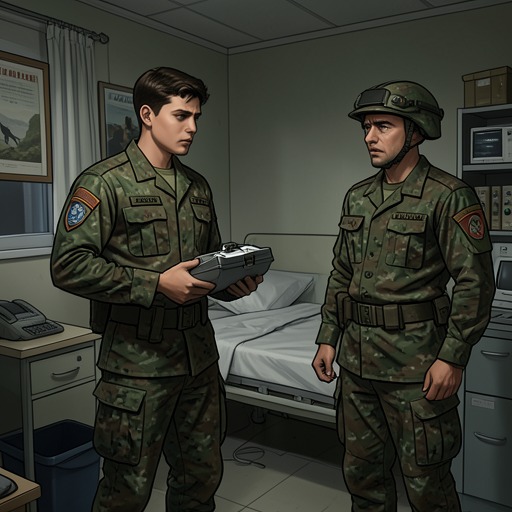
The Army’s training battalion gives its medical trainees the mantra “Warrior Medic,” glossed in the passage as “Warrior Medic” in translation from the phrase meaning warrior caregiver. The title is not offered as a description the trainees have chosen for themselves. It is an official form of address imposed from above, pairing the reassuring work of medical treatment with the martial identity the Army expects them to inhabit. Their response is largely mockery, yet the institution’s insistence makes the phrase consequential: it frames their training before they have tested their skills against the injured and dying.
Training as Performance
The fourteen-week course gave the designation a practical setting, but its teaching joined medical instruction to a deliberately theatrical military identity. Trainees began with emergency-care manuals and classroom lectures, punctuated by graphic films intended to familiarize them with death: a driver’s neck breaking in a rollover, a motorcyclist disemboweled, and a woman stabbed repeatedly. Each section had two instructors, an Army staff sergeant and a civilian paramedic. Grey, who worked for an air-ambulance service based at a San Antonio hospital, was presented as a particularly authoritative teacher, with expertise exceeding that of the Army medics collectively. The course thus placed technical medical knowledge beside a slogan that made the trainees’ combat identity impossible to ignore.
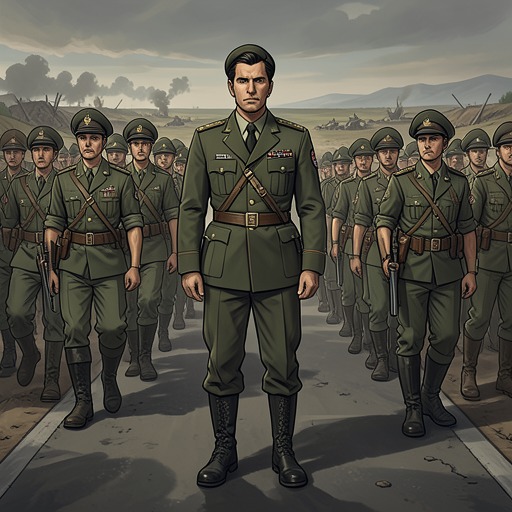
That identity was enforced through ritual. When Company Charlie missed the deadline to invent a rallying song, Sergeant Masters ordered the company into formation and drove the trainees through punishment until they lay face down, drenched in sweat and unable to continue. He then supplied the chant himself, beginning with the phrase Warrior Medics in Combat. The refrain was to continue until an order to stop; thereafter, every time the company came to attention, the trainees had to recite the entire song at full volume. The flag bearer performed robotic movements throughout. What the trainees had regarded as a ridiculous institutional label became a repeated bodily exercise: the Army made them enact the title in unison before deployment could test what its promise of care and combat actually required.
Clinical Practice and Its Limits
The hospital rotation at Brooke Army Medical Center, the hospital at Fort Sam Houston, turned the title’s promise of care into a series of encounters with actual patients. While taking the blood pressure of a motorcyclist with a broken leg, the trainee put the cuff on backward; when the machine inflated it, the patient handled the mistake better than his wife did. On another round, he washed a man stabbed in a fight among homeless people, a task that required lifting and cleaning his genitals. These episodes place basic care beside embarrassment and disgust, not as abstract competencies but as work performed on vulnerable bodies.
A patient in his thirties had been struck by a car while crossing the street. The impact had torn away his penis and left irreversible brain damage; his mother stayed at his bedside, and her grief was so intense that looking at her felt like staring into the sun. The trainee was relieved that he had learned to use the blood-pressure monitor: causing this family any further distress would have made him feel guilty. At the end of the corridor, he could see a boy burned in Iraq through the window of an isolation room. Infection risk kept visitors out. The boy’s presence made the future implicit in the medic’s training visible before the trainee himself had encountered combat casualties.
In Iraq, the gap between the title and the medic’s actual ability became acute when a young, barefoot Hadji lay wounded after the squad opened fire. The narrator was assigned to treat him. He packed gauze into the apparent abdominal entrance wound, covered it with a plastic bag taped on three sides, and had Sullivan hold the dressing while he searched for an exit wound. Finding none on the upper body, he cut away the man’s sweatpants with trauma shears. The narrator later identifies the treatment’s omissions precisely: he should have packed in much more gauze and placed the wounded man on his injured side. He did neither. Unable to find an exit wound or get an intravenous line into the man’s flattened veins, he reached for things to say and proposed elevating the feet to ward off shock. The title designated a trained caregiver, but in the moment the narrator did not know what to do.
The wounded man’s family made that uncertainty part of the scene’s moral weight. After the man died, the narrator placed his naked body in a body bag. An older woman tried to reach it and was pushed back by soldiers; she fell to her knees, threw handfuls of dirt over her head, and struck her face against the ground. A very pregnant young woman joined her, while two boys screamed. As soldiers carried the body away, the older woman followed and tried to pull the bag from them. The narrator felt close to crying and, in the extremity of the moment, to shooting himself. Then three long automatic bursts of AK-47 fire ended the mourning scene and sent the soldiers scattering. Later that evening the unit returned without incident. Sullivan subsequently told the narrator that the older woman had been killed by their own fire that morning; the narrator believed him because Sullivan would not have said so without being sure. The medic’s role here was not simply to treat a wound: it placed him beside a death he could not prevent, a family he could not console, and the later knowledge that their own gunfire had killed another bereaved person.
The Medic’s Voice and the Limits of Authority
The title also implies a responsibility to make danger legible to command, not merely to treat its aftermath. In one confrontation, the narrator rebukes a lieutenant for ignoring his warnings, recalling that he had advised against entering a field too soft for vehicles; the unit became bogged down, and four soldiers were killed. The narrator’s accusation that the lieutenant had killed his friends is, as he immediately acknowledges, an exaggeration: they were acquaintances, and remaining out of the field would not necessarily have saved them. That correction does not erase the underlying grievance. The Warrior Medic is expected to help, but the role offers no guarantee that a warning will be heard or that care can undo decisions made above him. Across training, clinical work, and combat, the title therefore holds together two demands that the narrator cannot reconcile by skill or slogan alone: serve within the military chain of command, and answer for the human consequences when that chain fails to heed what he knows.