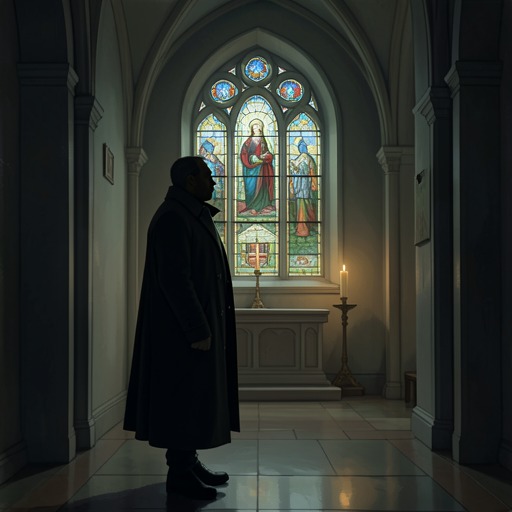
Church and God: The Conflict Between Institutional Loyalty and Conscience
ConclaveChurch and God: The Conflict Between Institutional Loyalty and Conscience names a central struggle in the conclave: whether loyalty to the Church’s unity and institutions can take precedence over truth, justice, and an individual’s conscience. Jacopo Baldassare Lomeli initially treats the preservation of the Church as a sacred obligation, but Vincent Benítez’s challenge forces him to confront the possibility that he has confused the institution with God. The tension becomes practical as well as spiritual, shaping how Lomeli understands canon law, corruption, abuse, and the legitimacy of decisions made in a crisis.
The Institution and Its Claims
For Lomeli, the Church is not merely an administrative structure. He calls its unity the divine gift of the single Universal Church, and insists that it is the living embodiment of the Holy Spirit. A schism, therefore, would violate what he has believed and worked for throughout his life. Benítez does not share his alarm at the prospect of a prolonged conclave or even a schism: he believes in God alone, and allows that division might be what God wants. Their disagreement is not simply between a believer and a skeptic. Both speak in religious terms, but they differ over whether institutional unity can be taken as evidence of fidelity to God.
That difference sharpens when Benítez asks whether unity is worth preserving at the cost of breaking a sacred oath. Lomeli rejects the suggestion as extraordinary and reasserts the Church’s spiritual character. Benítez answers by pointing beyond the institution to the women harmed by military policy in central Africa, whose suffering he invokes as a more immediate place to encounter the Holy Spirit. Lomeli is taken aback and insists that he would never knowingly break his oath to God, whatever the consequences for the Church. The exchange leaves the moral question unresolved, but changes its terms: fidelity cannot be judged by institutional unity alone if that unity demands silence about grave harm.
Conscience and the Weight of Past Failure
The conflict reaches beyond the conclave’s immediate competition. In conversation with Raymond O’Malley, Lomeli acknowledges the Church’s failure to respond adequately to sexual-abuse complaints. He considers how colleagues moved accused priests from parish to parish rather than taking victims seriously, while distinguishing their failures from deliberate evil: many, he suggests, did not understand the scale of the wrongdoing and preferred to avoid disruption. He also reflects on friendships that became too intimate and ended in sin and heartbreak, and on the way an isolated life could turn status and protocol into substitutes for fulfilment.
These admissions complicate the impulse to investigate every past lapse. Lomeli asks whether he should act like a witchfinder general, searching out colleagues’ failings from decades earlier. O’Malley invokes the Gospel injunction that the sinless should cast the first stone, but redirects the discussion to the more recent meeting between the late Pope and Joseph Tremblay. The exchange distinguishes blanket moral condemnation from a specific question of accountability. Lomeli’s difficulty is not only deciding whether wrongdoing occurred; it is deciding how to pursue the truth without pretending that the investigator stands outside the same flawed institution.
The argument becomes personal when Benítez’s accusation unsettles Lomeli’s understanding of his own spiritual life. During dinner, amid the cardinals’ gradual resignation that they may never again see an Italian pope, Lomeli cannot stop thinking about their conversation. He wonders whether he has spent thirty years worshipping the Church rather than God. In his heart, he cannot evade the possibility that the accusation is true, and connects it to his difficulty praying. The insight echoes an earlier moment of recognition in Saint Peter’s Basilica: the institutional question has become a crisis of conscience within Lomeli himself.
Law, Procedure, and Legitimacy
The novel also stages the conflict through competing interpretations of ecclesiastical law. When Wilhelm Mandorff doubts whether Vincent Benítez is truly a cardinal, Lomeli initially assumes the late Pope would have informed the Dean of the College of Cardinals. He learns, however, that the Pope had recently revised the canon law governing secret appointments. Lomeli explains that an in pectore appointment could be made without the name being disclosed, even to close associates, and that the Church had previously known a case in which the appointee’s identity remained unknown after the Pope’s death. The possibility that security considerations could apply to the Church’s senior representative in Baghdad makes secrecy a question of protection as well as trust.
Lomeli grounds Benítez’s right to participate in the conclave in paragraph thirty-nine of the Apostolic Constitution: a cardinal-elector arriving re integra, before a new pope has been elected, may join the election at the stage it has reached. He tells Mandorff that Benítez is legally a cardinal. The episode makes interpretation consequential: the text does not apply itself, and a contested status becomes a test of who can interpret the rules and what constitutes lawful participation. Lomeli’s defense rests not on private affection but on the rule’s conditions and the Pope’s authority to make the appointment.
Procedure is equally visible in the voting ritual. Lomeli reads aloud the constitution’s directions: each elector folds and displays his ballot, carries it to the altar, swears that his vote is given to the person he believes before God should be elected, and deposits it in the receptacle. After explaining the procedure, he votes for Aldo Bellini. The ballot joins a prescribed public act to a private judgment before God. Its ritual form does not eliminate the elector’s responsibility; it makes that responsibility explicit.
That balance becomes harder to maintain when coordinated attacks strike during the conclave. Lomeli sees black smoke rising from the piazza where the bombs exploded and from the Sistine Chapel chimney, beside shattered windows. He weighs suspending the conclave as a mark of respect against the leadership vacuum that suspension would prolong, while accelerating the vote would violate the Apostolic Constitution. O’Malley urges him to break the rules, arguing that the Church would understand. Lomeli resists: if the election’s legality were in doubt, the new pope’s decrees could be challenged from the first day. His choice exposes the cost on both sides. An emergency may make ordinary procedure feel inadequate, but dispensing with it risks weakening the authority needed to govern afterward.
Conscience as a Guide to Action
Lomeli’s doubts do not resolve into a simple rejection of the institution. When he asks Benítez whether he did the right thing, Benítez answers that a person who follows conscience does not thereby do wrong, even when the consequences are unintended or later reveal a mistake. Conscience, he says, is where a person most clearly hears the voice of God. The distinction matters: an action can have damaging consequences without having been morally wrong, while an institution’s claim to good intentions cannot by itself excuse a failure to act.
The conflict’s force lies in the fact that neither legal order nor institutional unity is dismissed. Lomeli treats the conclave’s rules as essential to legitimate authority, yet Benítez makes him question whether the Church can be the final measure of religious truth. Past failures, the possibility of a broken oath, and the danger of an unlawful election all demand judgment under pressure. By linking Lomeli’s inability to pray with his fear of schism and his concern for procedure, the novel presents conscience not as an escape from responsibility but as the place where competing duties must be faced.