Christian Nonviolence and Retaliatory Violence
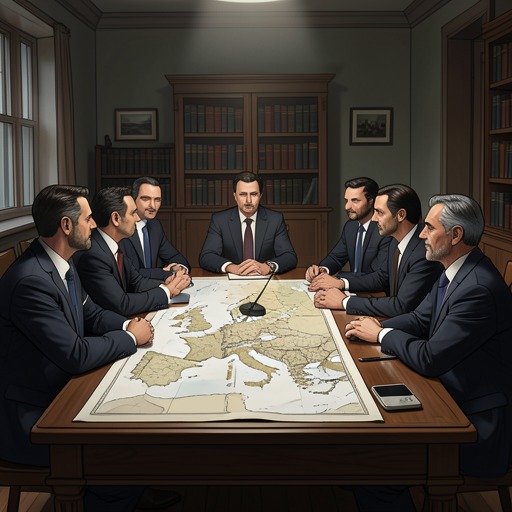
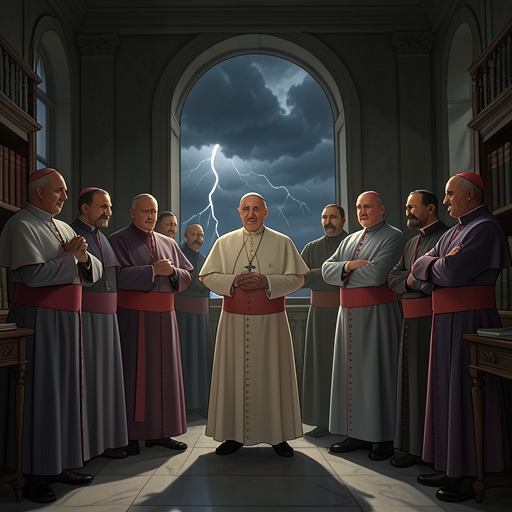
ConclaveChristian Nonviolence and Retaliatory Violence is the conflict over how the Church should answer violence when coordinated attacks strike during the papal election. Goffredo Tedesco interprets the attacks as proof that Christian restraint has become weakness and urges a more forceful response; Vincent Benítez counters with the testimony of communities he has served and buried, arguing that victims of persecution did not wish violence to be answered in kind. Their disagreement turns an emergency into a contest over the Church’s identity, while the cardinals’ eventual decision to return to voting rejects the conversion of the election into a political convention.
The attack and its immediate setting
Before the violence, the election is already enclosed by extraordinary security. As the cardinals arrive at Casa Santa Marta, Jacopo Baldassare Lomeli hears a helicopter above the darkening November sky and remembers the Italian Minister of the Interior’s warning that the terrorist threat is serious and imminent. Surface-to-air missiles and snipers are to be stationed on buildings around the Vatican, while five thousand uniformed police and army personnel patrol nearby streets and hundreds of plain-clothes officers mingle with crowds. Outside, demonstrators’ competing causes merge into an indistinguishable cacophony. Lomeli privately imagines the Church as an ark surrounded by a rising flood of discord.
The threat becomes immediate during the conclave. After a second explosion is heard, Lomeli goes through the screen into the vestibule and finds broken glass across the marble floor. The windows beside the stove flue have been blown in; security men arrive with guns drawn, followed by Monsignor O’Malley and Archbishop Mandorff. Lomeli blocks their entry and insists that nobody is injured, treating the intrusion into the voting space as a sacrilege even amid the emergency.
O’Malley reports that the attack appears to involve both a suicide bomber and a car bomb in Piazza del Risorgimento, a crowded pilgrimage site about four hundred metres outside Vatican City and the closest public place to the Sistine Chapel. The reported toll is at least thirty dead. A shooting has also taken place during Mass at San Marco Evangelista. Several witnesses say the bomber shouted “Allahu Akbar,” prompting O’Malley to condemn the use of a profession of God’s greatness in the attack. Lomeli cautions him against emotion: the violence is appalling, he says, but a deliberate assault on the Universal Church in three countries during the election risks being seen as the beginning of a religious war.
Tedesco’s case for forceful resistance
In the cardinals’ debate, Tedesco first objects to choosing a pope in haste merely to reassure a frightened public. The Holy Spirit, he argues, cannot be summoned on demand; the electors have sworn to choose the person they believe best fitted to be pope, not simply the candidate easiest to present to the crowd. He then challenges whether Lomeli, whom he calls a brother and friend, can lead through the crisis. Tedesco characterizes him as a man unsuited to heal the broken-hearted or sound a trumpet, and associates his doctrinal outlook with drift and relativism.
Tedesco’s rhetoric escalates from leadership to civilizational blame. He invokes the bloodshed at Piazza del Risorgimento and San Marco Evangelista to argue that Christians share some responsibility because they have tolerated Islam in their own lands. He contrasts that tolerance with the killing of Christians elsewhere, describes the situation as an unspoken genocide, and asks how long the Church will remain weak. His account treats the attacks not only as crimes but as evidence for a wider conflict between religious communities, making restraint appear culpable and force a necessary defense.
To give that argument historical and religious weight, Tedesco points to the fresco of the Battle of Lepanto in the Sala Regia, which the cardinals pass on their way to the Sistine Chapel. He recalls the Christian naval forces’ victory over the Ottoman Empire, attributed to Pope Pius V’s diplomacy and the intercession of Our Lady of the Rosary, as an example of leadership needed in the present. He blames the drift of the preceding fifty years, beginning with the Second Vatican Council, for leaving the Church weak before evil. The attacks, in his telling, are a supreme crisis and a sign that the Church must recover the strength to meet its enemies.
Benítez’s testimony against retaliation
Vincent Benítez answers Tedesco not with an abstract argument about restraint but with the experience of his ministry. He reminds the Patriarch of Venice that he is the Archbishop of Baghdad. Iraq had one and a half million Christians before the Americans attacked; now, he says, only one hundred and fifty thousand remain, and his own diocese is almost empty. He has seen holy places bombed, Christians killed in the Middle East and Africa, and has comforted and buried the victims.
Benítez says that not one of those victims would have wished violence to be met with violence. He presents their response as rooted in love of Christ, making their suffering a counter-witness to Tedesco’s call for strength through retaliation. The force of his position comes from the contrast between Tedesco’s appeal to an inherited military victory and Benítez’s account of the living consequences of violence among Christian communities.
Cardinals Ramos, Martinez, and Xalxo begin applauding Benítez, and the applause spreads across the room from Asia through Africa and the Americas to Italy. Tedesco looks around in surprise and shakes his head; the narration leaves open whether he regrets the response, recognizes his own error, or feels both. The applause marks a shift in the debate: the electors’ response gives visible support to Benítez’s rejection of retaliatory violence, without resolving the larger theological and political dispute.
Returning to the election
Aldo Bellini redirects the assembly from the argument over the attacks to its institutional responsibility. He acknowledges that Tedesco is right in one respect, but says the cardinals were summoned to choose a pope, not to continue as a congregation. He proposes abandoning lunch, which few appear to want, and returning immediately to the Sistine Chapel. The election, he insists, must proceed in strict accordance with the Apostolic Constitution, so the result’s legitimacy is beyond doubt, and with urgency, in the hope that the Holy Spirit will guide the electors.
Lomeli confirms that the rules permit two ballots that afternoon and require the following day to be set aside for meditation if no decision is reached. He asks the assembly to vote on Bellini’s proposal. A majority raises its hands in support; Tedesco is the sole opponent. Lomeli orders the drivers made ready and asks Father Zanetti to inform the press office that the conclave is about to hold its eighth ballot. Thus, the immediate outcome of the dispute is procedural rather than military: confronted with violence and pressure to interpret it as religious war, the cardinals resume the election under its rules. The scene places Benítez’s witness against retaliation beside the demand for legitimate collective action, leaving the Church’s response to violence contested but refusing to let the attack itself dictate the choice of pope.