Momentum
ConclaveMomentum is the changing force that gathers around candidates during the conclave: votes move, expectations harden or break, and the cardinals interpret those shifts as signs of either political advantage or divine guidance. It is never a simple synonym for popularity. The first ballot’s scattered results, Adeyemi’s sudden ascent, and his collapse after news spreads through the electors make momentum a fragile, contested reading of collective choice.
Meaning and Political Mechanics
The chapter heading “Momentum” names a process rather than a stable quality possessed by any one candidate. The narrator frames it as a force that secular observers call momentum and religious observers may understand as the Holy Spirit. That double description leaves the election’s movement open to interpretation: arithmetic records what the electors have done, but does not settle what their choices mean.
The contest begins with three candidates already associated with distinct constituencies. Bellini is the liberals’ intellectual hope, with a background as rector of the Gregorian University and Archbishop of Milan. Tremblay combines his office as Camerlengo with leadership of the Congregation for the Evangelisation of Peoples, giving him connections to the developing world while appearing American without being one. Adeyemi carries the possibility of becoming the first black Pope, a prospect that captivates the media. These established profiles shape expectations, but the ballots soon show that reputation and apparent factional strength cannot by themselves predict the outcome.
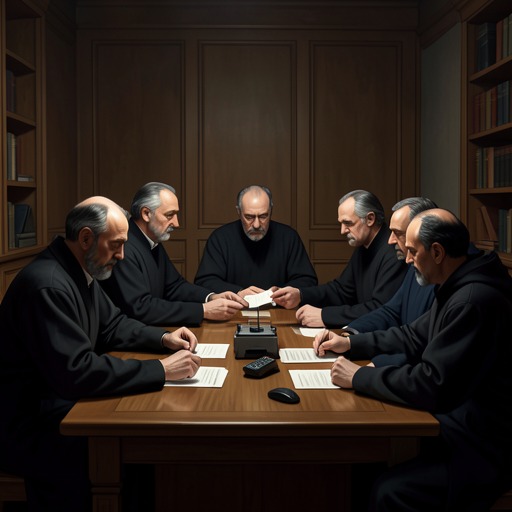
The vote is governed by a formal procedure: each elector folds and carries a ballot to the altar, takes an oath invoking Christ as judge, and places the paper in the receptacle. The ritual makes each vote an individual act of conscience, while the count turns those separate acts into a collective contest. Lomeli marks the names as results are read, trying to make a legible pattern from choices that initially seem almost random.
The First Ballot and the Limits of Prediction
The first ballot frustrates the expectation that the principal candidates will separate quickly. Thirty-four cardinals receive at least one vote, reportedly a record; some electors vote for themselves, friends, or fellow countrymen. Lomeli’s own name appears several times. At first he is touched, but the repeated votes alarm him: in so crowded a field, even a modest total could make him a contender.
The tally confirms how little the established forecasts can command. Tedesco receives 22 votes, Adeyemi 19, and Bellini finishes behind them; Tremblay is only two votes behind Bellini. Lomeli has five, while 38 votes go to other candidates. The result is far short of the 79 votes needed to elect a Pope. Bellini’s campaign manager, Sabbadin, had expected Bellini to lead with as many as 25 and Tedesco to receive no more than 15. Instead, Bellini places third, and Lomeli worries that his own votes may have taken support from Bellini and cost him the first-place standing that could have made victory seem inevitable.
The arithmetic therefore generates momentum and anxiety at once. A lead might encourage coordination, but no candidate has secured the threshold that would make the election appear settled. The rules allow repeated ballots in pursuit of a two-thirds majority, potentially extending the process to thirty ballots over twelve days before a different voting system becomes available. For Lomeli, that possibility makes the first result more than a disappointing count: it opens the prospect of a prolonged, unstable contest.
Adeyemi’s Surge
After the first ballot, Adeyemi appears to gain an advantage not only in the count but in the way other cardinals respond to him. While Tremblay follows potential supporters and Tedesco and Bellini circulate among the tables, Adeyemi remains in a corner of the lobby and lets interested electors approach him. A small queue forms. Lomeli watches the difference between active canvassing and the impression of attraction: Adeyemi’s supporters bring voters to him, giving his still-growing campaign the look of an already established force.
Lomeli also recognizes that Adeyemi’s public image complicates the usual ideological alignments. He suspects that some liberals who would criticize Adeyemi’s conservative views hesitate because he is black, and excuse his condemnation of homosexuality as an expression of African cultural heritage. The thought forces Lomeli to reconsider his earlier underestimation of the Nigerian. He begins to wonder whether Adeyemi could unite the Church and sees in him the breadth of personality required for the papacy. Momentum here is partly electoral, partly a change in Lomeli’s judgment of what the candidate might represent.
The second ballot strengthens the impression of a surge. The no-hopers fall away, and Adeyemi gains sixteen of their votes. Tedesco adds seven to his first-ballot total, while Bellini and Tremblay make little progress. Bellini’s result threatens to end his candidacy, since he may need a total in the high twenties to remain viable. Amid those larger shifts, Benítez’s increase from one vote to two registers as a minor surprise: the count contains not only dominant trends but small changes that may later matter.
By the third ballot, the shift becomes dramatic. Adeyemi receives 57 votes, leaving him only three short of a straight majority and twenty-one short of election. Lomeli looks down the row to find Adeyemi bent over his desk, grasping his pectoral cross and praying. The electors’ attention gathers around him; the possibility of the first black Pope suddenly feels immediate. The force of the moment is not yet a victory, but it changes what the cardinals must imagine as possible.
Reversal, Fragmentation, and Bargaining
The surge does not hold. After the lunch break, Adeyemi loses 32 votes, more than half his support. Tremblay gains eleven, Bellini eight, Lomeli six, Tedesco four, and Benítez three. Lomeli concludes that Nakitanda has spread the word, and that enough cardinals witnessed or heard about the scene in the dining hall to be frightened away from Adeyemi. The turn shows how momentum can be broken by information moving through the group: a candidate’s apparent strength gives way as electors revise their choices.
The new distribution produces several competing interpretations. Tedesco returns to the lead and approaches the 40 votes that could prevent anyone else from reaching a two-thirds majority. Tremblay may benefit if the developing-world vote shifts toward him. Bellini’s long campaign looks increasingly humiliating, while Lomeli’s votes may reflect a search for a steady hand in uncertain circumstances. Benítez, almost unknown to the cardinals two days earlier, has reached five votes. None of these observations settles the election; together they reveal a field whose alignments remain unsettled and whose candidates can acquire significance at different speeds.
Lomeli understands the instability through a contrast between earlier conclaves and this one. He recalls modern elections often concluding by the fifth ballot and had hoped for that conventional duration, which would have suggested a meditative discernment rather than schism or coronation. Instead, he applies Elias Canetti’s categories of crowds to the electors: a conclave can be timid or bold, but this one seems to be becoming a disintegrating crowd, troubled, fragile, and liable to turn suddenly in any direction. The image gives momentum a darker counterpart. Movement is not necessarily progress; a crowd may change course without arriving at a coherent choice.
The bargaining around Bellini and Lomeli makes the political mechanics explicit. Sabbadin argues that Bellini’s fifteen votes and Lomeli’s twelve cannot make Lomeli a viable alternative, even if Bellini’s supporters transferred as a bloc. Their combined 27, added to Tremblay’s 40, would bring Tremblay to 67, twelve short of the two-thirds threshold. Bellini accepts the logic despite his reservations, reasoning that if the Holy Spirit operates through the conclave, the electors must accept that God may wish them to give the Keys of St Peter to Tremblay. Momentum thus emerges not only from spontaneous shifts in sentiment but from strategic calculations about transfers, thresholds, and which coalition can still win.
The Meaning and Limits of a Result
The election’s later crisis makes the distinction between momentum and legitimacy unavoidable. After coordinated attacks in Rome, Lomeli considers whether to suspend the conclave in respect for the victims or accelerate voting to fill the leadership vacuum. Suspending it would prolong that vacuum; speeding it up would break the governing constitution and risk producing a Pope whose authority could be challenged from the beginning. The pressure to move faster cannot itself make a result valid. The cardinals’ sense of emergency is real, but procedure remains part of what gives the eventual outcome authority.
When Lomeli asks the gathered electors whether they wish to receive information about the crisis, he puts the matter to a vote under the constitution’s provision for special circumstances. Dozens of scarlet-sleeved arms rise in favor; only Tedesco, Krasinski, Tutino, and about a dozen others oppose. The scene echoes the ballot counts in miniature: a visible plurality becomes a collective decision, while the dissenting minority remains legible rather than disappearing. Lomeli’s chairmanship gives the group a way to act without pretending that unanimity exists.
The final count shown in the evidence gives Benítez 92 votes, Lomeli 21, and Tedesco five. Against Benítez’s early total of one, then two, and later five, the result makes visible an extraordinary accumulation of support. Yet the chapter’s account of momentum does not reduce that result to an inevitable ascent. Across the ballots, votes disperse, concentrate, retreat, and shift between candidates; the same collective movement can be read as political coordination or as providential guidance. Its power lies in changing what the electors believe is possible, while its instability keeps no apparent lead from becoming certainty.