Faith in the Church and Faith in God
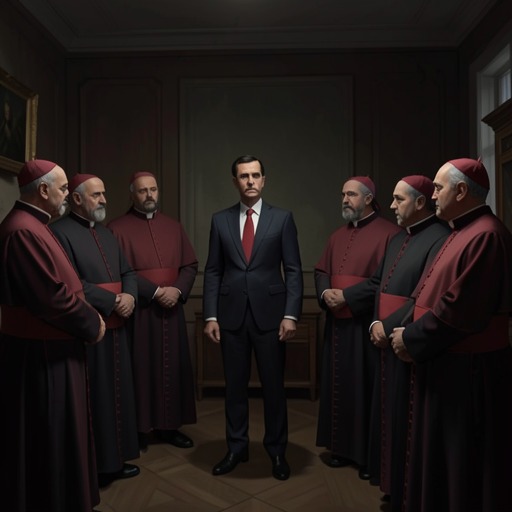
ConclaveFaith in the Church and Faith in God are not treated as interchangeable in the late Pope’s final days. Cardinal Bellini tells Jacopo Baldassare Lomeli that the Pope’s doubts were not about God but about the Church—a distinction that reframes the conclave’s institutional crises as a question of whether loyalty to the Church can survive disappointment in its human administration.
The distinction between God and the Church
Bellini makes the distinction while declining to join the crowd gathered around the late Pope’s death. Carrying a travelling chess set, he invites Lomeli to pray and celebrate Mass for their friend, then reveals that the late Pope had spoken to him about Lomeli’s difficulties with prayer. When Lomeli asks whether the Pope doubted God, Bellini insists that he did not: what the Pope had lost faith in was the Church. The disclosure gives Lomeli a way to understand doubt not as a simple rejection of belief, but as a rupture between trust in God and confidence in the institution that serves God.
The revelation unsettles Lomeli because he has tried to banish it from his mind. Its force grows when he sees the Curia’s senior officials as worldly and knowing, lacking the awe he recognizes in cardinals who have travelled from elsewhere. He recognizes the same spiritual disfigurement in himself and has prayed for the strength to resist it. The late Pope had warned the officials against vanity, intrigue, malice, and gossip; Lomeli suspects that these courtiers were among the people Bellini meant when he described the Pope’s loss of faith in the Church. Yet the Pope himself had appointed them, complicating any clean division between a reforming leader and a corrupt institution.
The administrative Church under scrutiny
The late Pope’s distrust is given material form in the records Lomeli discovers in a concealed compartment in the bedpost of the Pope’s residence. Among the documents are bank statements, money transfers, apartment addresses, and handwritten notes. An apartment list records the large Vatican residences occupied by senior churchmen, including Lomeli’s 445-square-metre apartment, while the Pope’s own accommodation at Casa Santa Marta is listed as only 50 square metres. An attached report estimates the Administration of the Patrimony of the Apostolic See’s holdings at 347,532 square metres and a potential value exceeding €2.7 billion, against a stated book value of €389.6 million. It also notes a paid occupancy rate of just 56 percent and suggests that much income is not being properly declared. The contrast makes institutional distrust concrete: the Pope’s concern is not only spiritual disillusionment but also the administration of wealth and the possibility that those entrusted with it have failed their responsibilities.
Bellini describes the late Pope’s response as a sustained struggle. From the beginning of his pontificate, the Pope refused full regalia and chose to live at Casa Santa Marta rather than the Apostolic Palace. He demanded financial transparency from the heads of the congregations: proper accounts, disclosed finances, outside tenders for building work, and receipts. He then brought in accountants and management consultants to examine files and gave them offices on the first floor of Casa Santa Marta. The scrutiny provoked hostility within the Curia. Leaks followed, bringing public embarrassment over funds intended for the poor being used to renovate apartments or pay for first-class travel. Meanwhile, Goffredo Tedesco and his allies attacked the Pope over his remarks on gay people, divorced couples, and women’s advancement. Bellini describes the resulting paradox: the Pope became more popular outside the Holy See while growing more isolated within it, until he scarcely trusted anyone.
Procedure, conscience, and institutional loyalty
The distinction between faith in God and faith in the Church also shapes Lomeli’s conduct during the conclave. When Wilhelm Mandorff questions whether the late Pope could have created a cardinal in secret, Lomeli argues that the Pope’s revised canon law governs the case. He invokes paragraph thirty-nine of the Apostolic Constitution: a cardinal-elector who arrives before the new Pope is elected may join the election at its current stage. Lomeli treats the rule as a matter of legal standing and insists that the Church’s wishes must be honoured, even while remaining uncertain about why the appointment was concealed. The episode shows institutional trust operating through interpretation and procedure, rather than through unquestioning confidence in every decision.
The same tension appears in the conclave’s voting ritual. Lomeli reads aloud the prescribed procedure: each elector carries a folded ballot to the altar, swears that the vote is given to the person he believes should be elected before God, and deposits it in the receptacle. He then writes Bellini’s name on his own ballot. The oath places divine judgment and personal conscience inside the machinery of institutional election; faith does not remove the need for rules, but the rules require each elector to answer for his choice before God.
When coordinated bomb attacks strike Rome during the conclave, Lomeli confronts the cost of treating procedure as expendable. He fears that suspending the election would prolong the leadership vacuum, while accelerating the vote would violate the Apostolic Constitution and risk producing a Pope whose authority could be challenged from the outset. O’Malley urges him to break the rules, but Lomeli insists that legitimacy matters even in a crisis. He obtains the assembled cardinals’ authority to discuss the situation under the constitution’s provisions for special circumstances, then puts the question of whether they should receive the information to a vote. The overwhelming decision to hear it turns procedure into a means of collective judgment rather than a refuge from responsibility.
The Church as a flawed instrument of faith
The concept’s central tension is neither an easy endorsement of the institution nor a declaration that institutional failure makes belief impossible. The late Pope’s demands for transparent accounts, his modest residence, and his efforts to examine Curial finances show a continuing attempt to serve the Church by confronting its failures. Bellini, for his part, argues that the Church remains the means through which Christians serve God, even when the Curia is imperfect. His defence does not erase the late Pope’s disillusionment; it places that disillusionment inside a continuing argument over what fidelity requires.
For Lomeli, that argument remains active rather than resolved. He recognizes the temptation to withdraw when exhaustion and strain make the conclave’s burdens feel intolerable, yet asks God to forgive his weakness and continues to carry out his duties. The late Pope’s lost confidence in the Church therefore becomes both a warning about institutional decay and a test of the distinction Bellini has drawn: belief in God may persist alongside grave doubt about the Church, while service to the institution demands discernment, accountability, and an acceptance that its human machinery can fail.