Corruption and Financial Accountability within the Church
ConclaveCorruption and Financial Accountability within the Church is presented as both a material problem and a crisis of institutional trust. The late Pope sought to expose opaque Church finances, but the records he secretly gathered implicated senior clergy and placed Jacopo Baldassare Lomeli in a dilemma: whether to use them during the conclave, despite the risk of exploiting a frail predecessor’s suspicions and harming his memory.
The hidden financial record
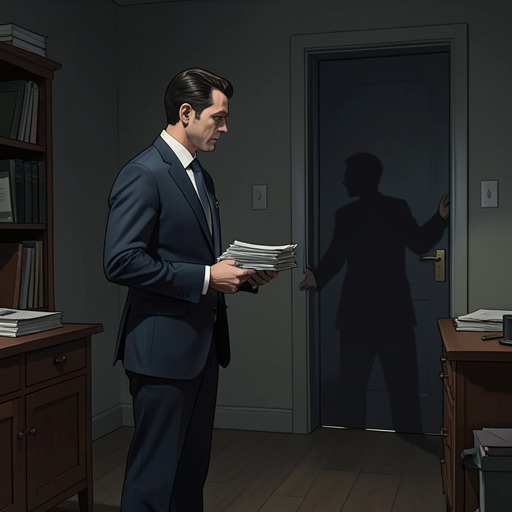
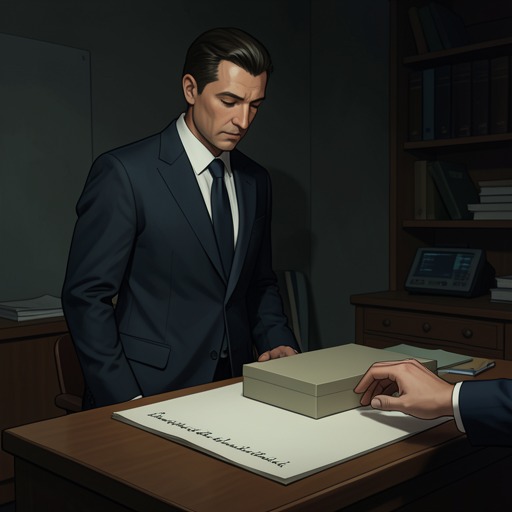
The late Pope’s investigation becomes concrete when Lomeli searches the bed in the papal apartment and discovers concealed wooden compartments. In one, a plain case holds documents containing bank statements, transfers, property addresses and the late Pope’s handwritten annotations. The papers include an inventory of official apartments occupied by serving and retired Curia members, prepared for the pontiff by the Administration of the Patrimony of the Apostolic See. Lomeli’s own apartment is listed at 445 square metres; the entries for Aldo Bellini, Joshua Adeyemi and Joseph Tremblay give 410, 480 and 510 square metres respectively. Beside these, the late Pope has recorded his own 50-square-metre accommodation at Casa Santa Marta, setting his modest living quarters against the much larger apartments assigned to other Church officials.
An attached report from special commissioner D. Labriola quantifies the suspected gap between the Church’s property holdings and their declared income. It estimates the total area of the Administration’s property at 347,532 square metres, with a potential value above €2.7 billion but a book value of €389.6 million. A paid occupancy rate of just 56 per cent, the report says, appears to indicate that much income is not properly declared. These figures turn the late Pope’s concerns from a general demand for reform into a documented question about accounting and revenue.
Other pages record private bank balances held at the Vatican Bank. Lomeli finds his own account balance, €38,734.76 at the end of September, a figure he had not known. The list gives Aldo Bellini €42,112, Joshua Adeyemi €121,865 and Joseph Tremblay €519,732; Goffredo Tedesco has €2,821, while Vincent Benítez appears to have no account. The papers also identify much larger wealth elsewhere, including €2,643,923 attributed to Calogero Scozzazi, Archbishop Emeritus of Palermo, who had worked at the Vatican Bank and been investigated for money laundering. The figures do not establish that every listed sum is illicit. Their significance lies in the scale of the late Pope’s scrutiny and in his suspicion that financial arrangements within the Church were not being honestly disclosed.
A reform campaign and its cost
Bellini recalls that the late Pope made financial transparency an early test of his pontificate. At an introductory meeting with the prefects of the congregations in the Sala Bologna, he demanded proper books, disclosure of accounts, outside tenders for even small building works, and receipts. He then brought in accountants and management consultants to examine the files, giving them offices on the first floor of Casa Santa Marta. The demand for oversight challenged established practices inside the Curia and met resistance from more than one quarter.
According to Bellini, disclosures began appearing in newspapers as the review proceeded. Reports of money being skimmed from funds for the poor to renovate apartments or pay for first-class travel brought public embarrassment. At the same time, Goffredo Tedesco and his allies attacked the late Pope over positions on gay people, divorced couples and the promotion of women. Bellini describes the resulting paradox: the pontiff’s popularity outside the Holy See rose while his isolation inside it deepened. By the end, Bellini says, the late Pope trusted very few people. Financial reform therefore appears not as a completed administrative correction but as a campaign entangled with leaks, factional opposition and personal distrust.
The concealed dossier complicates that campaign. Lomeli is disturbed not only by what the figures suggest about the Church’s wealth, but by the method used to obtain them: the late Pope had secretly secured colleagues’ private financial records. Lomeli recognizes that some concerns, such as the scandal surrounding Curial apartments, had already reached the press, and that he had long suspected some cardinals were wealthy. But the records also expose the late Pope’s state of mind and the breadth of his surveillance. The evidence that might support accountability thus also raises questions about privacy, authority and the reliability of an investigation conducted in secret.
The dilemma of disclosure
Bellini urges Lomeli not to use the papers, arguing that their release would do the late Pope’s memory no service. He says the pontiff had been frail and sick and that his condition affected his judgment; his advice is to return the report or destroy it. Lomeli resists the easy implication that concealing the material would be harmless, asking whether the alternative would be Joseph Tremblay as Pope. The exchange makes the dossier consequential to the election: financial evidence is not merely historical background but a potential factor in the choice of the Church’s next leader.
That choice is shaped by the difference between possessing information and being able to establish what it proves. The documents contain measurements, balances and a commissioner’s estimate, while the interpretation of those records remains contested. Lomeli’s disgust does not by itself establish that every person named has committed wrongdoing; nor does Bellini’s warning erase the report’s allegations about undeclared income. The scene leaves accountability suspended between a demand to confront institutional opacity and the risk of turning confidential records into an instrument of electoral politics.
The novel places this uncertainty within an institution governed by formal procedures. During the conclave crisis, Lomeli asks the assembled cardinals for authority to raise a matter under paragraphs five and six of the Apostolic Constitution, which allow discussion of certain problems in special circumstances if a majority agrees. He puts the question to a vote; scores raise their hands in favour of receiving the information, while Joseph Tremblay, Archbishop Krasinski, Tutino and roughly a dozen others oppose it. Once the motion carries, Lomeli makes clear that anyone unwilling to hear the material may leave, but no one does. The procedure gives the disclosure collective authorization without settling the truth or moral status of every allegation.
Accountability, authority and the Church
The financial papers connect disparities of property and personal wealth to the late Pope’s effort to make Church administration answerable to scrutiny. His own small residence, the far larger apartments listed for senior figures, and the gap between estimated property value and book value form a pointed contrast. Yet the novel does not reduce reform to the discovery of numbers: the records were secretly obtained, their publication could affect a papal election, and the investigator’s judgment may have been impaired by illness. Each fact complicates the claim that transparency alone resolves the crisis.
The resulting conflict is between institutional loyalty and the obligation to confront possible misuse of Church resources. Bellini fears that using the dossier would betray the late Pope’s memory; Lomeli fears the political consequences of leaving it unused. The records therefore function both as evidence and as a test of who may control evidence within the Church. Their force comes not from a final accounting or a definitive verdict, but from the unresolved gap between wealth held in the institution’s name, the disclosures its leaders demand, and the trust required for either investigation or reform.