Elizabeth Taylor
CrashElizabeth Taylor occupies a paradoxical position in the novel: she is among its most visually powerful figures, yet almost entirely through the projections of Robert Vaughan and the narrator. Known as a film actress and screen actress, she becomes Vaughan's chosen object of pursuit and the imagined victim of a meticulously devised car-crash death. Her decisive significance lies in the gap between her public visibility and her lack of control over the meanings imposed upon her. Vaughan does not encounter her as a person with a voice or independent desire; he transforms her into an image, a body, and finally the ceremonial centre of an accident that he wants to make both erotic and fatal.
Public Image and First Appearance
Elizabeth Taylor first appears at the aftermath of Vaughan's final car-crash. Vaughan has driven on a collision course toward her limousine, his car leaving the London Airport flyover and plunging through the roof of a bus filled with airline passengers. When the narrator reaches the scene, the crushed bodies of package tourists still lie across the bus's vinyl seats, while Elizabeth Taylor stands alone beneath the revolving ambulance lights, holding the arm of her chauffeur. Her gloved hand rises to her throat as she confronts the wreckage and Vaughan's body. The scene gives her a stark physical presence, but it also immediately places her inside a spectacle constructed by someone else: the catastrophe has been directed toward her, even though she is not physically struck by it.
Her gesture at the accident site becomes the novel's visual emblem of threatened recognition. The narrator wonders whether she can see, in Vaughan's posture, the formula of the death he had designed for her. That question does not establish her thoughts as fact; instead, it shows how completely Vaughan's fantasy has organized the scene through the narrator's perception. Elizabeth Taylor's visible reaction is limited to the hand at her throat and her isolation beside the chauffeur, while the surrounding wreckage supplies the language in which others interpret her. She is both survivor and image, a living woman forced into the position of witness to an imagined death intended to complete her own public legend.
Vaughan's Pursuit and Imagined Death
During the final weeks of his life, Vaughan thinks of little except Elizabeth Taylor's death. He treats the proposed crash as a ceremonial production, staging it with the devotion of an Earl Marshal and imagining it as a coronation of wounds. Her death is not conceived as an incidental consequence of reckless driving. It is the culmination of a design in which impact, mutilation, celebrity, and sexual fantasy are arranged into a single event. Vaughan's fixation therefore makes her central to his private mythology even before she has any direct knowledge of him.
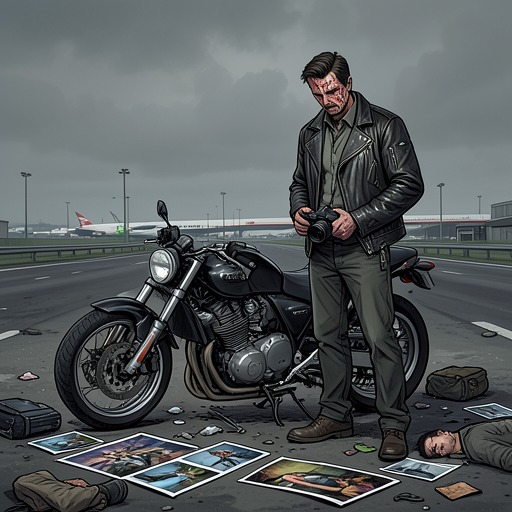
The walls of Vaughan's apartment near the film studios at Shepperton are covered with photographs taken through his zoom lens as Elizabeth Taylor leaves her hotel in London, crosses the spaces observed from pedestrian bridges above the westbound motorways, and moves near the studios. The photographs isolate details of her knees, hands, inner thighs, and the left apex of her mouth. The narrator uneasily prepares enlarged copies for Vaughan in his office, handing over packages of prints as if they were instalments of a death warrant. At Vaughan's apartment, the photographed details of her body are matched against grotesque wounds in a textbook of plastic surgery. Her public movements are thus processed into anatomical fragments, and the distance between surveillance and planned violence collapses.
Vaughan's photographic interest also links Elizabeth Taylor to the larger archive of celebrity accidents that he constructs. His questionnaires contain images of Jayne Mansfield, John Kennedy, Albert Camus, and James Dean, all marked with coloured crayons, circled around vulnerable parts of the body, and overlaid with possible points of impact. When Elizabeth Taylor's image appears as the last of Vaughan's victims, she is positioned as the newest and most important entry in this catalogue. The photograph shows her stepping from a chauffeured limousine outside a London hotel and smiling across her husband's shoulder from the rear seat. Vaughan's attention converts an ordinary publicity image into a technical diagram of possible injury.
The narrator imagines the calculations behind this transformation as a new algebra of leg stance and wound area. Elizabeth Taylor's thighs and kneecaps are read alongside chromium door frames and cocktail-cabinet lids; the cars transporting her become devices capable of exploiting every erotic possibility of sex, death, and mutilation. The passage makes clear that Vaughan's fantasy depends on the collision of two systems of representation: the glamour photograph and the clinical or mechanical diagram. Her body is not desired apart from technology but through the surfaces, fittings, and forces of the automobile.
The Final Pursuit and Survival
The narrator understands the danger of Elizabeth Taylor's position before the final crash occurs. After Vaughan's own death, the narrator hears police broadcasts reporting multiple injuries to the screen actress, though the reports are soon cancelled. The brief, garbled announcement is enough to identify the ordeal that Vaughan has been preparing. It reveals that the imagined victim has become a real target, while the uncertainty of the broadcast sustains the atmosphere of a death being rehearsed before it is confirmed.
The narrator and Vaughan drive westward in the Lincoln toward the accident site at Harlington. Vaughan listens to the police frequency and steadily raises the volume, as if waiting for a final confirmation to arrive at full crescendo. The journey makes Elizabeth Taylor's possible death into a public transmission as well as a private obsession. Vaughan is not merely waiting to learn whether she has survived; he is listening for the completion of the narrative he has authored around her.
Elizabeth Taylor ultimately survives the crash that the narrator fears. At the junction, the accident involves three cars: a customized fibreglass sports car and a silver Mercedes coupe collide at right angles, after which a chauffeur-driven government saloon strikes the sports car from behind. The evidence does not identify Elizabeth Taylor as one of the injured drivers or describe the mechanics by which she escapes, but the police broadcast, the spectators' assumptions, and her later presence make the essential outcome clear: she has narrowly missed death. Her survival frustrates Vaughan's planned culmination while intensifying the spectacle surrounding her.
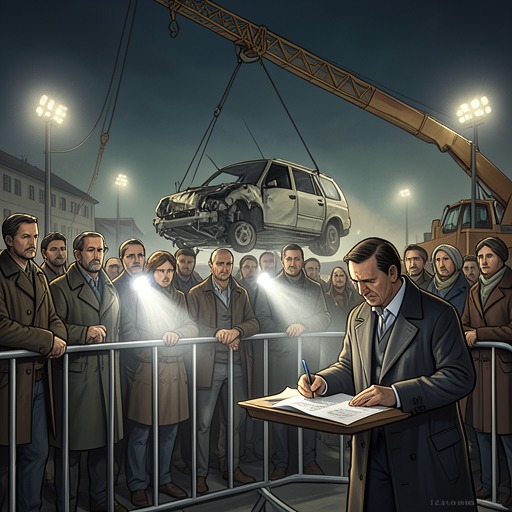
At the final accident site beneath the flyover, Elizabeth Taylor stands beside her chauffeur as spectators gather around the deformed vehicles. At least five hundred people occupy the verges and parapets, and many appear to have come because they believe the film actress has died or nearly died. The crushed roof of the airline coach rises above the crowd, while police cars and ambulances form the practical perimeter of the scene. Yet attention remains fixed less on the human victims than on the damaged vehicles at the centre, turning Elizabeth Taylor's survival into another public image within Vaughan's aesthetic of catastrophe.
Spectacle, Agency, and Narrative Function
Elizabeth Taylor's presence is mediated at every stage by looking. Vaughan watches her through a zoom lens, the narrator handles and copies the resulting photographs, and the crowd gathers to watch her stand beside the wreckage. Even her body language is absorbed into this chain of interpretation: the gloved hand at her throat is read as a response to the image of the death she has avoided. The novel gives her no sustained speech or interior account in the supplied scenes, and this silence is thematically important. The celebrated woman is highly visible but not granted the power to define what that visibility means.
Her relationship with Vaughan is therefore radically asymmetrical. Vaughan imagines intimacy through shared wounds and a joint collision, but she does not reciprocate the relationship and appears not to know that he has made her the centre of his death fantasy. His desire depends on replacing mutual recognition with technical access: photographs substitute for contact, anatomical diagrams for conversation, and the planned crash for a relationship. Elizabeth Taylor becomes the surface upon which Vaughan projects the union of celebrity and mortality, while her actual survival exposes the distance between his constructed scenario and her uncontrollable life.
The ending preserves that contradiction. Elizabeth Taylor is alive, but the public drama around her has already converted survival into another form of spectacle. She stands protected by a clear space left by police and ambulance workers, while spectators stare at the vehicles as if they contained models of their own future lives. Her narrow escape does not dissolve Vaughan's influence; instead, it leaves behind the stage he designed, with his dead body, the crushed coach, the watching crowd, and the actress at its centre. Elizabeth Taylor's narrative role is consequently less that of a conventional protagonist than that of a living threshold between image and person, glamour and injury, celebrity fantasy and the uncontrollable reality of death.