James Ballard
CrashJames Ballard is the novel’s narrator and central consciousness, a forty-year-old producer of television commercials whose survival of a road collision becomes the threshold into Robert Vaughan’s world of photographic surveillance, eroticized wounds, and planned automotive violence. Rather than recovering into an ordinary post-accident life, Ballard learns to treat the crash as a new way of reading bodies and machines. His story is therefore not simply one of trauma or obsession: it is the gradual remaking of a survivor into Vaughan’s witness, collaborator, sexual counterpart, and eventual threatened victim.
Identity and Introduction
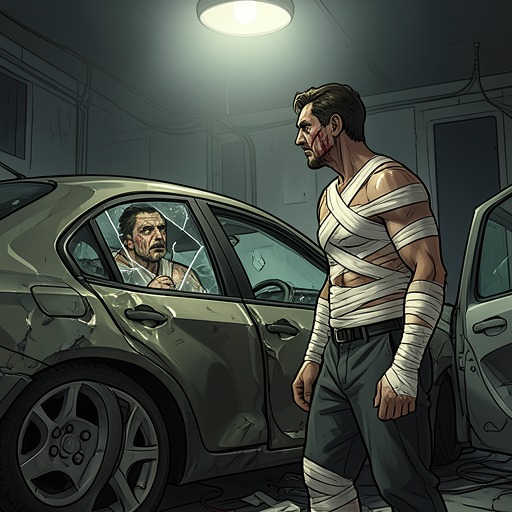
Ballard first appears as a practical, socially situated man, but the collision that injures him destroys the separation between his body and his car. In hospital, his wounds and the remembered interior of the vehicle become part of his relationship with the dead Dr Hamilton, whose death occurred in the same accident. The police and medical institutions can classify the event, but Ballard experiences it as an intimate conjunction of pain, metal, sexuality, and mortality. Even Catherine Ballard’s expressions of grief strike him as stylized performances beside the physical reality of the wreck and the dead man’s final violence.
His recovery does not restore a stable moral or bodily position. Catherine visits him in the ward and recounts the crushed radiator grille and blood spattered across the bonnet with the persistence of a voyeur. Ballard responds by treating the account of the crash as an erotic stimulus, and their intimacy becomes inseparable from the accident’s imagery. When Catherine warns that he can barely walk yet intends to drive, his return to the road is not a simple assertion of independence. It places his damaged body back inside the machinery that injured it and makes driving itself part of the couple’s altered sexual and emotional life.
The Crash and the Transformation of Perception
Ballard’s defining change is a shift from seeing the automobile as transport to seeing it as an environment that organizes sensation, injury, and desire. After the inquest returns a verdict of accidental death and brings no charge of manslaughter or negligent driving, legal judgment closes the matter without resolving Ballard’s experience. He continues to look at the traffic, flyovers, airport runways, and parking lots as systems of possible collision. The hundreds of cars outside Catherine’s airport office form a lake of metal, while the layered flyovers appear to him as immense bodies locked together. Public infrastructure becomes a field of latent violence rather than a neutral background.
This perception also makes Ballard unusually receptive to Robert Vaughan. When he first recognizes Vaughan, he sees a former television scientist whose career had been built around computerized control of international traffic systems and an idealized vision of the automobile’s role in modern life. Vaughan’s own motorcycle crash has left his face and body visibly rearranged: scar tissue, a broken and reset nose, missing canine teeth, and the memory of legs crushed beneath a truck. Ballard reads these injuries not only as evidence of suffering but as a form of authority. Vaughan’s scarred body appears to have crossed a threshold that Ballard has only begun to approach.
From their first meeting, Ballard understands that the relationship has already acquired its governing pattern. Vaughan drives the damaged Lincoln Continental aggressively and erratically, compensating for its missing second gear by alternately crawling along Western Avenue and jerking the vehicle to a halt before a waiting taxi. His conduct is aggressive, distracted, sensitive, clumsy, absorbed, and brutal in turn. Ballard’s hostility gives way to deference and perhaps subservience because Vaughan’s handling of the car seems to disclose a complete behavioral code: risk, control, helplessness, mockery, and sudden violence are all interchangeable states.
Surveillance, Desire, and Responsibility
Vaughan’s photographic album makes Ballard both subject and interpreter. Vaughan has photographed Ballard’s arrival at Ashford Hospital, followed him from the police pound to the airport, and observed him near Helen Remington’s house; he even listened for the ambulance on his car radio before Ballard reached the hospital. Yet the photographs are less a portrait of Ballard than a record of Vaughan’s own preoccupations. Cars, traffic jams, flyovers, cul-de-sacs, and lovers’ lanes surround the injured man in nearly every image. Vaughan is interested in the interaction between an anonymous individual and his vehicle, in the movement of a body across cellulose panels and vinyl seats, rather than in Ballard’s professional identity.
Ballard recognizes the danger of this gaze while submitting to it. Vaughan’s cameras turn the aftermath of accidents into a private archive, and his attention gives Ballard a new status as a body whose wounds can be studied, repeated, and desired. Vaughan’s display of his own half-erect penis, his use of sex as a casual provocation, and his calm descriptions of wounds bind Ballard to him through a mixture of hostility, fascination, and dependency. Ballard understands that Vaughan can keep him from leaving by making his own sexuality appear disposable, as though it could be abandoned forever at any moment. The narrator’s insight does not free him; it becomes part of the mechanism of captivity.
Ballard also participates in the redistribution of responsibility that surrounds the crashes. At the coroner’s inquest, institutional language reduces Dr Hamilton’s death to an accident, while Ballard privately rehearses the collision as a scene joining his body, the dead man’s body, and sexual release. Later, when Vaughan follows him through airport entrances and filling stations, Ballard begins to imagine himself driving a target vehicle toward Vaughan or toward a victim chosen by Vaughan. He even suspects that he is unconsciously steering himself into Vaughan’s path and waiting for another accident to occur under Vaughan’s eyes. The distinction between coercion and complicity therefore becomes progressively harder for Ballard to maintain.
Bodies, Disability, and New Sexual Grammars
Ballard’s erotic imagination increasingly treats damaged bodies and adapted machines as instruments for discovering sexual possibilities that ordinary anatomy supposedly conceals. The transformation is especially visible in his response to the injured young woman whose recovery is documented in Vaughan’s photographs. First shown trapped in a wrecked sports car, she later appears in a chromium wheelchair, at an archery meeting, and learning to drive an invalid car with treadle-operated brakes and gear changes. Ballard interprets this recovery as a rebirth produced by the contours of the crushed vehicle, but his language also exposes how completely he converts her rehabilitation, bodily difference, and public self-direction into material for his own fantasies.
The same contradiction governs Ballard’s encounter with Gabrielle. At the motor show at Earls Court, he watches Vaughan guide her among immaculate cars, concept vehicles, limousines, and invalid controls. Her shackled legs, spinal harness, scarred hands, and injured hips confront the polished geometry of the motor industry; she touches the vehicles and moves through the displays with a hostile, provocative pleasure. When Vaughan urges Ballard to walk with her, Ballard becomes the temporary attendant and observer, discussing auxiliary controls while staring at the way her body is reflected in the technology designed to accommodate it.
Ballard later makes love to Gabrielle in the rear seat of her small car, surrounded by braces, straps, treadles, and levers. He experiences her body through unfamiliar planes and junctions, treating each deformity as a metaphor for a new violence and each mark left by a brace as a possible template for a future sexual organ. The scene reveals both the force and the limitation of his altered perception. He attends closely to the concrete pressures of supports, buckles, skin, and controls, yet repeatedly translates Gabrielle’s lived body into an erotic theory of technological evolution. Her adapted car offers practical mobility, but Ballard reads its equipment as a machinery of desire, extending the novel’s unstable fusion of disability, prosthesis, and sexual fantasy.
Relationship with Vaughan and Final Condition
Ballard’s relationship with Vaughan develops through a reciprocal pattern of domination and recognition. Vaughan treats him as a useful witness and potential participant, while Ballard sees in Vaughan a damaged masculine figure whose scars confer power. The two men are joined by cars, photography, violence, and sexual projection, but their intimacy is never secure. Ballard understands that Vaughan’s tenderness toward him coexists with the intention to kill him. This knowledge does not arrive as a clean revelation at the end; it is present within the relationship’s earliest gestures and becomes increasingly difficult to separate from desire.
Vaughan’s final crash confirms the logic that has governed Ballard’s transformation. Vaughan dies beneath police arc-lights at the foot of a flyover, his broken limbs and blood-marked face parodying the crash photographs that covered his apartment. The actress remains nearby on her chauffeur’s arm, and Vaughan has achieved the death he imagined: dying at the moment of her orgasm. Ballard does not simply mourn him. He sees Vaughan as someone who can never entirely die in a car crash, because the figure will be reborn through twisted radiator grilles and cascading windshield glass. Even after remembering Vaughan’s crude handling of women and automobiles, Ballard recalls his submissive tenderness and the knowledge that Vaughan had planned a final attempt to kill him. Vaughan’s death thus leaves Ballard not with closure but with an inheritance of repetition.
Ballard’s own ending is a condition of continued entanglement rather than recovery. He remains with Catherine, whose car bears a minor mark from another collision, while aircraft, motorways, and possible trajectories continue to populate his perceptions. He sees Catherine’s plane as a glass dragonfly above the motorway and reads the cars below as blueprints for their future passage. The seasons shift unpredictably within his retina, and brief visions return him to overpasses, flies, corpses, and Vaughan’s resurrected body. His survival has become inseparable from recurrence: he carries the crash forward as a bodily and imaginative structure.
Narrative Role and Significance
As narrator, Ballard is both the novel’s chief witness and its most compromised interpreter. His account supplies precise material details—hospital wards, police procedures, damaged transmissions, adapted controls, photographic sequences, airport roads—while repeatedly converting those details into erotic and metaphysical patterns. The reader receives no external correction that can fully stabilize his testimony. His moral judgments are selective, his descriptions of other bodies are intensely projective, and his account of consent, responsibility, and violence remains entangled with the pleasure he finds in describing them.
Ballard’s importance lies in this double position. He is not merely a passive victim drawn into Vaughan’s experiment, because he actively eroticizes his own wounds, participates in the interpretation of crashes, and seeks new sexual meanings in damaged bodies and machines. Yet neither is he simply Vaughan’s disciple: his narration records resistance, exhaustion, fear, and the persistent recognition that desire can be a form of coercion. Through Ballard, the novel makes trauma less a closed past than a technology of perception. The collision changes what he can see, what he wants, and what he is able to call an accident; the act of narrating becomes the continuing scene in which those changes are exposed without being resolved.