Seagrave
CrashSeagrave is a former racing driver employed as a studio stuntman, but his decisive function in the narrative is more disturbing than that occupational description suggests. He becomes the human instrument through which Robert Vaughan turns automobile accidents into rehearsed spectacle, gender performance, and fatal prophecy. First presented as a performer strapped into a doorless car, Seagrave eventually dies in a real collision while still dressed as Elizabeth Taylor, making his body the accidental substitute for the death Vaughan had reserved for himself and the actress.
Identity and Introduction
Seagrave appears at a Northolt racetrack during a public reenactment of a multiple pile-up in which seven people had died on the North Circular Road. He is introduced as a huge, oil-smeared man in a silver-studded jacket, with dyed-blond hair tied behind his head by a scarlet rag and the pallid, hungry face of an unemployed circus worker. The description places him between professional driving and theatrical display: he is a former racing driver, yet his expertise is being used to reproduce catastrophe before an audience rather than to win a race.
Vaughan treats Seagrave as the star of an experimental production. He leans against the windshield pillar, gives aggressive instructions, adjusts the driver's straps and the rake of the steering column, and choreographs the sequence of impacts as though directing a film. Seagrave, by contrast, sits back smoking a loosely rolled hash cigarette that Vaughan holds for him while the preparations continue. The imbalance is revealing. Vaughan controls the image, the timing, and the meaning of the crash; Seagrave supplies the body that must endure it.
The Reenactment and Its Failure
The planned accident involves five cars. A skidding truck is to cannonade Seagrave's target vehicle into the path of four oncoming cars, converting a recorded mass death into a controlled public performance. Vaughan adds a private dramatic detail by announcing that Seagrave has asked his closest friend to drive the skidding truck. The supposed intimacy of that choice gives the spectacle a ritual dimension: friendship is not protection from violence but a way of making the collision more personal.
The performance fails as an orderly simulation. The truck strikes Seagrave's car and locks onto its raw fenders, carrying it fifty yards before ramming it into one of the oncoming saloon cars. The impact is hard and unshielded, and the audience rises as one when the collision exceeds the safe distance implied by the reenactment. Seagrave survives, but he is concussed and must be helped across the parking lot. Vaughan remains unmoved, more interested in the event's force than in the distinction between a staged accident and an actual injury.
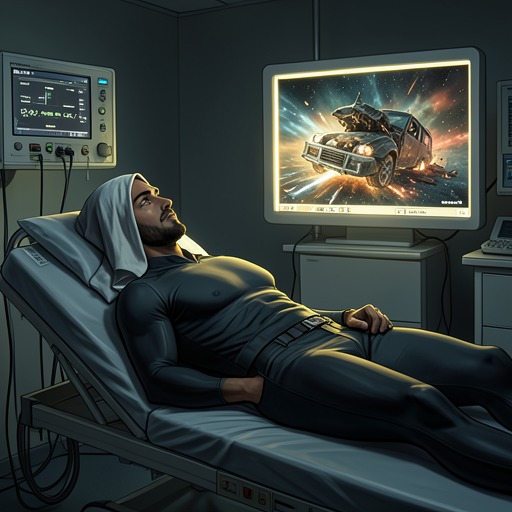
Vaughan then persuades Helen Remington to accompany Seagrave to Northolt General Hospital and drives rapidly through the night. The damaged Lincoln has lost its second gear in an earlier road race with Seagrave, a mechanical defect that makes Vaughan's driving alternately sluggish, helpless, and abruptly aggressive. Seagrave slumps beside Helen in the back seat while Vaughan uses the journey to test the narrator, overtaking a police car on the wrong side of the Northolt overpass and treating speed as another form of command. Seagrave's injury therefore extends beyond the racetrack: it becomes the occasion for Vaughan to bind accident, pursuit, and interpersonal domination together.
Costume, Gender Performance, and Vaughan's Camera
Seagrave later participates in a film-studio reconstruction whose imagery makes his role more explicitly theatrical. Sitting on the bonnet of a Citroen, he wears a woman's fawn suede driving coat over his jeans, while a stuffed brassiere creates the contours of large breasts beneath his red polo-necked jumper. His face has been made up to resemble Elizabeth Taylor's, and his blond hair is arranged beneath a wig. The result is not a convincing impersonation but a grotesque and injured-looking parody: a masculine stunt body forced into the visual signs of a glamorous actress.
The costume exposes gender as a repeated set of surfaces—hair, makeup, clothing, posture, and the arrangement of the body—while also showing how violently such surfaces can be administered by a director. Seagrave watches Vaughan with resentment, as though Vaughan has compelled him to perform this parody day after day. His apparent resistance does not remove him from the spectacle; it makes the coercion visible. The body is both actor and prop, and the crash is the mechanism through which the performance is supposed to become convincing.
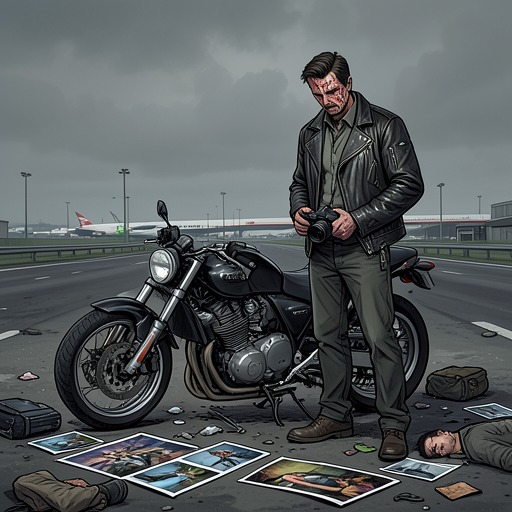
Vaughan's camera intensifies this transformation. He photographs accidents, wounds, vehicles, and people from positions of surveillance, and his presence near the studio set turns Seagrave into an object arranged for visual consumption. The narrator recognizes Vaughan as the scarred former television scientist whose career ended after a severe motorcycle crash. Vaughan's own damaged face and body give him an authority founded on collision, but he transfers that authority to Seagrave by directing the stuntman's movements and clothing. Seagrave is thus made to carry, in public, the fantasies that Vaughan has already organized through photographs and crash imagery.
Fatal Collision at Harlington
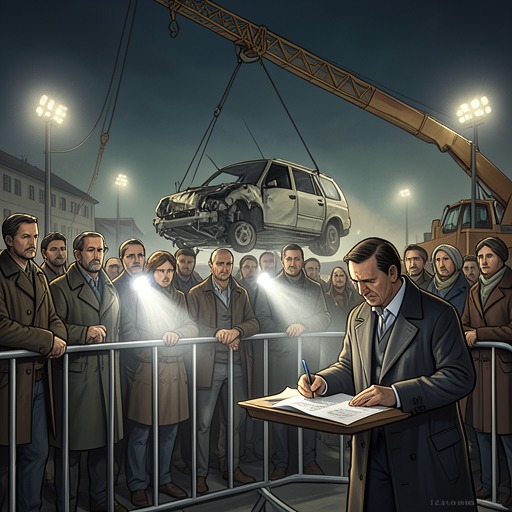
The staged violence is followed by Seagrave's genuine death at Harlington. Three cars collide at a high-speed intersection: a customized fibreglass sports car strikes a silver Mercedes coupe at right angles, and a chauffeur-driven government saloon then hits the sports car from behind. The sports car, whose bulbous and fin-shaped styling evokes the 1950s, becomes a crushed display of obsolete automotive design. Seagrave lies dead in its cockpit beneath the buckled instrument panel.
He is still wearing the leopard-skin coat associated with the actress, and his platinum hair remains secured by a nylon hair-net; a black wig lies on the seat beside him. Shattered safety glass covers his face and body, making him appear to be crystallizing or escaping from the damaged world of the set. The details matter because the costume survives the performance. What was intended as an artificial image has entered the material scene of death, so that Seagrave's corpse cannot be separated from the role he had been made to play.
Robert Vaughan reacts not simply with grief or shock but with a crisis of authorship. He moves toward the injured woman in the Mercedes, then returns to Seagrave's crushed car and studies the blood, the instrument panel, and the trajectories of the impacts. The narrator later understands that Vaughan is most disturbed because Seagrave has pre-empted the death Vaughan had reserved for himself. By dying in Elizabeth Taylor's wig and costume, Seagrave has already enacted the collision that Vaughan imagined as his own final union with the actress. Vaughan's fantasy has not been fulfilled; it has been stolen by an expendable performer.
Narrative Significance
Seagrave's arc moves from controlled spectacle to uncontrolled reality. At Northolt, he is a professional body placed inside a carefully announced reenactment, yet the truck's impact already breaks the boundary between simulation and danger. At the film set, his gendered disguise makes him a substitute image for Elizabeth Taylor. At Harlington, the substitute becomes a corpse, and the performance acquires the irreversible authority of an actual death.
His death also helps explain Vaughan's later relation to automobile violence. Vaughan repeatedly treats crashes as erotic compositions of wounds, bodies, metal, and glass, while the narrator connects those scenes to sexual postures and scars. After Vaughan's own encounters with wrecked vehicles, the narrator imagines the dead and injured as being reborn through the traffic system's damaged grilles and cascading windshield glass. Seagrave's body is central to that logic: he is not remembered as an individual biography so much as a figure whose costume, injuries, and mechanical entrapment have become part of Vaughan's private mythology.
The final irony is that Seagrave's death is both accidental and scripted. He does not receive the ceremonial death Vaughan has designed, yet the collision seems to complete Vaughan's design more effectively than any rehearsal could. The stuntman's performance becomes a fatal ritual, and his corpse turns the automobile accident into an altar on which Vaughan's imagined future has already been enacted.