Gabrielle
CrashIdentity and Accident
Gabrielle is introduced as a young social worker associated with Vera Seagrave and the child-welfare department in Stanwell. She is present in the Seagraves’ living room, rolling cigarettes while her own body displays the durable consequences of injury: faint circular scars on her kneecaps, surgical supports clamping each instep, and a rigid posture suggesting a back brace. A chromium cane rests beside her. Her suspicious glance toward James Ballard indicates that she distinguishes between people who have actually been injured in automobile crashes and those who merely observe them, a distinction that becomes important in a novel where bodily damage is repeatedly converted into spectacle.
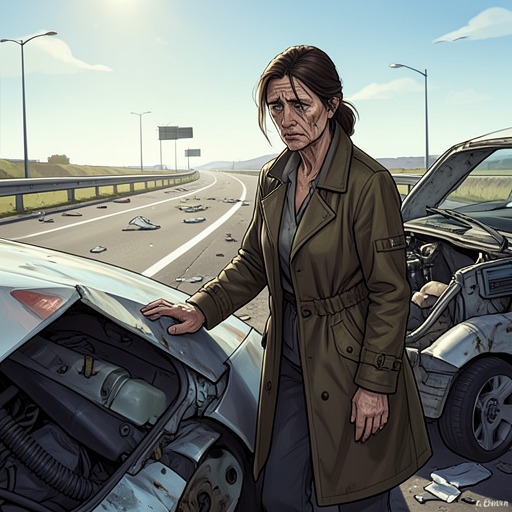
Her disability originates in a collision near the airport underpass, where her small sports car struck an airline bus. Vaughan’s dossier records the accident from the first emergency scenes through hospitalization and convalescence. In the earliest photographs Gabrielle appears as an ordinary young woman trapped in a crushed vehicle, with the full extent of her injuries not yet visible. Bruises then spread across her face, arms, and shoulders, marking the places where the steering column and instrument panel struck her. The photographs turn medical emergence into a sequence: the accident first conceals the damage, then inscribes it visibly upon her body.
Recovery and Technological Adaptation
The final photographs in Vaughan’s album show Gabrielle in a chromium wheelchair, propelling herself across the grounds of a convalescent institution and attending an archery meeting before taking her first lessons in an invalid car. Her recovery is consequently represented not as a return to an earlier, uninjured condition but as an acquisition of new techniques. She studies treadle-operated brakes and altered gear controls, learning to make a vehicle answer to a body that ordinary automotive design does not accommodate.
The adapted car becomes a practical extension of her changed mobility, but the narrative also shows how quickly such equipment is absorbed into other people’s fantasies. James Ballard sees the controls, braces, and altered seating as a new geometry joining body and machine. During a later sexual encounter, the leg brace and spinal harness remain part of the scene rather than disappearing beneath a conventional image of intimacy. The straps leave red depressions and buckle grooves in Gabrielle’s skin, while the vehicle’s chromium treadles, clutch levers, steering-column fittings, and specially moulded seat define the space around her. The apparatus records both bodily pressure and social adaptation: it is evidence of pain and dependence, but also of engineering designed to restore movement and agency.
Vaughan’s Photographic Construction
Vaughan’s dossier does more than document Gabrielle’s accident. It follows her from the wrecked sports car through medical treatment and rehabilitation, turning recovery into a prolonged act of surveillance. He photographs the crushed vehicle, the bloodstained seats, the emergency workers removing her, and her later movement in the wheelchair and invalid car. His attention treats injury as a developing visual narrative, while his own presence beside the wreck—posed with his penis visible through the tight crotch of his jeans—makes clear that the photographer inserts his sexuality into the record.
Vaughan interprets Gabrielle’s changed body as if the crash had released a hidden sexual nature. The narrator adopts and intensifies this interpretation, imagining her deformed thighs, braces, and controls as signs of “new genital organs” and of sexual possibilities created by future crashes. Such language reveals the limits of the novel’s gaze: Gabrielle’s bodily experience is rarely allowed to stand outside the fantasies imposed upon it. At the same time, her conduct unsettles the idea that she is merely an object. She notices Vaughan’s interest, looks knowingly toward his camera, and uses her altered mobility in ways that expose the discomfort of spectators and salesmen.
Public Presence and Sexual Agency
At the motor show at Earls Court, Vaughan guides Gabrielle through a crowd of cars, displaying his scarred face as though his own injuries authorize his association with her crippled legs. Gabrielle, however, is not presented as an embarrassed exhibit. She swings herself between the stands, places her scarred hands on immaculate vehicle bodies, and rolls her injured hips against them. On the Mercedes stand she provokes a young salesman into helping her into a white sports car, then takes pleasure in his embarrassment. Her movements force the polished automobile industry to confront the body that its idealized machines exclude.
Vaughan continues to escort her from one vehicle to another, including styling exercises, concept cars, limousines, and a small Japanese sedan. The narrator watches her braces, deformed thighs, knees, and swinging shoulder as though they were challenges addressed to the geometrical perfection of the displays. Vaughan eventually tells Ballard to walk with her and hold her arm, then withdraws under the pretext of looking for Seagrave. This apparent act of facilitation is also a transfer of control: Vaughan arranges the encounter, but Gabrielle and Ballard are left to create its immediate meaning.
Ballard becomes Gabrielle’s first lover. Their sexual encounter takes place in the rear seat of her small car among the auxiliary controls and restraints. He experiences her body through the distortions of his own imagination, treating each deformity as a metaphor for unfamiliar violence and each brace or strap as an alternative erotic structure. Gabrielle’s actual responses are less easily absorbed into that fantasy. Her eyes follow her hand as it touches Ballard’s face, and she lifts a braced foot onto his knee; yet the encounter finally suggests that the conventional junctions of breast, penis, anus, vulva, nipple, and clitoris do not provide the expected excitement. The scene displaces sexuality from normative anatomical points, but it also shows how strongly Ballard’s interpretive language competes with Gabrielle’s own opaque experience.
Relationship with Helen Remington and Aftermath
Gabrielle’s later relationship with Helen Remington marks a decisive movement away from Vaughan’s authorship of her story. Helen is present in the early aftermath of Seagrave’s accident and helps guide Gabrielle through the grass outside the Seagrave home. Later, when Gabrielle drives, Helen accompanies her as a lover and caretaker. Their relationship joins medical knowledge, bodily vulnerability, and intimacy without reproducing Vaughan’s exact position as photographer and director of crashes.
After Vaughan’s death, Helen and Gabrielle visit the vehicle pound together. Gabrielle sits at the controls of the car while Helen steps out to look at what remains of Vaughan. Their arrival is interpreted as a final glimpse of the wreckage associated with his obsessions, but the pair also appear to have appropriated the roads, car parks, and damaged vehicles for their own shared life. Helen’s arm rests on Gabrielle’s shoulder as Gabrielle reverses away, a small gesture that contrasts with Vaughan’s controlling guidance and with his habit of converting women into images of injury.
Gabrielle’s ending is therefore deliberately unresolved but not passive. The narrative does not provide a conventional cure, nor does it return her to the uninjured identity visible in the first photographs. Instead, she remains a disabled driver whose body and vehicle have been remade together. Her continuing presence with Helen suggests that the accident has produced a durable, if deeply troubling, alternative social and sexual world. Yet that possibility is inseparable from the narrator’s and Vaughan’s objectifying fantasies, making Gabrielle both a figure of agency and the clearest test of the novel’s tendency to turn disability into narrative symbolism.
Narrative Significance
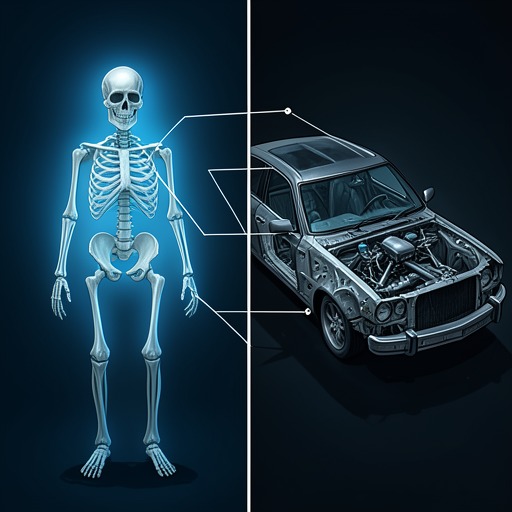
Gabrielle embodies the novel’s collision between the medical, social, and erotic meanings of injury. Hospitals, physiotherapy, braces, wheelchairs, adapted controls, motor shows, and public spectators all shape what her body can do and how it is seen. The car is not merely a symbol placed beside her; its controls determine posture, movement, dependence, and new forms of competence. Her altered environment demonstrates that disability is produced not only by bodily damage but also by the relation between bodies and systems designed around an uninjured norm.
At the same time, the novel repeatedly uses Gabrielle as a “narrative prosthesis,” making her injuries carry meanings about sexuality, technological modernity, and the transformation of the human body. Vaughan sees the crash as a source of images, Ballard sees it as an invitation to invent new erotic anatomies, and the automobile industry presents a polished technological order that Gabrielle’s body disrupts. Her significance lies in the tension between these appropriations and the concrete details of her life: she rolls her own wheelchair, learns unfamiliar controls, enters cars in public, confronts embarrassed onlookers, drives, chooses intimacy, and leaves Vaughan’s orbit with Helen. The story cannot fully free her from the fantasies imposed upon her, but her movement through those fantasies gives her a force that the photographs alone cannot contain.