Catherine Ballard
CrashCatherine Ballard is James Ballard's wife and one of the central figures through whom the novel connects marriage, aviation, sexuality, and the erotic imagination of the car-crash. At first she appears as an independent woman whose professional ambitions and sexual autonomy have placed increasing distance between herself and James. Yet her relationship with him later develops a new tenderness, even as both remain marked by the violence and fantasies organized around Robert Vaughan.
Identity and Independence
Catherine's life is defined by movement beyond the domestic role expected of a wife. She works in the overseas tours section of Pan American, takes flying lessons, and begins a small air-tourist charter firm with one of her boyfriends. These activities are pursued with deliberate concentration, as though she were claiming an expanding territory for herself and insisting on self-reliance. Her light aircraft repeatedly passes over the Ballards' apartment at weekends, its persistent drone becoming an audible emblem of the distance between her life and James's work at the television commercial studios in Shepperton.
This independence is also entangled with sexual separation. Before James's accident, the marriage is described as almost entirely abstracted from direct intimacy, maintained through imaginary games and perversities rather than sustained physical closeness. Catherine's morning routine is rendered in mechanical terms, and James privately wonders where and with whom she makes love during her lunch hour, including possible affairs with pilots and airline executives. The suspicion is not resolved into a conventional accusation; instead, it becomes part of the marriage's atmosphere of imagined infidelity, technological routine, and emotional detachment.
Marriage After the Crash
Catherine's attitude changes after James's accident. When she visits him in hospital, her concern for his scalp wound surprises him, because her previous reserve had made such warmth unfamiliar. She promises to return with make-up, joking that the only cosmetic attention available to patients might be at Ashford Mortuary. The remark retains the book's macabre humor, but her gesture establishes a newly intimate form of care.
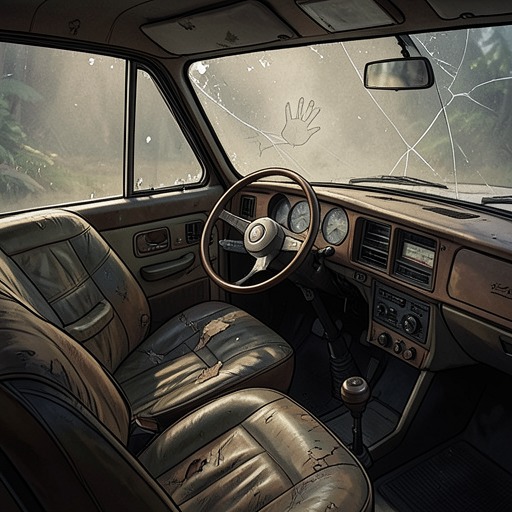
Her interest in the accident is not conventionally consoling. While sexually stimulating James, Catherine talks insistently about the police investigation and describes the damaged car with the persistence of a voyeur, concentrating on the crushed radiator grille and blood scattered across the bonnet. She regrets missing the funeral of the man killed in the crash, saying that the dead should be left lying around for months because she had not been ready. Her response shows that death and wreckage have entered the marriage's emotional vocabulary rather than remaining external facts.
Catherine subsequently rededicates herself to the marriage. James observes that the earlier repertory of distance and abstraction has been replaced by a growing set of tendernesses and affections. He can reach orgasm simply by thinking about the car in which he has sex with Helen Remington, so even the renewed marital intimacy remains mediated by crash imagery and by the sexual possibilities opened through technological violence. Catherine's return is therefore neither a clean restoration nor a rejection of the past: the marriage becomes more affectionate precisely while its erotic life is increasingly structured by cars, accidents, and other bodies.
Vaughan's Intrusion
Catherine becomes directly involved with Robert Vaughan when he takes James's place in the sexual and technological drama surrounding the Ballards. At a car-wash, while the vehicle is enclosed by water, soap, glass, and mechanical rollers, Vaughan holds Catherine's right breast. She does not simply recoil; she looks down at it with fascination, as if encountering its geometry for the first time. In the deserted washing bay, Vaughan arranges her body through a series of deliberate positions, treating the encounter less as ordinary intercourse than as a ritual of motion, collision, and mechanical design.
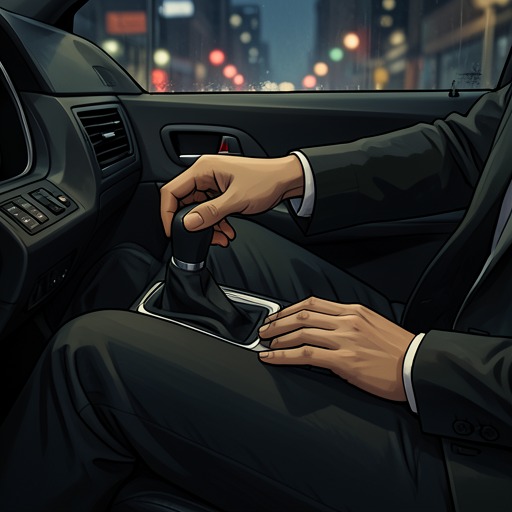
For James, this scene intensifies rather than resolves his relation to Catherine. He watches Vaughan's hands and body as though they were operating a complex vehicle, and the car's interior becomes a technological stage on which bodies are repositioned like controls. Vaughan's scars, Catherine's body, and the automobile's instrument panel form a single visual and erotic system. The scene also converts James's jealousy into participation: his witnessing does not place him outside the encounter but draws him further into Vaughan's structure of desire.
Vaughan's obsession with the film actress Elizabeth Taylor gives Catherine another place within his compulsive pattern. The women he brings to his cars increasingly resemble the actress, from a dark-haired schoolgirl resembling her youth to others representing later stages of her life. Catherine is not identified as a simple substitute, but Vaughan's treatment of women repeatedly turns their bodies into representations within his anticipated crash. His desire seeks not ordinary possession but a tableau in which sexuality, celebrity, injury, and automobile technology become indistinguishable.
The Aviation and Automobile Counterpoint
Catherine's aviation provides a counter-image to Vaughan's fixation on the terminal automobile disaster. Her aircraft appears above the motorway as a glass dragonfly carried by sunlight, while the cars below trace possible trajectories across the landscape. The image does not free her from the novel's technological imaginary: flight and road traffic become related systems of transit, with the motorway seeming to blueprint the aircraft's passage through the sky.
When James sees Catherine's aircraft during her last flying lesson, the sight summons Vaughan's continuing presence. James believes that Vaughan cannot truly die in a car-crash, because he will be reborn through twisted radiator grilles and cascading windshield glass. Catherine's chosen technology of flight thus passes through James's memory of Vaughan and becomes part of the same network of trajectories, bodies, and imagined collisions. Her independence remains real, but it is never outside the novel's violent symbolic field.
Change, Survival, and Ending
Catherine's final appearance is marked by a minor collision of her own. Her car is parked below the bedroom window, its left side carrying fresh damage. James immediately asks whether she is all right, and she leans against him while removing her flying jacket, as though the collision were being memorialized through the pressure of their bodies. The moment joins physical survival to marital contact: the damaged automobile records an event, while the couple's embrace records its emotional afterlife.
By this point, James recognizes that both he and Catherine have separately made love to Vaughan. The statement does not mean that their experiences are identical. Catherine has encountered Vaughan bodily, while James has been bound to him through watching, sexual identification, submission, hostility, and the expectation of violence. Nevertheless, Vaughan has entered the marriage as a shared presence, and his death does not end that presence. Catherine's survival, professional independence, renewed affection, and damaged car leave the marriage suspended between ordinary life and the continuing aftershock of the crash.
Catherine's narrative role is therefore not merely that of the endangered wife or the object of male rivalry. She is a worker, pilot, entrepreneur, sexual agent, witness, and survivor whose mobility challenges James's resigned domestic position. At the same time, the narrative often presents her through James's and Vaughan's eroticized gaze, especially when her body is placed beside instruments, controls, and wrecked vehicles. Her significance lies in that tension: she acts within a technological world that men attempt to convert into an erotic and destructive mythology, yet she continues to move through it on her own terms, flying, driving, returning to the marriage, and surviving the collisions that seek to define her.