Helen Remington
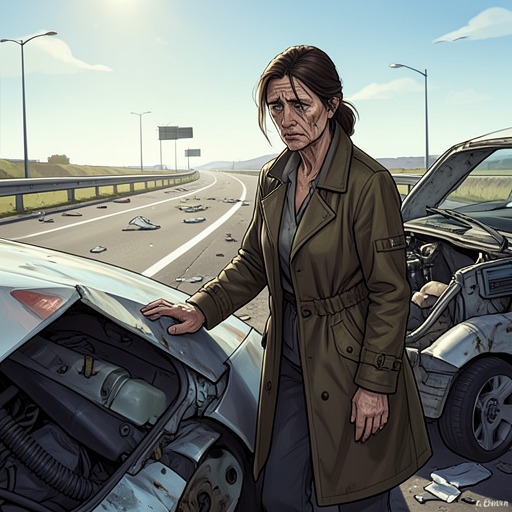
CrashHelen Remington is a doctor whose husband, Charles Remington, is killed when the narrator’s car crosses the reservation beneath the Western Avenue flyover and strikes their vehicle head-on. She survives with a bruised cheekbone and a long scar running from the corner of her right eye to the apex of her mouth, while the narrator escapes with comparatively minor injuries. Her decisive importance lies in the way she carries the crash forward: first as its bereaved witness, then as a medical professional drawn toward the Road Research Laboratory, and finally as the narrator’s sexual partner in a relationship that repeatedly reconstitutes her husband’s death inside the automobile.
Identity and First Appearance
Helen first appears as the young woman doctor seated beside Charles Remington’s body after the collision. At the hospital she moves with a stick, which the narrator interprets as partly functional and partly a postural disguise for the injury on her face. Her white plaster runs from one shoulder to the opposite armpit, emphasizing both the seriousness of her bodily damage and the narrator’s tendency to read injured bodies as charged surfaces. She confronts him with calm hatred rather than theatrical grief, and when he asks whether she is Dr Remington, she changes her grip on the stick as though prepared to strike him.
Her scar becomes the central visible record of the accident. The narrator studies it as a seam across her face and invents an imagined biography from the history written into her skin, linking her previous life as a medical student, her marriage, and her widowhood to the wound. Helen therefore enters the narrative not merely as a survivor but as a body that the narrator tries to interpret, eroticize, and possess through description. Her medical identity does not protect her from this gaze; instead, it intensifies the connection between clinical observation and sexual fantasy.
Grief and the Crash
Helen’s response to Charles’s death is marked by resistance to the conventional rituals of mourning. At the hospital, Catherine discusses the damaged car and the police inquiries with voyeuristic persistence, while the narrator reproaches her for not attending the funeral. Helen’s reported response is that the dead are buried too quickly and should be left lying around for months because she was not ready. The remark gives her grief a material and temporal insistence: Charles cannot yet be reduced to a completed ceremony or a socially acceptable gesture of regret.
The narrator’s own response is more disturbing. As he lies in the hospital, he imagines having sex with Helen among the X-ray equipment, as if the union of their bodies could re-conceive Charles in her womb and conjure him back from the conjunction of machinery, metal, and injury. Helen’s widowhood thus becomes entangled with the narrator’s desire to turn the fatal collision into a reproductive and erotic event. The official inquest later returns a verdict of accidental death and brings no charge of manslaughter or negligent driving against the narrator, but the legal conclusion does not settle the emotional or bodily meaning of the crash for either of them.
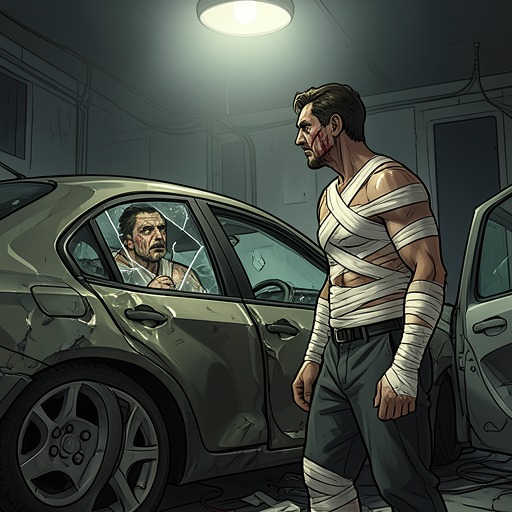
Helen reappears at the police pound, walking among wrecked cars like an intelligent gallery visitor. She does not recognize the narrator’s vehicle as the car that killed her husband until she sees him through its empty windshield, seated behind the deformed steering wheel among Charles’s dried bloodstains. Her attention moves over the crushed radiator grille and the damaged interior before returning to the narrator himself. She then withdraws toward another wreck, leaving their expected confrontation unresolved while making the vehicles themselves a gallery of evidence and possible memory.
Work, Mobility, and the Road Research Laboratory
After the inquest Helen begins planning a second life. She tells the narrator that the Road Research Laboratory needs a medical officer and that the salary is larger, adding that there is a certain moral virtue in being materialistic. The position would place her close to the institutional study of crashes, precisely the technological environment that reproduces and analyzes the violence through which she became widowed. Her decision is not presented as simple professional duty. Helen says that she can now give something she had not previously been aware of and describes the choice as commitment rather than obligation.
Her movement through airport roads, traffic jams, and institutional workplaces mirrors the novel’s larger organization of experience by transport systems. She hires a taxi to take her anywhere, only to remain almost motionless in a traffic jam, and she travels along Western Avenue while the flyovers recede behind her. The roads offer mobility but also repetition, delay, enclosure, and involuntary return. Helen’s new medical work consequently places her inside the same machine landscape that the narrator experiences as a field of wounds and possible deaths.
Relationship with the Narrator
Helen and the narrator begin a sexual relationship that can function only inside his automobile. In the bedroom of her rented house, he cannot achieve an erection, and Helen becomes argumentative and remote, speaking about the duller aspects of her work. In the car, by contrast, the traffic lanes form an unseen audience and the two can arouse each other. The automobile is therefore not a neutral setting for their affair: it is the technological compartment in which grief, injury, desire, and remembered collision become mutually dependent.
Their encounters repeatedly re-enact Charles’s death. Helen grows more tender toward the narrator and attempts to reassure him about his body, yet each sexual act also re-seeds the image of Charles’s body in her vagina through the changing perspectives of mouths, thighs, nipples, tongues, metal, and vinyl. The narrator understands their intimacy as a recapitulation rather than a recovery from the crash. Helen’s sexuality does not erase widowhood; it gives widowhood a new physical form, one that joins her husband’s death to the narrator’s survival and to the car’s enclosed architecture.
The relationship also alters the narrator’s marriage to Catherine. Catherine shows little interest in discovering the affair and has redirected herself toward tenderness within the marriage. The narrator can reach orgasm with Catherine simply by thinking of the car in which he and Helen have sex. Helen thus remains present even when absent, functioning as a memory embedded in the narrator’s sexual response and as a bridge between the original collision and the marriage’s altered emotional life.
Connections with Vaughan and the Ending
Helen is also drawn into Robert Vaughan’s network of crash fantasies. Vaughan treats women and cars through the same obsessive logic, shifting between irony, politeness, boredom, affection, and appraisal of possible wound areas. He asks whether Helen might treat Seagrave’s wife and child, or perhaps himself, yet he can just as quickly dismiss her medical qualifications. His relation to her exposes the conflict between her professional authority and the violent erotic system organized around damaged bodies.
The narrator’s encounter with Vaughan intensifies the sexual and destructive circuitry surrounding Helen. Vaughan’s own scarred body, his photographic study of crashes, and his fascination with a final collision involving Elizabeth Taylor make Helen’s affair with the narrator part of a larger economy in which injury is at once evidence, spectacle, and sexual stimulus. The narrator later imagines Vaughan as capable of being reborn through twisted radiator grilles and cascading windshield glass, while also remembering Vaughan’s tenderness and his threat to kill him. Helen’s history remains one of the principal wounds through which that contradiction is understood.
Helen’s later whereabouts are not given a separate resolution. She remains associated with the laboratory, with the airport’s traffic corridors, and with the narrator’s recurring mental returns to the crash. Even after Vaughan’s death, the narrator’s visions connect technological movement, bodies, and resurrection: Catherine’s aircraft appears above the motorway while the cars below trace its possible trajectories, and Vaughan’s corpse-like image returns as someone who cannot simply die in a car crash. Helen’s significance lies in this unresolved persistence. She is neither freed from the accident nor reduced to it; she becomes the figure through whom medicine, widowhood, sexual desire, and the modern traffic landscape are repeatedly forced into the same enclosed space.