Renata
CrashRenata is the narrator’s secretary and former lover, and her limited appearances provide a crucial measure of the world that the narrator is abandoning. She belongs to the ordinary professional and sexual life surrounding the automobile, yet repeatedly encounters a consciousness that has begun to treat injury, responsibility, and desire as parts of the same technological spectacle.
Identity and Introduction
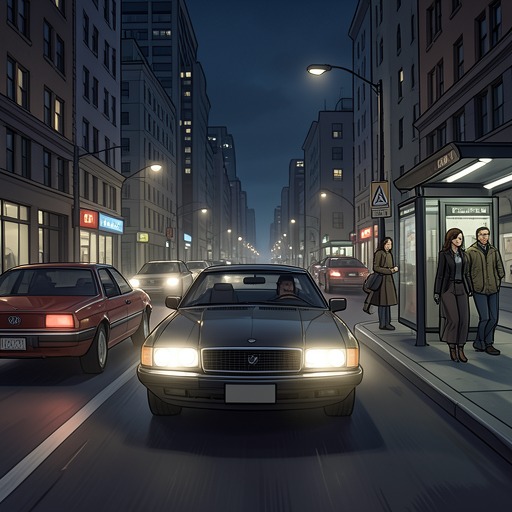
Renata is introduced through her unsettling affair with the narrator. On the evening of his collision with the Hamiltons, he leaves her while she is trying to free herself from their relationship. The safety belt he has deliberately fastened is connected to this departure: he wants to spare her the embarrassment of embracing him, but the gesture also places their intimate separation directly beside the catastrophe that follows. His bruised chest, crushed knees, and severed scalp nerve therefore carry the physical imprint of a private relationship already coming apart.
The crash gives Renata a position from which to judge the narrator’s survival. When she visits him in hospital, she reports that the police had asked her to identify his wrecked car because the sergeant did not believe he had escaped alive. Her response to the death of Dr Hamilton’s husband is brief and conventional, but the narrator treats that conventional sympathy as a false performance. The contrast is revealing: Renata speaks within the recognizable language of condolence, while the narrator insists on the material reality of blood, impact, and bodily collision and dismisses moral gestures as theatrical.
Relationship with the Narrator
After the accident, Renata remains physically and emotionally available to him, even though he has described their affair as something from which she was attempting to escape. When she joins him in the rental-company vehicle, she asks whether he is all right and where they are going. He answers her concern by unbuttoning her raincoat, placing his hand on her thigh, and kissing her throat while she holds his shoulder with reassuring, almost governess-like affection. Their intimacy is neither a simple reconciliation nor a stable continuation of the affair. It is immediately absorbed into the narrator’s obsession with the crash.
He tells Renata that he saw her just before the accident and claims that they made love, treating her as though she were already implicated in the collision. Renata recognizes this displacement and asks whether he is still involving her in his crash. Her question identifies the pattern governing their relationship: the narrator converts private memory into accident imagery, while Renata attempts to distinguish the emotional event between them from the violent scene through which he now understands everything.
Renata also functions as a counterpoint to Robert Vaughan. She is present when the narrator’s attention has shifted decisively toward Vaughan, whose scarred body, damaged cars, cameras, and deliberate provocations exert an almost magnetic force. Against Vaughan’s aggressive fusion of sexuality, driving, and self-destruction, Renata represents a relationship still capable of ordinary concern, embarrassment, irritation, and social judgment. The narrator’s decreasing awareness of her marks the progress of his alienation: even when she sits beside him, his attention is fixed on the steering wheel, the instrument panel, and the possibilities contained in the vehicle.
Responses to the Crash Culture
Renata’s disapproval becomes explicit when she gives the narrator two tickets to the Northolt stock-car races. She knows about his affair with Helen Remington, the widow of the man he killed, and the tickets appear to be an ironic gesture rather than an invitation to shared pleasure. At the stadium, the stripped-down saloon cars circle the cinder track while stunt drivers perform forms of “hell-driving”; the half-empty stand, bored crowd, booming announcer, and half-hearted cheers from the drivers’ wives make the spectacle seem both normalized and spiritually exhausted. Renata’s gesture places her outside the narrator’s emerging cult of the crash, even as she helps provide access to one of its public rituals.
Her reaction to the damaged vehicle at Shepperton Studios is still more direct. Seeing the black Citroen Pallas saloon car, its long bonnet crushed by a head-on collision, she calls it “That terrible machine” and asks whether the narrator ordered it. When he explains that it is needed for the Elizabeth Taylor film’s crash sequence, she immediately asks whether the actress will drive it. Her concern is practical and human: the machine is dangerous because it can injure a person. The narrator, by contrast, treats the wreck as a production requirement and as part of a developing imaginative system in which celebrity, technology, and impact are inseparable.
Marginalization and Narrative Function
Renata gradually recedes as the narrator’s relationship with Vaughan intensifies. The narrator is barely aware of her when she joins him in the car after his meeting with Catherine, and his inner attention has become so dominated by the vehicle that her presence registers only as an interruption to his concentration on controls and surfaces. Her earlier attempt to separate herself from him thus acquires a larger significance: she withdraws from a man whose desires are increasingly organized by repetition, danger, and the erotic charge of damaged bodies.
Her marginality does not make her insignificant. Renata supplies the narrative with a recurring test of normality. She notices the wreck as terrible, the risk to Elizabeth Taylor as a genuine danger, and the narrator’s behavior as something that can still be questioned. Her language remains tied to social consequence, whereas the narrator’s vocabulary turns increasingly toward wounds, machines, and reenactment. Through her, the novel shows what is lost when human relationships are made subordinate to the automobile’s symbolic and erotic power.
Contrast with Vaughan and the Ending Pattern
Renata’s distance from Vaughan’s world is underscored by the narrator’s later reflections on Vaughan’s scarred body and his anticipated attempt to kill the narrator. Vaughan’s scars, sexual provocations, and damaged vehicles are treated as a single continuum, while Renata’s earlier intimacy with the narrator is remembered as something that can be rewritten into the crash. This contrast does not make Renata wholly detached from the novel’s violence: she is present at its edges, witnesses its consequences, and becomes one of the people against whom the narrator’s transformation can be measured.
By the later stages of the story, Renata’s practical objections have been displaced by the pursuit of Vaughan and the final logic of engineered collision. Her disappearance from the narrator’s central field of attention is therefore itself a consequence. She belongs to the social world that recognizes accidents as accidents, deaths as deaths, and lovers as people who may leave one another. The narrator moves toward a world in which those distinctions collapse, and Renata’s importance lies in making that collapse visible.