Robert Vaughan
CrashRobert Vaughan is the novel’s central figure of engineered catastrophe, a former computer specialist who converts the automobile crash into a private science, erotic ritual, and projected form of death. Scarred by an earlier motorcycle collision, he presents himself as both expert and outlaw, using cameras, questionnaires, medical research, television authority, and stolen or borrowed cars to make accidents into spectacles that he can study, rehearse, and finally inhabit. His decisive significance lies in the way he makes technological knowledge inseparable from bodily violence: through Vaughan, James Ballard learns to see collision not as an interruption of modern life but as one of its most intense forms of desire and self-recognition.
Identity and Introduction
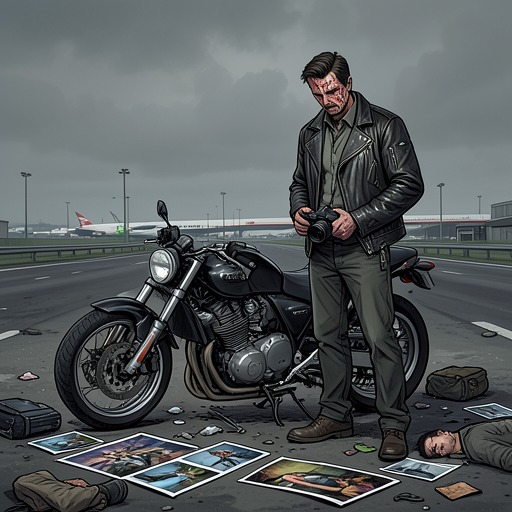
Vaughan first appears as the tall man with a camera who watches James Ballard near an accident and later photographs him from the roof of a multi-storey car park. He carries photographic equipment as if it were an arsenal: cameras, a tripod, flashbulbs, and a cine-camera fixed to the dashboard of his car. Ballard eventually recognizes him as Dr Robert Vaughan, once a prominent television scientist who had combined personal glamour, heavy black hair, a scarred face, an American combat jacket, and an aggressive lecture style. Vaughan’s former public subject was the computerized control of international traffic systems, and his early television image made him a “scientist as hoodlum,” a figure whose technical authority was inseparable from theatrical menace.
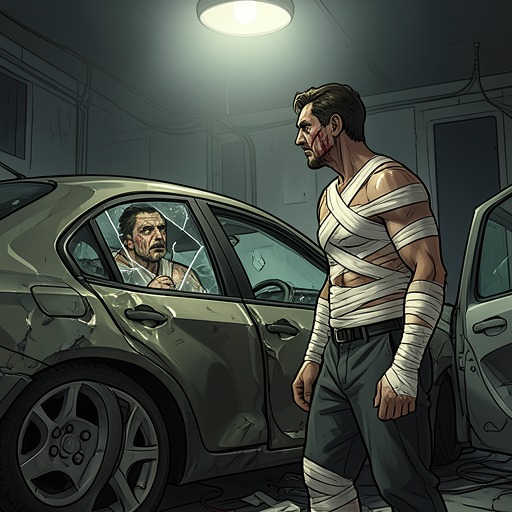
His career ended abruptly after a serious motorcycle crash. The impact left his face visibly displaced: scar tissue ridged his eyebrows and mouth, his nose had been broken and reset, two upper canine teeth were missing, and his self-cut hair and worn leather jacket gave him a neglected, hostile appearance. His legs had been broken by the rear wheels of a truck in a motorway collision, so that his body seemed to preserve the accident as a permanent record. The scars are not merely biographical marks. They establish Vaughan’s authority over the novel’s world of damaged bodies while also exposing the bodily cost of the expertise he claims to possess.
The Crash as Method
Vaughan treats the automobile crash as an experimental field. He and Ballard visit the Road Research Laboratory, where calibrated vehicles are driven into concrete target blocks, and later watch slow-motion films of test collisions in the darkness of Vaughan’s apartment. The repeated impacts first calm and then arouse Ballard, who begins to imagine himself at the controls of the colliding cars. Vaughan’s research therefore operates through repetition: the laboratory test, the photographed accident, the replayed film, and the anticipated future crash all become versions of the same event.
His photographic workshop turns this method into an archive. Hundreds of images cover the walls and benches: frontal views of cars and heavy vehicles involved in highway collisions, impacted radiator grilles and windshields, spectators, police, ambulance attendants, and images taken hurriedly from moving cars. Alongside these accident records are carefully composed photographs of women observed through windshields and revolving doors. Vaughan’s camera does not simply document what has happened. It selects bodies, isolates wounds, and converts moments of vulnerability into material for future scenarios.
He extends the same procedure into a television project. Vaughan announces to Ballard that he is preparing a special series after leaving the N.C.L., claiming that the project is too important for a large government laboratory to handle psychologically or otherwise. His questionnaires are distributed among former laboratory colleagues, airport stewardesses, medical workers, Helen Remington’s associates, Seagrave and Vera Seagrave, the television producer, and Gabrielle. Every participant has experienced at least one automobile crash. They are asked to imagine the death of a public figure in a car accident, while Vaughan supplies an exhaustive catalogue of mechanisms and injuries: ejection, whiplash, compartment deformation, roll-over abrasions, amputations caused by roof assemblies and door sills, dashboard and window injuries, fuel-tank burns, steering-column impalements, windshield trauma, and injuries involving invalid controls and specialized automobile accessories.
The most carefully assembled category concerns genital wounds. Vaughan gathers photographs from forensic journals and plastic-surgery textbooks, internal medical monographs, operating-theatre reports, and material taken during visits to Ashford Hospital. His apparent scientific completeness conceals a private fixation: the questionnaire transforms technical classification into a catalogue of erotic possibilities. Expert vocabulary gives his fantasies the surface of institutional knowledge, while the institutions he has left behind supply the authority that makes his personal experiment appear methodical.
Sexuality, Spectatorship, and Control
Vaughan’s sexuality is inseparable from his manipulation of the gaze. While discussing wounds and collisions, he deliberately uses his body to keep Ballard near him, allowing his heavy groin to enter Ballard’s peripheral vision and treating his own sexual organ as something that could be discarded at any moment. His display is casual, provocative, and coercive. It turns intimacy into a test of submission and makes Ballard’s fascination part of Vaughan’s apparatus of control.
The same logic governs his encounters with women. Vaughan photographs aspiring prostitutes in abandoned cars and studies injured women through medical images, treating sexual postures and damaged bodies as related forms. His interest in women is repeatedly refracted through imagined wound areas, and his treatment of Helen Remington shifts between irony, deference, affection, boredom, and clinical appraisal. Even when he asks whether she might treat Seagrave, Vera Seagrave, or himself, his concern with medical care is entangled with the injuries he wants to witness or produce.
His pursuit of Elizabeth Taylor gives this visual and sexual logic its most concentrated object. Vaughan photographs her each morning as she leaves her hotel in London, watches her from pedestrian bridges above westbound motorways and from the multi-storey car park at Shepperton Studios, and covers the walls of his apartment with enlarged details of her knees, hands, thighs, and mouth. Ballard reproduces the prints for him at the office, recognizing the packages as installments of a death warrant. Vaughan compares the magnified fragments of her body with photographs of grotesque surgical wounds, collapsing celebrity image, anatomical detail, and planned violence into one visual grammar.
Vaughan imagines a head-on collision in which the two cars meet through repeated slow-motion impacts and the bodies receive corresponding wounds. The fantasy includes windshield glass breaking around Elizabeth Taylor’s face, fractured thighs striking handbrake mountings, and injuries to the genitals caused by the machinery and decorative emblems of the vehicles. Vaughan speaks of these imagined wounds with an erotic tenderness, as though collision were the consummation of a long-separated relationship. He believes that a unique vehicle collision could transform the dreams and fantasies surrounding the actress, and that the man who died with her would become part of that transformation.
Relationships and Conflict
Ballard’s relationship with Vaughan is established almost immediately as a mixture of hostility, deference, fascination, and subservience. During their first evening together, Ballard observes that Vaughan’s handling of the Lincoln Continental predicts his conduct in every other sphere: aggressive, distracted, sensitive, clumsy, absorbed, and brutal. The car has lost second gear after a road race with Seagrave, and Vaughan sometimes crawls along Western Avenue while holding up traffic, then abruptly jerks the vehicle to a halt near a waiting taxi. His driving performs disability, helplessness, and imminent violence at once, making the damaged car an extension of his contradictory personality.
Vaughan controls Ballard less through direct commands than through the distribution of fascination and fear. At accident scenes he moves toward crushed vehicles with cameras while Ballard follows, and he appears to give each person around him what that person most wants and most fears. At one collision, Vaughan is completely calm as he surveys broken vehicles and bodies, leaning from the window as though prepared to seize one of the victims and memorializing every bent fender and broken bone through rapid facial expressions. The accident is simultaneously a public emergency, a visual archive, and a private performance for the men who watch it.
The relationship becomes openly threatening when Vaughan steals Ballard’s car. After the theft, he uses the vehicle in the final sequence of his pursuit, attempting to drive it into the limousine carrying Elizabeth Taylor. Ballard’s later conviction that Vaughan may have been a projection of his own fantasies and obsessions does not erase Vaughan’s reality; instead, it makes their relationship more disturbing. Vaughan acts as an external figure who gives form to impulses Ballard recognizes within himself, including the wish to merge sexuality, injury, and mechanical force.
Final Pursuit and Death
Vaughan’s obsession becomes increasingly disordered when Elizabeth Taylor’s hoped-for death fails to occur. In the final days, he and Ballard sit in a deserted parking lot behind Ballard’s apartment house in Drayton Park, listening to police and ambulance broadcasts while Vaughan frets beside an overloaded ashtray. The silence of the expected catastrophe intensifies rather than diminishes his fixation. When a broadcast reports multiple injuries involving the screen actress and the reference is then cancelled, Ballard understands that the death-ordeal they have imagined is about to take place.
The three-vehicle collision at Harlington initially appears to offer Vaughan the scene he has designed. A customized fibreglass sports car and a silver Mercedes coupe strike each other at a high-speed intersection, and a chauffeur-driven government saloon then hits the sports car from behind. Vaughan listens to the police frequency while Ballard drives toward the site, turning up the volume as though waiting for a final confirmation. Yet the crash does not produce the death Vaughan wants. Elizabeth Taylor survives, and the anticipated consummation remains unrealized.
Ten days after Vaughan steals Ballard’s car, he dies on the London Airport flyover while trying to force it into the actress’s limousine. The car jumps the rails and plunges through the roof of a bus carrying airline passengers, killing or crushing passengers and leaving Vaughan’s body so disfigured that police initially identify it as Ballard’s. Elizabeth Taylor stands under the revolving ambulance lights beside her chauffeur, while Ballard kneels over Vaughan’s body. The final accident reverses Vaughan’s fantasy: instead of dying with the actress at the moment of her orgasm, he dies amid the anonymous bodies of airline passengers, his carefully staged private mythology swallowed by a mass public disaster.
Afterlife and Narrative Significance
Vaughan’s death does not end his influence. Ballard later sees him as someone who could never simply die in a car crash, but would be reborn through twisted radiator grilles and cascading windshield glass. This imagined rebirth expresses Vaughan’s continuing presence as a technology of perception. His scars, sexual aggression, cameras, questionnaires, and crash films have taught Ballard to interpret roads and vehicles as maps of desire, violence, and mortality.
The abandoned Lincoln becomes the material emblem of that afterlife. After Vaughan disappears, the car rapidly disintegrates: autumn leaves settle on its roof and bonnet and fall through the broken windows, it sinks onto flat tyres, and passers-by attack it until youths smash the windshield and kick in the headlamps. The vehicle’s decay contrasts with Vaughan’s imagined rebirth in collision. His body is destroyed, but the damaged machine remains as a contaminated relic, preserving both his violence and the world that made his fantasies possible.
Vaughan’s narrative role is therefore double. He is a character with a specific history, a public career, an injured body, and a fatal objective; he is also the organizing principle through which the novel links scientific expertise, mass media, automotive design, sexual display, spectatorship, and death. His final crash appears to complete a private design, yet its consequences expose the limits of design itself. Vaughan can photograph accidents, classify injuries, rehearse collisions, and recruit others into his vision, but he cannot control the bodies, meanings, or histories released when the machine finally strikes.