Charles Remington
CrashCharles Remington is the chemical engineer killed when the narrator’s car crosses the central reservation at the Western Avenue flyover and strikes his vehicle head-on. Although he appears only through the circumstances of his death and the memories of those left behind, his body, profession, marriage, and damaged car establish the human cost against which the novel’s later fascination with automotive violence is measured. His death is officially accidental, yet it becomes the foundation for relationships and fantasies that repeatedly convert injury into erotic and technological spectacle.
Identity and Death
Charles Remington worked as a chemical engineer for an American foodstuffs company. He was travelling with his wife, Helen Remington, when the narrator lost control on a rain-swept June evening after leaving the film studios at Shepperton. A blown tyre sent the narrator’s car across the reservation and up the high-speed exit ramp; after narrowly missing two approaching saloon cars, it struck Charles’s car directly. The impact propelled him through his windshield, and he died instantly on the bonnet of the narrator’s vehicle.
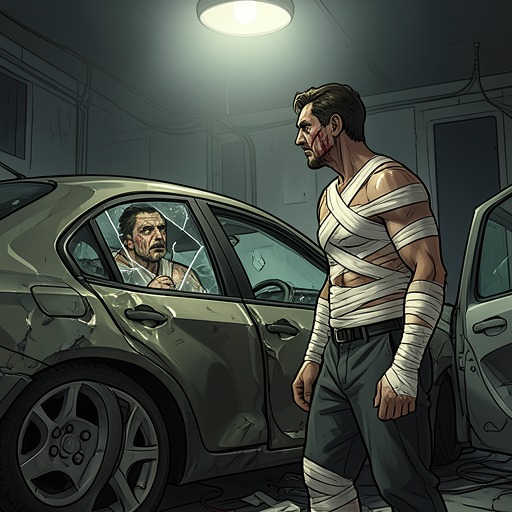
The physical details of the collision make Charles more than a name in an accident report. His blood was sprayed through the fractured windshield across the narrator’s face and chest, while the firemen who cut the narrator from the crushed cabin initially assumed that the apparent chest wound was fatal. Charles’s death therefore enters the narrator’s body as a visible stain and as a permanent sensation of collision between flesh and metal. The narrator later recalls the brief, immobile tableau in which Helen and he looked at one another through their broken windshields, with Charles’s body lying between them.
Helen Remington and the Aftermath
Charles’s death leaves Helen physically almost unharmed, apart from a bruised upper jawbone and loosened teeth, but it radically alters her relation to the narrator and to the automobile. At Ashford Hospital, the narrator imagines the two survivors locked face to face across the wreckage, bound together by the dead man between them. His response is not conventional mourning: he experiences an erotic charge in the collision and imagines sexual union with Helen as a way of re-conceiving Charles in her body and conjuring him back from death.
Helen’s grief is presented in conflict with the narrator’s increasingly clinical and erotic attention to the crash. When she visits him, she describes the crushed radiator grille and blood-spattered bonnet with persistent, voyeuristic interest. She regrets not attending Charles’s funeral, saying that the dead should be left lying around for months because she was not ready; the narrator answers that Remington was ready. Her words reveal grief as a delayed, unresolved condition, while his reply reduces Charles’s death to a stark encounter with readiness, impact, and bodily finality.
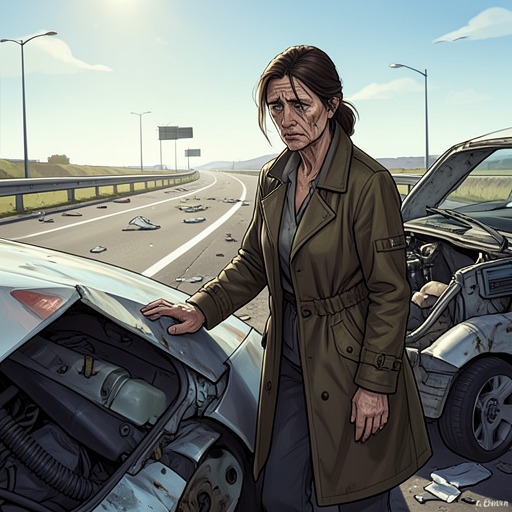
The narrator also encounters Helen while searching for Charles’s car at the police pound. She asks how anyone can look at a car, let alone drive one, after such an event, then explains that she is trying to find Charles’s vehicle. The damaged car becomes an object through which she attempts to locate the dead man and through which the narrator continues to read character, desire, and injury. At the coroner’s inquest, the death receives little ceremony: the verdict is accidental death, and the police bring no charges of manslaughter or negligent driving against the narrator. This legal conclusion separates formal responsibility from the narrator’s private sense that the collision has created an intimate and morally disturbing bond between him and Helen.
Charles as an Absent Presence
Charles remains important precisely because he is absent. The narrator repeatedly thinks about the dead man’s final milliseconds, his pain, the violence of being catapulted from an ordinary domestic interval into what the narrator calls a concertina of metallized death, and the effects of that death on Helen and her family. Yet the narrator also recognizes that his own connection with Charles is inseparable from the wounds on his chest and legs and from his body’s collision with the interior of the car. Charles is thus remembered both as a person with a profession and marriage and as a pattern of force impressed upon surviving bodies.
A particularly charged image gives that absence a technological emblem. Charles’s hand, thrown only inches from the narrator beside the right windshield wiper, had struck a rigid object; the resulting blood blister formed the triton signature of the narrator’s radiator emblem. The mark fuses Charles’s body with the branding of the car, making the dead man’s wound appear as a sign produced by the machine. This image anticipates the novel’s broader movement in which automotive design, human anatomy, and sexual symbolism become inseparable.
Charles’s death also shadows the narrator’s later association with Robert Vaughan. The narrator’s first meeting with Vaughan occurs after another crash, and Vaughan’s scarred body, aggressive driving, and photographic study of collisions turn the earlier accident into a model for a new relationship. The narrator’s recollection of Charles supplies the moral and corporeal history that Vaughan’s experiments repeatedly appropriate. Even Vaughan’s interest in automobile assassinations and his ten-year-old Lincoln Continental place the private death of Charles within a wider mythology of public violence, celebrity, machinery, and masculine risk.
Narrative and Thematic Significance
Charles represents the point at which an apparently accidental road event becomes a recurring system of meaning. The narrator’s collision with the Hamiltons is treated by the law as accidental death, but the novel’s subsequent scenes continually reactivate it through damaged vehicles, scars, sexual fantasies, police procedures, and repeated acts of looking. Charles’s death is not simply an initiating plot fact; it is the wound from which the narrator’s altered perception of cars and bodies develops.
His identity as an engineer also sharpens the contrast between technical modernity and human vulnerability. He belongs to a world of professional expertise and industrial rationality, yet his death is rendered through windshield glass, radiator emblems, seat belts, instrument panels, and the violent mechanics of impact. The narrator’s later conviction that Vaughan could be reborn through twisted radiator grilles and cascading windshield glass extends the logic first established by Charles: death does not disappear from the technological landscape but returns as a visible, repeatable form.
Charles therefore functions as a dead husband, an accident victim, a legal case, and an eroticized memory without being reduced entirely to any one of these roles. Helen’s difficulty accepting his burial, the narrator’s fixation on the blood between their windshields, and the official verdict of accidental death all preserve different versions of him. His death exposes the novel’s central conflict between ordinary social accounts of responsibility and a darker imaginative account in which collisions create new bonds, new desires, and new forms of identity. By the time later crashes and police pursuits unfold, Charles’s original death remains the buried template beneath them: the first collision in which a human body, a marriage, and a machine become permanently joined.