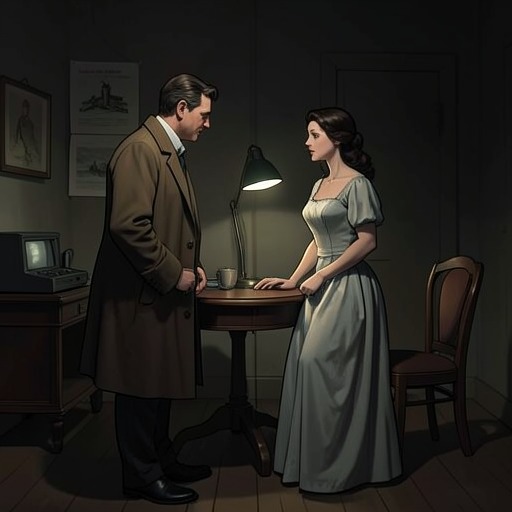
Elizabeth Cole’s lasting emotional distress
CurtainElizabeth Cole’s lasting emotional distress is bound to the family life she describes as a kind of imprisonment and to her continuing disbelief that her sister Margaret could have murdered their father, Matthew Litchfield. At Styles, her own account moves from the loneliness of a life she feels she never experienced to an unresolved question of identity and memory: Margaret confessed, Elizabeth knows that she confessed, and yet Elizabeth cannot make that act belong to the sister she remembers.
Identity and the life she describes
Elizabeth explains that Cole was her mother’s name and that her real name is Litchfield. The change of name accompanies a painful family history she does not readily disclose. Asked why she has used the word maimed, she identifies herself with it: it is, she says, the truth about her. The word presents her distress not as a passing mood but as her understanding of what her life has become.
She describes her father as an invalid and a tyrant who forbade his daughters an ordinary social life. They could not invite friends to the house and were kept short of money; Elizabeth sums up their situation by saying they were in prison. Her recollection links her adult sense of deprivation to the restrictions of her childhood, rather than to a single moment at Styles.
Alienation at Styles
Elizabeth’s distress becomes visible in conversation about age and youth. When Arthur Hastings speaks as if she and he were contemporaries, he realizes that she is more than ten years his junior and worries that he has been tactless. Elizabeth tells him not to apologize: she means that she does not know what it is to have been young, and that she never had what is called a good time. Her correction turns an awkward exchange into a concise statement of a life she regards as missed.
She extends that feeling to the people around her. Guest houses such as Styles, she says, are full of people who have failed, been defeated by life, and are old, tired, and finished. Hastings recognizes the sadness in her description and includes himself, Elizabeth, John Franklin and his unwell wife, the limping Stephen Norton, and the physically diminished Hercule Poirot among Styles’ unhappy residents. Elizabeth’s words give shape to a shared atmosphere of disappointment, while her own bitterness makes clear that this collective condition does not erase her particular wound.
Her contrast between the residents and William Boyd Carrington is telling. She sees him as belonging to the outside world of success and independence, not among the maimed. When Hastings asks why she chose that word, she answers with sudden force that she is maimed. The exchange exposes how deeply she feels set apart, even in a house where she sees others as broken by life.
The Litchfield family wound
The family history surfaces only after Elizabeth has named her alienation. Once Hastings recognizes the name Litchfield, he connects it with Matthew Litchfield. Elizabeth then describes the household’s restrictions and begins to speak of her sister, but stops because the subject is too painful. Her halting account shows that the story is not simply background: it remains difficult for her to tell.
Elizabeth knows that Margaret went to the police, gave herself up, and confessed to their father’s murder. What she cannot accept is that the confession expresses who Margaret was. She insists that the facts are not in dispute; her disbelief concerns her sister herself. Margaret’s act seems to Elizabeth inconceivable and unlike her, as though the person who committed the crime could not have been the sister she knew.
That distinction sustains Elizabeth’s distress. She does not deny the confession or claim that the evidence was false. Instead, she holds together two incompatible truths as she experiences them: Margaret confessed, and Margaret could not, in Elizabeth’s understanding, have done what she confessed to doing. Her grief and doubt remain attached to the gap between the known account of the crime and her memory of her sister.
Aftermath and narrative significance
Elizabeth’s pain is not resolved in the conversation at Styles. Hastings recognizes that she is right about Margaret, but knows that the time has not yet come to tell her. The withheld confirmation leaves Elizabeth speaking from incomplete knowledge; her distress is shaped both by what she remembers and by what she has not yet been told.
The wider narrative places her family history beside other deaths whose meanings are contested. Leonard Etherington’s wife was acquitted of his arsenical poisoning, though public opinion continued to treat her as guilty; she later died after taking an overdose of sleeping draught, and an inquest returned an accidental-death verdict. In another case, Freda Clay said that she had given her suffering aunt too much morphia to ease her pain, while police suspected a deliberate act but considered the evidence insufficient to prosecute. These earlier cases establish a pattern of uncertain motive and judgment around death, without making Elizabeth’s experience equivalent to theirs.
That pattern returns after Barbara Franklin’s death. Hercule Poirot testifies that he saw Barbara leave the laboratory carrying a small bottle and appear startled; the coroner directs the jury to consider whether she took the poison herself, took it accidentally, or received it from another person. The jury finds that she took her own life while temporarily of unsound mind. Later, a resident at Styles invokes the earlier murder there and doubts aloud whether the verdict about Barbara can be trusted. As with Elizabeth’s account of Margaret, a formal conclusion does not prevent uncertainty and suspicion from continuing in private and public speech.
Elizabeth’s lasting distress therefore gives the book an intimate measure of the harm left behind by a family crime: a confession can settle what a person admitted without settling what a survivor can believe about that person. Her story also connects the private persistence of grief to the wider atmosphere at Styles, where verdicts, recollections, and suspicions do not always bring emotional closure.