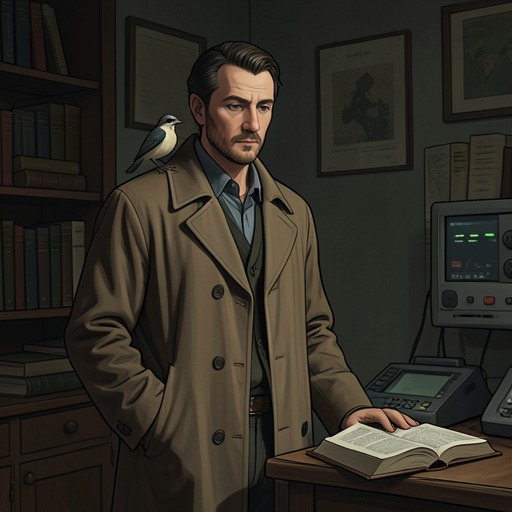
Stephen Norton’s addiction to psychological violence
CurtainStephen Norton’s addiction to psychological violence is the principle that connects his apparently gentle manner to the deaths and attempted crimes he helps bring about. He does not implant murderous desires in people, Hercule Poirot explains; instead, he weakens the resistance that would normally prevent those desires from becoming actions. This distinction makes Norton’s method intimate and difficult to detect: the people he influences can believe they have chosen for themselves, while he experiences their choices as an expanding source of power.
A Talent Turned into a Compulsion
Norton’s influence begins with a quiet social skill. He listens well and appears sympathetic; people like him without paying him much attention. He resents that lack of notice, then discovers that close observation can give him another kind of distinction. By learning people’s private wishes and reactions, and supplying the right words and stimuli, he can influence what they do. Poirot presents this discovery as a source of power: Norton finds that others may be led to do what they do not want to do—or think they do not want to do.
The account distinguishes this process from hypnotism. Norton does not simply impose an alien intention. He finds a desire or grievance already present and works on the person’s ordinary moral resistance, using exact words, phrases, and intonation to bring cumulative pressure to a vulnerable point. The method’s danger lies partly in its apparent continuity with the victim’s own character: it calls on what Poirot describes as the best in a person, but turns it into an alliance with the worst. Its effects can therefore be consequential without making the person influenced aware that Norton has intervened.
Poirot traces the development from experiment to appetite. Norton first discovers that he can influence people; gradually he develops a morbid taste for violence carried out at second hand. The pleasure becomes a passion and then a necessity, compared to dependence on an addictive drug. Norton’s gentle, sympathetic presentation thus stands in sharp contrast to the secret sadism Poirot attributes to him: he seeks mental torture and the emotional experience of violence while avoiding its direct physical execution.
Power, Repetition, and Earlier Cases
Norton’s satisfaction has two connected sources: sadistic interest and the sense of command that comes from controlling other people’s actions. Poirot describes him as possessing, in effect, the keys to life and death. That formulation makes the addiction more than a taste for a particular kind of influence. It is a repeated exercise of power over whether another person lives, dies, or becomes implicated in a crime.
Poirot links Norton to a series of earlier cases, while distinguishing the cases he traced from the possibility of others he did not identify. Norton knew Leonard Etherington, whose death was initially thought to result from food poisoning but was found at autopsy to have been caused by arsenic. Leonard Etherington’s wife was charged and acquitted; although general opinion treated her as guilty, she later died after taking an overdose of sleeping draught. The case leaves a stark gap between a legal verdict and the community’s continuing suspicion, and between that public account of the death and Poirot’s later identification of Norton as an influence behind the earlier crimes.
In another case, Norton had met Freda Clay on a cruise. Poirot says Norton encouraged her developing belief that her elderly, suffering aunt’s death would release the aunt from pain and give Freda a more comfortable life. Freda later admitted giving her aunt too much morphia, describing it as an effort to ease her suffering; the police suspected a deliberate act but did not consider the evidence sufficient for prosecution. The competing accounts—mercy, personal advantage, and deliberate killing—show the kind of existing motives Norton could draw together without making his own part visible.
Poirot also connects Norton with Margaret Litchfield. Norton was a friend of the Litchfields, and Poirot says that his conversations helped Margaret imagine herself as a heroine rescuing her sisters from a life of imprisonment. Across these cases, the recurring pattern is not that every participant lacks a motive of their own, but that Norton detects and strengthens a motive until it can support an act the person might otherwise have resisted. Poirot believes the people he identified would not have acted as they did without Norton’s influence, while acknowledging that there may have been additional cases beyond the five he tracked down.
Styles and the Failed Design
Norton’s arrival among the Franklins gives his method a new opportunity. Poirot says he had been following Norton for some time and immediately recognized danger when Norton became acquainted with them. Norton, however, needs an existing “seed” on which to work: his method can develop what is already present, not create every relevant feeling from nothing. The Franklin household offers such material in the mutual love between Dr John Franklin and Judith Hastings, alongside Dr Franklin’s commitment to the marriage he has chosen. Norton can exploit the conflict between feeling and duty without having created either.
Barbara Franklin’s death appears to offer Norton a dramatic outcome. At the inquest, Hercule Poirot testified that he had seen Barbara come out of the laboratory holding a small bottle and appear startled when she saw him. The coroner told the jury that she had died from physostigmine sulphate poisoning and considered whether she had taken the poison herself, administered it to herself, or received it from someone else. The jury returned a verdict that Barbara Franklin had taken her own life while temporarily of unsound mind. The formal finding therefore settled the manner of death for the proceedings, but it did not satisfy Norton.
Poirot says Norton was thwarted of the emotional spectacle he wanted from the case: suspicion, fear, and the involvement of the law. The murder he had arranged had gone awry. He then began dropping hints designed to reopen uncertainty, including an earlier suggestion, conveyed through his glasses, that he had seen Judith with Major Allerton in a compromising situation. Because Norton had not made a definite allegation, Poirot reasons, the incident could be redirected to suggest that he had seen Judith with Dr John Franklin instead, casting doubt on the suicide verdict. The episode shows how Norton’s interest extends beyond causing a death: he also wants to sustain and reshape the emotional and social consequences around it.
Exposure and Narrative Significance
The formal outcomes of the cases Norton influences do not consistently disclose his role. Barbara Franklin’s death receives a suicide verdict; Norton’s own death later receives the same verdict after an inquest. The evidence appears orderly: he is found with a pistol in his hand, the door is locked from inside, the key is in his pocket, the windows are shuttered, and the weapon is apparently his own. A surgeon notes that shooting oneself in the exact centre of the forehead is unusual, but that doubt does not displace the official conclusion. As with the earlier cases, the available signs offer a plausible surface account while leaving the hidden pattern unresolved.
Norton’s addiction gives that pattern its coherence. A crime can be arranged through another person’s action and then surrounded by circumstances that seem to settle the question of responsibility. His method depends not on overt command but on the pressure of suggestion, on the person’s own motives, and on the concealment of the influencer. In this way, the apparent separation between the person who acts and the person who engineers the action becomes the central moral and investigative problem of the cases.
The conclusion is especially unsettling because it turns Norton’s psychological method back upon the detective partnership. Hercule Poirot explains that ordinary people can experience a wish to kill without willing to act on it; Norton’s art is to weaken that customary restraint. Poirot then reveals that he came to Styles because he knew a crime would be committed—and that he himself intended to commit it. Norton’s influence is thus not only a device for connecting past cases or exposing concealed motives. It confronts Poirot with the possibility that a person may justify an otherwise forbidden act through purpose and circumstance, even while recognizing the moral boundary the act crosses. The addiction belongs to Norton, but its reach forces the narrative to examine the dangerous distance between wishing, prompting, and doing.