Hercule Poirot’s physical decline
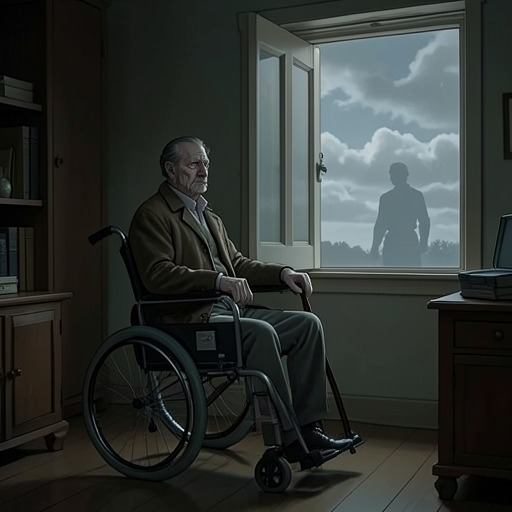
CurtainHercule Poirot’s physical decline marks a stark change in the detective while leaving his defining intellectual capacity intact. Almost crippled by arthritis, dependent on a wheelchair and help with ordinary care, and increasingly weakened by heart trouble, he faces the limits of an aging body even as he returns to Styles to hunt a murderer. The narrative sets bodily dependence against his confidence that his mind still functions, making the decline both a concrete condition of his life and a constraint on his work.
Identity and Background
When Arthur Hastings meets Poirot again, he has not seen his old friend for nearly a year. The last meeting had already left Hastings shocked and saddened by Poirot’s condition. Poirot had gone to Egypt hoping that the change would improve his health, but returned in worse shape rather than better. His letter inviting Hastings to Styles therefore brings the old partnership back into view at a moment when Poirot’s physical state has markedly deteriorated.
The change is visible in Poirot’s appearance as well as his mobility. His once-plump frame has become thin, and his face is lined and wrinkled. His hair and moustache remain jet-black, but Hastings sees their artificiality as conspicuous against the signs of age. This outward contrast makes the familiar theatrical presentation of Poirot seem newly fragile; only his eyes, still shrewd and twinkling, appear unchanged, though softened by emotion.
The Body’s Increasing Dependence
Arthritis has progressed to the point that Poirot propels himself about in a wheelchair. He describes himself as unable to walk, crippled and twisted, and dependent on others for being put to bed, washed, and dressed. He can still feed himself, but otherwise requires care “like a baby.” The specific everyday tasks make his loss of independence more than a general sign of age: they establish how thoroughly his physical condition has altered the practical terms of his life.
Poirot’s own account distinguishes bodily failure from mental failure. He calls himself a wreck and a ruin, but rejects Hastings’s suggestion that the soundness he means is his heart. For Poirot, the surviving core is his brain: despite the decay of the outside, he insists that it still functions magnificently. The exchange gives the decline its defining tension. His body has become dependent and constrained, but he does not understand that condition as the end of his intellectual agency.
Heart Trouble and the Limits of Work
Poirot’s weakness extends beyond arthritis. Curtiss, his attendant since Poirot returned from Egypt, tells Hastings that Poirot’s health is fairly good in general but that he sometimes suffers alarming heart attacks. In recent months, his heart has become much weaker. Hastings understands this as a gradual failure, and worries for an old friend who continues to struggle despite growing frailty.
That decline shapes the possibility of Poirot’s return to detective work. At Styles, he tells Hastings directly that he has come to hunt down a murderer. The declaration establishes that his investigative purpose persists, but it does not erase his physical vulnerability. Later, when Poirot sighs and looks worried, Hastings recognizes that he is no longer fit for sustained effort: his brain remains keen, but he is sick and tired. The distinction between intellectual sharpness and the stamina needed to pursue an investigation becomes an immediate practical limit.
Change and Narrative Significance
Poirot’s return to Styles recalls the place where he first made his home in England, now transformed into a guest house. At his age, he says, revisiting the past has its appeal. That return gives his physical decline a setting shaped by memory: the familiar detective comes back to an old place, but not in the vigorous condition in which Hastings remembers him. The contrast between remembered partnership and present dependence lends their reunion its emotional force.
The narrative does not treat bodily impairment as proof that Poirot’s mind has ceased to function. Instead, it holds two facts together: he is increasingly dependent and unable to sustain prolonged effort, yet still capable of identifying his purpose and trusting his intellect. His decline therefore changes how he can conduct his work without cancelling the identity built around it. The detective’s persistence is real, but so is the cost imposed by a body that can no longer reliably support the demands of investigation.