Arthur Hastings’s bereavement
CurtainArthur Hastings’s bereavement is not a single passage of mourning but a persistent absence that changes how he inhabits the present. His wife has died in Argentina, and the widower she leaves behind measures the altered world against the shared life he has lost. When worry about Judith’s attachment to Major Allerton presses on him, grief becomes practical as well as private: Hastings misses not only his companion but the judgment on which he had relied in caring for their children.
The Loss and Its Setting
Hastings remembers his wife as having died in Argentina in a manner she would have wished: without prolonged suffering or the feebleness of old age. That description acknowledges a measure of mercy in the circumstances, but it does not soften the consequence for him. She is gone, and he is left lonely and unhappy. The brevity of the account sharpens the contrast between the death’s comparatively swift course and the continuing life of the person who must bear its aftermath.
The loss also marks a boundary between two versions of Hastings’s life. Looking back to 1916, when he first travelled to Styles, he wishes that he could begin again from that day. The wish opens onto a list of changes: Styles has been sold by the Cavendishes, John Cavendish is dead, Mary lives in Devonshire, and Lawrence is in South Africa with his family. The familiar world has thinned and dispersed. Against that catalogue of absences and altered circumstances, Hastings finds one unexpected continuity: he is returning to Styles to meet Hercule Poirot. His wife’s death belongs to a broader reckoning with time, but it gives that reckoning its most intimate cost.
Grief in the Present
A remembered exchange with Poirot brings the bereavement briefly into direct view. The conversation turns to two women and to a former hope of meeting someone in France; Hastings stops short as he reaches the point at which he met the woman who became his wife. The unfinished recollection matters: happiness is present in the memory, but it cannot be narrated onward without encountering the fact that she is gone. Poirot recognizes the wound and gently pats Hastings’s arm, telling him not to dwell on the past but to look forward. The gesture offers sympathy, while the advice exposes the gap between what a friend can recommend and what a mourner can yet manage.
Hastings answers Poirot’s encouragement with a question about what there is to look forward to. It is not simply a rejection of optimism; it gives voice to a present made difficult to imagine without his wife. The exchange also establishes that his grief remains fresh even after the earlier adventures and shared history with Poirot. Memory returns not as a settled account but as a point at which speech falters, and comfort arrives through recognition rather than any promise that the loss can be repaired.
The Missing Counsel
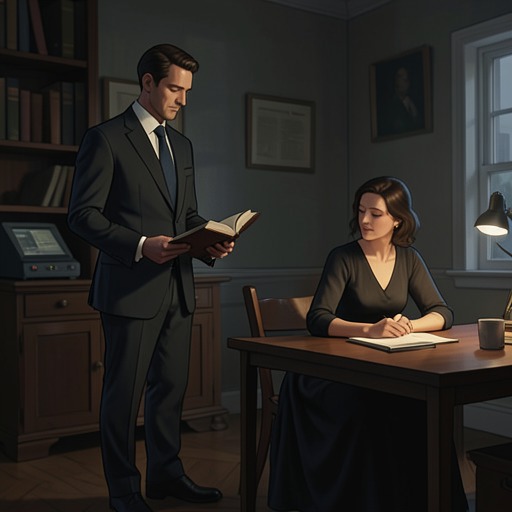
The bereavement surfaces again when Hastings hears information about Judith and Allerton. He tries to reassure himself that his clever, cool daughter will not be deceived by a man whose reputation troubles him, but the unease persists through the night. As he lies awake, fear of what may happen to Judith expands into a sense of despair and loss. He wishes his wife were alive, remembering her as the wise and understanding person whose judgment he had trusted for years, particularly in matters concerning the children.
That memory gives his anxiety a specific shape. Hastings feels that responsibility for the children’s safety and happiness now rests with him alone, and doubts whether he is equal to it. He describes himself as not clever and prone to blunders; the thought that Judith might lose her chance of happiness or suffer intensifies his sense of inadequacy. Switching on the light and sitting up, he responds to imagined danger in the household as a father without the partner whose judgment once steadied him. His grief is therefore bound to responsibility: he mourns his wife, but also the shared capacity for care that her presence represented.
Grief and Fatherhood
When another man advises Hastings to warn Judith about Allerton, Hastings hears the ease of that advice as a consequence of having no children. He cannot simply treat intervention as an obvious solution. He wonders whether speaking to Judith would help or make matters worse, and again imagines what his wife would know how to do and say. Her absence leaves him without a trusted answer at precisely the moment he must decide whether to act.
Hastings admits that he is tempted to remain silent, then identifies that impulse as cowardice: he shrinks from the unpleasantness of confronting Judith and is afraid of his tall, beautiful daughter. The scene shows grief operating through an unresolved choice rather than a completed act of mourning. His wife’s remembered judgment is a standard against which he measures his own hesitation, but it cannot make the decision for him. Bereavement thus complicates fatherhood: the pressure to protect Judith persists, while the counsellor with whom he once shared responsibility is unavailable.
Narrative Significance
The episodes connect bereavement to the book’s larger movement between return and change. Hastings can go back to Styles and meet Poirot again, but he cannot restore the life that made an earlier return imaginable. The old place carries the weight of changed relationships and absent people; the reunion with his friend is a genuine continuity, not a replacement for his wife. The contrast keeps nostalgia from becoming simple recovery: returning to the familiar setting makes its losses more legible.
The narration also lets grief recur in different circumstances rather than confining it to a single announcement. It appears in Hastings’s backward glance at 1916, in the interrupted memory of meeting his wife, in a sleepless night over Judith, and in his hesitation about warning her. Each recurrence reveals a different consequence of the same absence: loneliness, thwarted hope, diminished confidence, and the burden of deciding alone. Poirot can name the wound and urge Hastings forward, but the narrative leaves the force of the loss visible in the practical questions that remain unanswered.