Sleeping pills
CurtainSleeping pills are at once a danger, a safeguard, and an instrument of lethal planning in the closing events of the story. Hercule Poirot uses them first to stop Arthur Hastings from acting on a murderous impulse, then to put Stephen Norton to sleep; the same substance that returns Hastings to his better judgment helps Poirot carry out an act he has come to regard as necessary.
The tablets in Hastings’s room
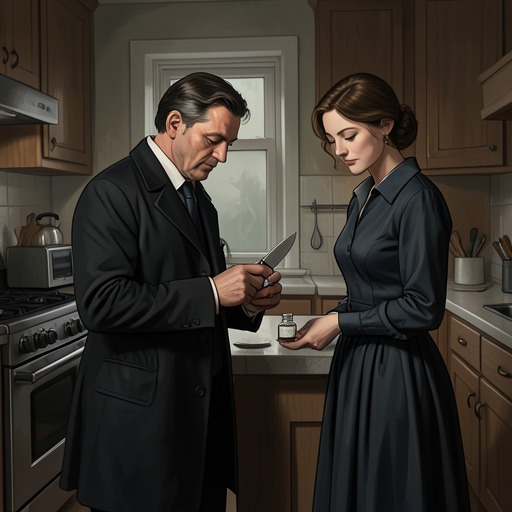
Poirot realizes that Hastings is contemplating murder after hearing him enter Major Allerton’s room and, moments later, hearing him in the bathroom. Looking through the keyhole, he sees Hastings manipulating the sleeping tablets and understands what he intends to do. The tablets are not merely an incidental part of Hastings’s plan: their presence gives Poirot direct evidence of the danger and a chance to intervene before Hastings commits an act that could destroy him.
Poirot acts without confronting Hastings in the moment. He returns to his room, prepares a countermeasure, and sends Curtiss to fetch Hastings when Curtiss comes upstairs. Hastings arrives yawning and says that he has a headache. Poirot makes a fuss over him and urges remedies; Hastings agrees to drink a cup of chocolate for the sake of peace, gulping it down because he wants to leave quickly. Poirot has put sleeping tablets in the drink. The intervention depends on Hastings accepting what appears to be care, rather than recognizing the danger Poirot has identified.
Sleep as protection
The dose makes Hastings sleep until morning. He wakes as his sane self and is horrified by what he nearly did. Poirot regards that recovery as decisive: Hastings is safe, and, in his view, will not attempt the deed again now that he has returned to himself. The sleeping tablets have not resolved the moral problem by argument or confession; they have interrupted it long enough for Hastings’s judgment to return.
That rescue also changes Poirot’s assessment of the stakes. He knows Hastings is not a murderer, but fears that Hastings could be hanged for a murder committed by another man whom the law would consider innocent. The tablets thus avert more than Hastings’s intended violence: they prevent him from being made the apparent criminal in a separate scheme. Poirot’s praise of Hastings’s kindness, conscientiousness, and innocence underscores the peril of allowing a temporary loss of judgment to define an otherwise honourable man.
The chocolate and Norton’s death
Later, sleeping tablets again determine the course of events, this time in Poirot’s plan concerning Stephen Norton. Poirot explains that he too takes them every night and has developed enough tolerance that a dose capable of putting Norton to sleep would have little effect on him. When Norton asks to drink from Poirot’s cup instead of his own, Poirot agrees. Both men receive the same dose in the chocolate, but the difference in their tolerance means that Norton falls asleep while Poirot remains sufficiently alert; Poirot adds that his strychnine tonic further counteracts the tablets’ effect on him.
Once Norton is asleep, Poirot places him in Poirot’s wheelchair and wheels him back to its usual position in the window recess behind the curtains. Curtiss then puts Poirot to bed. When the house is quiet, Poirot wheels Norton to his room, intending to make use of Hastings’s eyes and ears. The tablets therefore enable a shift from an apparent shared drink to a concealed operation: Norton’s sleep gives Poirot the opportunity to move him without waking him, while Poirot’s own familiarity with the drug allows him to remain in control.
A changed meaning
Across these episodes, the tablets have sharply different consequences without changing their basic function. For Hastings, they impose a temporary sleep that protects him from acting on a murderous idea and waking to its irreversible consequences. For Norton, they produce the unconsciousness that makes Poirot’s final actions possible. The contrast is central to the object’s narrative role: a substance associated with private nightly use becomes, first, Poirot’s means of preserving Hastings’s innocence and, later, part of the machinery of his plan against Norton.
The two scenes also distinguish rescue from control. Poirot uses the chocolate to interrupt Hastings’s crisis without his knowledge, trusting that sleep will return him to sanity. In the later episode, he deliberately exploits Norton’s vulnerability to the same kind of dose, while relying on his own tolerance to avoid being incapacitated. Sleeping pills are thus not a simple symbol of rest: in the closing sequence, their effects depend on who takes them, how accustomed that person is to them, and what Poirot intends to do while the other man sleeps.