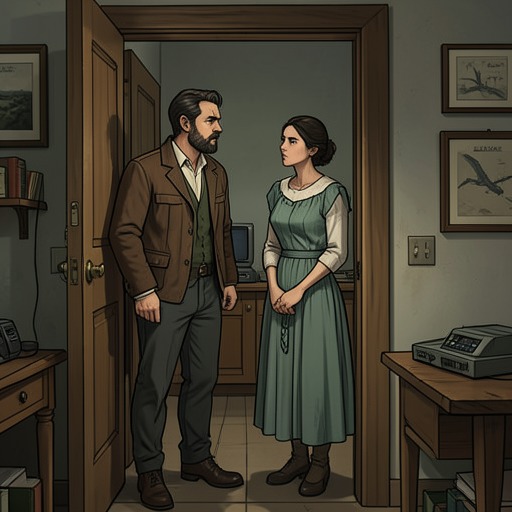
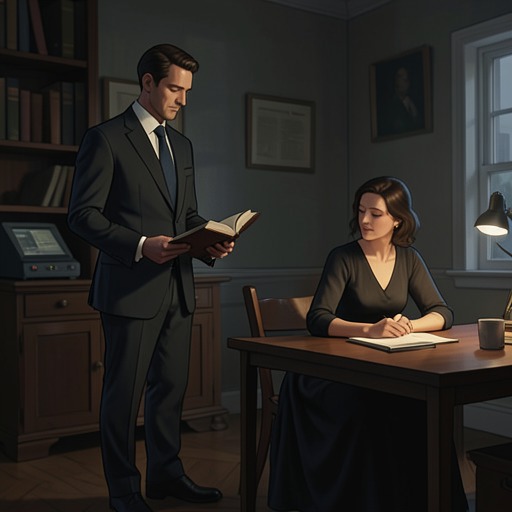
Poirot’s manuscript for Hastings
CurtainPoirot’s manuscript for Hastings is the sealed posthumous account in which Hercule Poirot explains why he concealed the identity of X and discloses that he killed Stephen Norton. Received by Arthur Hastings four months after Poirot’s death, it transforms the apparent suicide at Styles into a murder and leaves Hastings—and the reader—with an unresolved question about Barbara Franklin’s death.
Delivery and purpose
The manuscript reaches Hastings through a firm of lawyers, acting on instructions from their late client. He receives a sealed packet and reproduces its contents as a postscript to his own account. The four-month interval between Poirot’s death and delivery makes the document a communication from beyond the events it explains: Poirot has chosen what Hastings should learn, and when he should learn it.
Poirot opens by saying that he had debated whether to write down the truth about the second Styles affair, but decided that someone needed to know it. His intended reader is not an abstract public but his old friend, whom he anticipates may have formed far-fetched theories and be suffering over them. The letter’s personal address makes disclosure an act of friendship as well as an explanation of the case.
A controlled account of the investigation
The manuscript revises Hastings’s understanding of Poirot’s request that he come to Styles and serve as Poirot’s eyes and ears. Poirot says those words were true, but not in the sense Hastings had understood: Hastings was to see and hear what Poirot wanted him to see and hear. The document thus identifies the investigation as deliberately managed, not simply as an ordinary partnership in which both men share the same information.
Poirot also acknowledges Hastings’s accusation that he had been unfair by withholding the identity of X. He confirms that he did withhold it, but says that the reason he gave at the time was not the real one. The manuscript therefore does more than fill gaps in the investigation: it exposes the gap between Poirot’s outward explanation and his private purpose, while insisting that Hastings had been given indications from which he might have reached the truth.
That claim is sharpened by Poirot’s judgment of Hastings as possessing too beautiful and trusting a nature. In the letter, affection and reproach are inseparable. Poirot treats his friend’s trust as the reason he failed to interpret the clues, while the manuscript itself demonstrates how far that trust had allowed Poirot to control the information available to him.
Norton’s death and the false verdict
Before the manuscript arrives, Hastings has concluded that Poirot’s death was not natural and that Norton and Barbara Franklin had also been killed. Yet the public account of Norton’s death is a suicide verdict. At the inquest, the locked door, the key in Norton’s pocket, the shuttered windows, and the pistol in his hand made suicide appear straightforward. A surgeon noted that it was unusual for a man to shoot himself in the exact centre of the forehead, but this remained only a shadow of doubt; the pistol had also been seen on Norton’s dressing table during his stay at Styles.
Against that apparently complete scene, the symmetrical bullet hole becomes a clue whose meaning Hastings recognizes only after reading Poirot’s account. In his final note, Hastings admits that he should have understood when he saw it. The manuscript consequently changes the significance of details already presented: the official verdict and the arrangement of the scene had made a staged death look conclusive, while the clue was visible but misread.
Poirot tells Hastings that he should know who killed Norton, even if he remains in the dark about who killed Barbara Franklin. The disclosure makes the distinction explicit: the manuscript resolves Norton’s death but does not claim to solve Barbara’s. Its answer is therefore deliberately partial, not a complete clearing-up of every death associated with the affair.
The final exchange between friends
The manuscript ends with Poirot’s own written account; Hastings’s final note then records his response. He says that he cannot yet believe what he has read, but accepts that Poirot was right about his failure to recognize the clue. His recollection of the centred bullet hole connects the last page to the inquest evidence and gives the revelation a concrete point of recognition rather than a detached summary.
Hastings also recalls a thought that had been in the back of his mind that morning, but the supplied ending does not spell it out. The manuscript thus closes the central question of Norton’s death while preserving a small remainder of uncertainty in Hastings’s own recollection. Its final effect is both explanatory and elegiac: Poirot’s written truth reaches his friend only after Poirot can no longer speak to him, and their long relationship is given its last exchange through a sealed packet and a reply written after reading it.