Othello
CurtainOthello is both a book physically present among Hercule Poirot’s final clues and a model for understanding X’s method of crime. A small, cheap edition appears alongside John Ferguson, marked at its third act; later, Poirot explains that Iago supplies the literary counterpart to X, a criminal who orchestrates deaths while remaining outside the apparent circle of action. The play’s role is therefore double: it is an object Hastings encounters and a framework that makes a concealed pattern legible.
The book as an object and clue
In a moment of private distress, Arthur Hastings turns away from Judith and pretends to search for a book. He finds an old edition of Othello and opens it, alighting on Iago. Judith asks what he is doing; Hastings gives a muddled explanation about a clue while turning the pages. The book briefly becomes a refuge from the need to show his feelings, but the scene also places Iago’s language before him at a consequential moment.
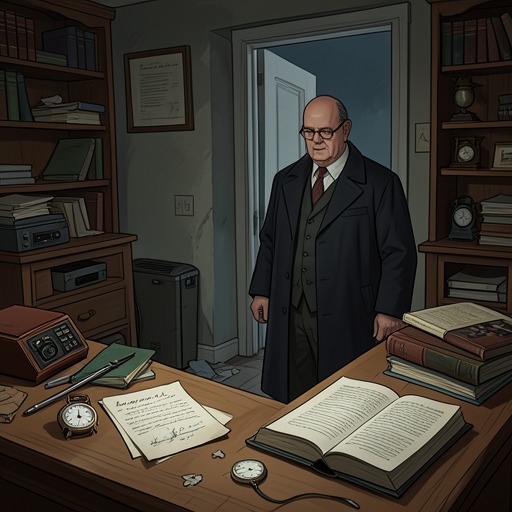
Much later, Hastings examines the case Poirot has left behind. It is not empty: inside are two books, a small, cheap copy of Othello and John Ferguson by St John Ervine, with a marker in the latter at Act Three. Hastings recognizes these as Poirot’s promised indications, yet stares at them without understanding what they mean. The contrast is essential to the clue’s operation: the evidence has been left in plain sight, but its significance depends on a literary connection Hastings has not yet made.
Iago as a model for X
Poirot supplies the interpretation by comparing X to Iago. In his account, Iago is the perfect murderer because the deaths associated with him are planned and brought about by his influence, while he remains outside suspicion. Poirot emphasizes the means: Iago does not need to issue direct instructions. He holds others back from violence and voices horror at suspicions that have not been raised until he introduces them. Othello thus points toward murder accomplished through suggestion and manipulation rather than by the instigator’s visible hand.
Poirot also uses the play to distinguish a compelling model of criminal method from the way Shakespeare has to expose it. Iago’s scheme is nearly complete, but the handkerchief ultimately unmasks him. Poirot regards that device as a conspicuously clumsy departure from Iago’s otherwise indirect technique: the author must provide a tangible proof to reveal a criminal whose method depends on avoiding direct evidence. This observation sharpens the comparison with X, whose defining advantage is precisely the ability to act without appearing to act.
The paired literary clue
Othello does not work alone. Poirot pairs it with John Ferguson, whose third act features Clutie John, described as half-witted, inducing others to kill the man he hates. The two works offer complementary demonstrations of psychological suggestion: Iago remains outside suspicion while arranging the consequences of his influence, and Clutie John prompts other people to carry out violence against his enemy. Poirot presents these as literary precedents that help reveal how X can influence crimes without personally committing their visible acts.
The marker at the third act of John Ferguson makes the pairing specific rather than a general appeal to literature. Yet Hastings’s first encounter with both books yields no solution. Poirot’s arrangement asks him to infer a method from two fictional analogies, not to discover a conventional physical clue that immediately identifies the culprit. Othello is consequently both part of the evidence and a test of Hastings’s ability to interpret evidence.
From literary analogy to identification
When Poirot completes the explanation, he states that Othello and Clutie John indicate that X was Stephen Norton. The books have helped identify the person who catalyzed other people’s actions, but they do not settle who killed Norton himself. Poirot poses that final distinction directly: if Norton was X, who could have killed Norton? His answer is Hercule Poirot. The clue therefore participates in a reversal: the literary analogy exposes Norton’s concealed role, while the final question turns attention from the manipulator to the detective who brought his influence to an end.
Othello’s importance lies in this movement from reading to recognition. At first it is a cheap volume among two unexplained books; in Poirot’s account it becomes a compact illustration of indirect criminal agency. The play helps Hastings understand not merely who X was, but how a person could stand outside the immediate acts of violence and still be responsible for arranging them. Its place among Poirot’s last indications makes literary interpretation part of the investigation’s final answer.