Calabar-bean alkaloid solution
CurtainThe Calabar-bean alkaloid solution is the laboratory poison at the center of Barbara Franklin’s death and Hercule Poirot’s final reconstruction of the case. Its role turns on a chain of material and human misdirection: a laboratory bottle had been diluted, the poison was intended for John Franklin, and Barbara instead drank the poisoned coffee herself. The resulting death was treated as suicide, although Poirot understood it as the unintended consequence of her attempt to kill her husband.
Laboratory Preparation and Medical Evidence
At the inquest, the medical evidence established that Barbara had died from physostigmine poisoning and that other Calabar-bean alkaloids were also present. The poison had been taken sometime between seven o’clock and midnight on the preceding evening; the medical witnesses would not specify the time more closely. The finding identifies the relevant substance as a preparation containing more than physostigmine alone, while leaving the precise moment of ingestion unresolved.
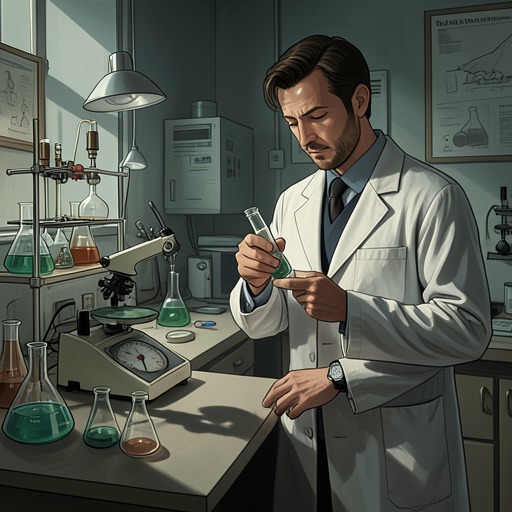
After Barbara’s death, John checked the solutions in his laboratory. One bottle that should have held a strong solution of Calabar-bean alkaloids had been filled with ordinary water, with only a trace of its original contents remaining. He could not say when the change had occurred, because he had not used that preparation for several days. The discrepancy was therefore significant but not, by itself, a record of when or by whom the bottle had been altered.
John explained that the laboratory was usually locked and that he generally carried its key. Judith Hastings, his assistant, had a duplicate; anyone wishing to enter had to obtain a key from one of them. Barbara had sometimes borrowed it when she had left personal belongings in the laboratory. John said he had never brought a solution of physostigmine into the house or Barbara’s room and believed accidental ingestion was impossible. These access details made the laboratory and its contents part of the inquiry without establishing that Barbara’s fatal dose had been taken accidentally.
Intended Poisoning and Reversal
In Poirot’s later account, the poisoned solution was meant for John. Barbara had prepared those around her to imagine that he might die from a scientific experiment, not from an attempted murder: she had voiced fears that he might experiment on himself. Poirot interprets this as advance preparation for a death that would appear to result from research, with the alkaloid represented as harmless until it proved otherwise.
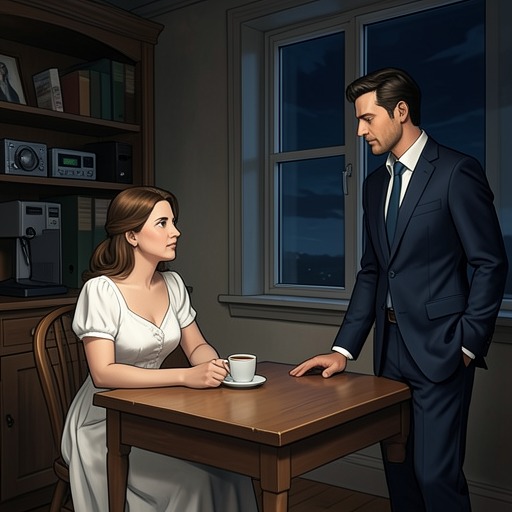
The plan depended on Barbara taking the right opportunity to give John the poisoned coffee. On the evening in question, she asked the others to come to her room and made coffee with conspicuous fuss. Her own cup was beside her; John’s was on the other side of the bookcase table. When shooting stars drew the group outside, Arthur Hastings remained behind with his crossword puzzle and memories. To conceal his emotion, he turned the bookcase around to look for a Shakespeare quotation. Poirot’s reconstruction makes this movement part of the crucial confusion: when the group returned, Barbara drank the coffee containing the alkaloids intended for John, while John drank the plain coffee intended for her.
The switch reversed the intended outcome. John survived, and Barbara ingested the poison intended for him. Poirot’s brief judgment on the Calabar bean’s effect is deliberately double-edged: in this instance, he says, it spared the innocent and killed the guilty. The solution thus functions not merely as a laboratory substance but as the physical agent through which Barbara’s plan collapses upon herself.
Inquest, Verdict, and Poirot’s Intervention
The official inquiry took place two days after Barbara’s death. John’s testimony presented him as cooperative and clear, and he described both the altered laboratory bottle and the limits of what he knew about its history. He also testified that Barbara had been in a low, nervous state, with depression and rapidly changing moods, but that she had seemed cheerful recently. He said they had been on good terms, had not quarrelled, and that she had appeared in good spirits on her final evening. The evidence therefore placed her earlier illness beside an apparently improved period and a final evening that did not look, to him, like a period of melancholy.
Poirot later explains that he recognized what had happened but could not prove it. He believed that if Barbara’s death were treated as anything other than suicide, suspicion would fall on John or Judith, both of whom he knew to be innocent. He therefore emphasized Barbara’s unconvincing remarks about ending her life and gave them the force needed to support a suicide interpretation. His standing as a man experienced in investigating murder meant that his conviction carried weight; his intervention helped direct the inquest away from the truth about the poisoned coffee.
The solution’s narrative significance lies in the contrast between chemical certainty and legal interpretation. Medical evidence identified the poison, but it could not settle the complete sequence of intention, cup placement, and mistaken drinking. The bottle’s diluted contents, the laboratory’s controlled access, the two coffee cups, and the rearranged bookcase form a chain whose meaning emerges only in Poirot’s reconstruction. The poison’s identity is established; the apparent suicide verdict is not the same as the actual account of how Barbara came to drink it.