Slumberyl
CurtainSlumberyl is a prescription barbiturate sleeping medicine introduced as an easy route to sleep, but its narrow margin between a useful and toxic dose makes it a potential poison. At Styles, Arthur Hastings later selects it for a covert plan against Major Allerton, manipulating its bottle and tablets so that the intended overdose would appear ambiguous. The medicine’s ordinary form is central to the scheme: the tablets resemble aspirin, yet their replacement and the absence of Allerton’s fingerprints would make the bottle tell a story Hastings had not intended.
Identity and Introduction
Slumberyl enters the narrative in a bathroom cupboard, where Allerton takes out a bottle of tablets and presents them to Hastings as an effective sleeping aid. He calls it by its patent name and says it will produce heavy sleep and pleasant dreams. The setting and manner make the medicine appear like an everyday convenience, passed from cupboard to conversation without ceremony.
Allerton’s enthusiasm unsettles Hastings, who wonders whether he is a drug taker and asks whether the medicine is dangerous. Allerton explains that it is dangerous if taken in excess: it is a barbiturate whose toxic dose lies very near the effective one. That warning establishes Slumberyl’s defining property before it becomes part of Hastings’s plan. The same small difference between a sleeping dose and a lethal one that makes the drug hazardous also makes it appear useful to someone contemplating an overdose.
The exchange also establishes that Slumberyl is not freely available. When Hastings says he would have expected a doctor’s prescription to be necessary, Allerton confirms that it is, adding that he has influence in that area. The bottle therefore signals not only a drug’s pharmacological danger but Allerton’s access to it. What Hastings learns casually in the bathroom later supplies both the means and the practical knowledge for his scheme.
Use in Hastings’s Plan
Hastings’s plan takes shape after he decides that Allerton’s pursuit of Judith must be stopped. He goes into Allerton’s room and bathroom, opens the cupboard, and examines the Slumberyl bottle. Knowing from Allerton that the toxic dose is not high, he calculates that eight tablets should be ample, although the stated dose is only one or two. He reads the label’s warning that it is dangerous to exceed the prescribed dose, then proceeds despite the warning.
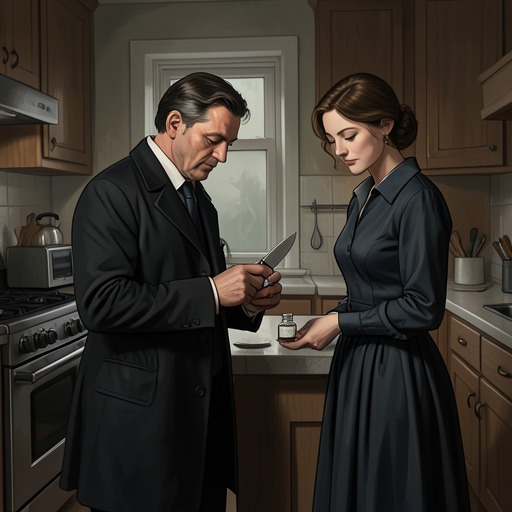
He wraps a silk handkerchief around his hand before unscrewing the bottle, intending to leave no fingerprints. The substitution depends on the tablets’ appearance: Hastings finds that Slumberyl tablets are almost exactly the same size as aspirin. He empties the bottle, puts eight aspirin tablets in it, and returns the Slumberyl while leaving out eight tablets. After the exchange, the bottle looks as it did before, while its contents have been altered in a way a casual observer might not notice.
Hastings then considers how to administer the drug without attracting suspicion. He prepares whisky, glasses, and a siphon, expecting Allerton to accept a nightcap, as he has done before. Before using the mixture, Hastings tests the tablets in a little spirit; they dissolve easily, and he judges the taste only slightly bitter and hardly noticeable. His intended method is to offer Allerton the drugged drink while making and drinking a separate one himself, disguising the poisoning as an ordinary social gesture.
The bottle’s apparent normality is essential to this design. Hastings wants Allerton to see nothing unusual, and he expects the tablets to vanish into whisky without a conspicuous taste. Yet the attempt at concealment creates physical traces of its own: the tampered contents and the missing fingerprints would be open to forensic interpretation after a death. Slumberyl is thus not simply the poison Hastings chooses; it is the material center of a plan whose evidence he only partly understands.
Forensic Reversal and Significance
When Poirot dismantles Hastings’s reasoning, he explains that wiping the bottle clean would remove not only Hastings’s fingerprints but Allerton’s as well. If Allerton were found dead from a Slumberyl overdose, the absence of his prints would be difficult to explain as an accident or suicide, since either circumstance would give him no reason to wipe the bottle. The precaution Hastings had treated as protection would therefore make the bottle more suspicious.
The altered tablets would provide another clue. An analysis would show that nearly half the remaining tablets had been replaced by aspirin. Hastings responds that practically everyone has aspirin, but Poirot connects the substitution to the surrounding circumstances: Hastings had quarrelled with Judith about Allerton the day before, and witnesses could attest to Hastings’s violent feelings toward him. The drug’s resemblance to aspirin, which had seemed to make substitution convenient, would not erase the significance of the substitution once the bottle and motive were considered together.
Slumberyl’s role turns on the difference between an object’s intended use and the evidence its handling leaves behind. As a sleeping medicine, it can be offered as an innocuous kindness; as an overdose, it can be made to resemble accident or suicide. But the very precautions intended to preserve that ambiguity—removing fingerprints and replacing tablets—would expose the bottle to suspicion. In the exchange between Allerton’s warning and Hastings’s later plan, the drug shifts from household remedy to potential poison and then to evidence against the would-be poisoner.