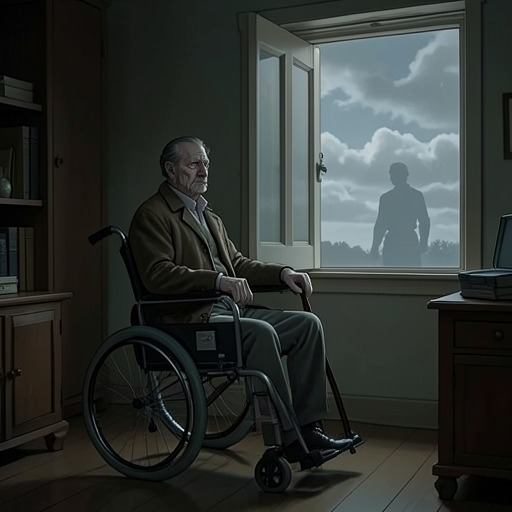
Poirot’s wheelchair
CurtainPoirot’s wheelchair serves first as a means of moving him around, then as an essential instrument in the carefully staged killing of Stephen Norton. Its mechanisms allow Poirot to transport Norton while concealing what has happened, making the chair part of both the practical logistics and the deception that follows.
Practical Use in the Staging
After the chocolate has taken effect and Norton is asleep, Poirot says he gets him into the wheelchair and wheels him back to its usual place in the window embrasure behind the curtains. Poirot notes that the chair has many kinds of mechanism, presenting it as manageable for this difficult task. The chair thus helps return Norton to a position where his apparent presence can be maintained while Poirot prepares the next stage.
The Apparent Return to Norton’s Room
Once Curtiss has put Poirot to bed and the house is quiet, Poirot wheels Norton to his room. He then uses Hastings as an unwitting witness: disguised in Norton’s dressing gown, with his hair ruffled, Poirot comes to Hastings’s door. Hastings sees what appears to be Norton limping across the passage into his own room and hears the key turn in the lock from inside. The wheelchair has enabled the movements that make this false sequence possible, though the disguise and Hastings’s mistaken identification complete the illusion.
The Locked-Room Deception
Poirot next lays Norton on the bed and shoots him with a small pistol. He puts the key in Norton’s pocket, locks the room from outside with a duplicate key, and wheels the chair back to his own room. The chair therefore links the concealed transportation of Norton to the final arrangement of the scene: Poirot can leave the room without being seen to return on foot, while the locked door and Hastings’s account support the appearance that Norton entered the room alive and secured it himself.
Narrative Significance
The wheelchair is not merely background to Poirot’s physical condition. In the final explanation, its mechanisms become part of the method by which he controls bodies, routes, and appearances. A mobility aid associated with his own movement is repurposed to move the victim and sustain a false account of events; its ordinary function becomes inseparable from the deception that enables Poirot’s killing of Norton.