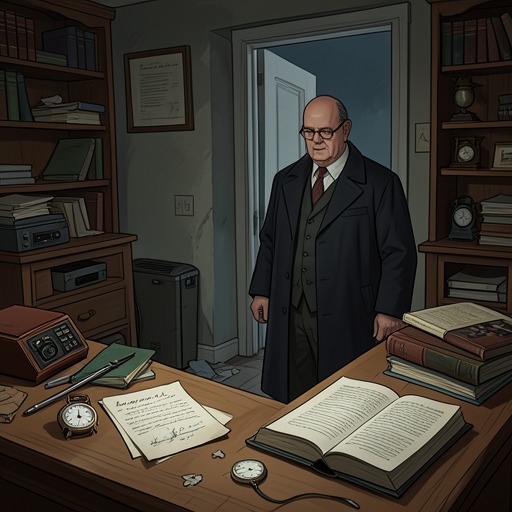
Norton’s checked dressing gown
CurtainNorton’s checked dressing gown becomes the apparent proof that Stephen Norton entered his room alive and locked himself inside, and then the key prop in Hercule Poirot’s reconstruction of a murder. Its distinctive, ugly colouring makes it memorable enough for Arthur Hastings to identify at once; that very familiarity helps Poirot use it to turn a convincing sight into a false one.
Appearance and First Identification
Hastings sees Norton coming from the bathroom and entering his own room in a checked dressing gown whose colouring he considers particularly hideous. Norton’s hair is sticking up, as usual. The man shuts the door, and Hastings hears a key turn immediately afterward. In the stormy quiet of the night, the sequence leaves Hastings uneasy: to him, the gown, the familiar hair, and the sound of the lock belong to an ordinary but unsettling glimpse of Norton.
The garment’s conspicuous appearance later gives Hastings confidence in what he saw. When he tells Poirot that he witnessed Norton go into his room, Hastings points specifically to the dressing gown as something he would recognize anywhere. But the recognition establishes only that the figure wore Norton’s gown. Hastings admits that he did not see the man’s face; his other identifying details are the hair and a slight limp. Poirot’s challenge separates the object from the person: anyone could wear the gown, just as someone could imitate the limp. What Hastings took for confirmation is thus a clue to the limits of eyewitness identification.
The Gown as a Disguise
In Poirot’s explanation, the apparent sighting was staged. After Curtiss had put Poirot to bed and the house was quiet, Poirot wheeled Norton to his room. He then put on Norton’s checked dressing gown, ruffled up his own grey hair, and came down the passage to knock at Hastings’s door. Hastings, waking and looking out into the passage, saw the disguised Poirot leave the bathroom, limp across to Norton’s room, and enter it. He heard the key turn on the inside, just as Poirot intended.
The episode reverses the gown’s evidentiary meaning. It first seems to anchor Hastings’s recollection in a concrete, recognizable object; in fact, it is the means by which Poirot supplies the missing face with a false identity. The sighting is not wholly invented: Hastings did see a figure in the gown enter the room and heard a lock turn. The deception lies in arranging those accurate impressions so that Hastings draws the wrong conclusion about who wore it.
Restored to Norton and the Locked-Room Deception
After using the gown to impersonate Norton, Poirot put it back on Norton, laid him on his bed, and shot him with a small pistol. He then placed the key in Norton’s pocket and locked the room from outside with a duplicate key he had possessed for some time. The scene Hastings had witnessed could now support the appearance of suicide in a locked room: Norton seemed to have entered, locked the door from within, and later been found dead with the key in his pocket.
The garment’s return to Norton completes the deception. It links the staged passageway sighting to the body and helps conceal that the person Hastings saw was Poirot. Its function is not simply to disguise the killer during the impersonation; it helps make the false timeline plausible, while the duplicate key and the position of the key in Norton’s pocket complete the locked-room arrangement.
Narrative Significance
The dressing gown is a small, ordinary possession made decisive by the confidence attached to it. Hastings remembers its ugly pattern more readily than he remembers a face he never saw, and his certainty about the object initially hardens his mistaken certainty about the man. Poirot’s explanation shows how a true sensory detail can mislead without being fabricated: the gown was there, the figure entered the room, and the lock turned, but none of those facts proves that Norton himself went inside.
Because Hastings has already supplied the reader with the sighting, the later explanation transforms a seemingly settled observation into evidence of Poirot’s preparation. The gown is therefore both disguise and planted confirmation: it carries the appearance of Norton through the corridor, then returns to Norton’s body, making a staged sequence look like an ordinary last sighting. Its conspicuousness, once a reason to trust Hastings’s identification, becomes the very mechanism by which that identification is defeated.