Morphine molecule
DopesickThe morphine molecule is the book’s recurring image for the force that can make an opioid more compelling than relationships, security, or plans for the future. It is not presented as a technical account of chemistry. Instead, the phrase names the central pressure described by people living with addiction and by those trying to understand it: once dependence takes hold, ordinary priorities may lose their power, while obtaining the drug and avoiding withdrawal can organize daily life. The image connects private experience to a crisis that crossed social and geographic boundaries and repeatedly outlasted attempts to contain its supply.
Dependence and the Reordering of Priorities
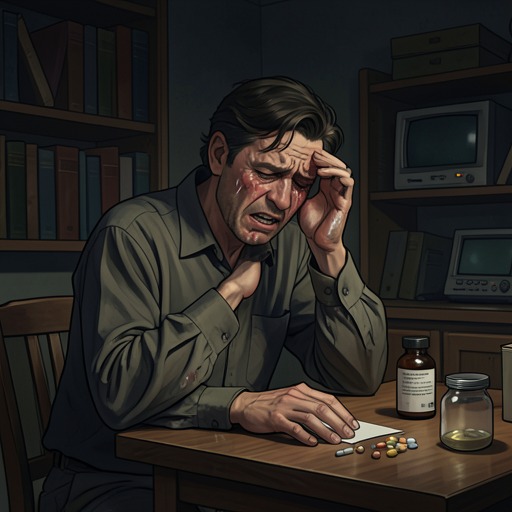
A patient working with addiction researcher Warren Bickel gives the book one of its clearest expressions of the molecule’s pull. The patient had extensive injection marks and had exhausted the veins in his arms; what he wanted Bickel to understand was comparable to the account of a Lee County, Virginia, farmer who told his doctor that OxyContin had taken everything from him. The two accounts meet in the idea that, under addiction, little can rival the drug’s claim on attention. Love, family, sex, and shelter can all recede beside the relationship between a person and the substance.
That formulation treats addiction not simply as a matter of wanting pleasure, but as a change in what feels urgent and attainable. The immediate need to use, or to avoid becoming dopesick, can crowd out attachments and longer-term aims. The book makes this change legible without reducing it to a single person’s character: the same account is heard across different lives and settings, from a farmer describing what OxyContin had cost him to a patient in Bickel’s research environment.
Bickel’s research gives the idea a measure of scale. He compared the average nonaddicted person’s perception of the future, calculated at 4.7 years, with an addicted user’s perceived future of only nine days. The contrast helps explain why appeals to distant consequences may have limited force when the near future is dominated by dependence. Bickel hoped to develop methods that could identify future risk among children and help people at risk extend their sense of the future. In this account, understanding the molecule’s pull includes asking how treatment might restore room for choices beyond the next few days.
Supply, Enforcement, and Recurrence
The molecule also names a demand that persists after individual dealers are arrested. Law-enforcement official Don Wolthuis contrasted heroin trafficking with a chain of bank robberies: arresting a robber can stop those robberies, but removing a heroin seller does not remove the drug’s draw or the need among dependent users. In Roanoke, Virginia, people who sold heroin without seeking the wealth associated with major traffickers could be trying to keep themselves from becoming dopesick. Their role in distribution thus emerged from the same dependence that enforcement was intended to address.
The local trade had become substantial. By the time Clifton Lee received an eleven-year sentence in 2008, prosecutors attributed to him the repeated delivery of a thousand bags of heroin, two or three times a week. The first bags sold in Roanoke were stamped Funeral and Green Frog, and some were reported to be 90 percent pure. Such details show the gap between interrupting a supply network and changing the demand that drew people toward it. Wolthuis suspected that users and user-sellers would continue seeking routes to fresh supplies, including from Baltimore and Richmond, even as particular traffickers were locked up.
The metaphor also resists the comforting idea that addiction belongs to one class or neighborhood. The book describes an earlier assumption that heroin addiction was confined to poor rural residents, a small group of Black users in the inner city, or a few suburban young people. The drug’s spread across city and county lines, with little regard for race, neighborhood, or class, unsettled that stereotype. Later, affluent young people and working-class users were described as falling into the same crisis and relying on friends’ couches when they were fortunate enough to have somewhere to stay. Art Van Zee had predicted that OxyContin would not be recalled until suburban young people were dying from it; their deaths made the crisis’s reach impossible to dismiss as somebody else’s problem.
Stigma and the Gaps Around Care
The molecule’s power appears alongside another force that keeps people isolated: shame. When reporting on the heroin epidemic began in the suburbs of Roanoke in 2012, many families were reluctant to speak on the record. Parents could experience the crisis as a public mark of personal failure, even while trying to find help for their children. In that period, families in different parts of Virginia had not yet formed the online networks that would later let them exchange advice about rehabilitation, coping, and practical support.
The book places those private struggles within gaps between health care and criminal justice. At a Families Anonymous meeting in a Lutheran church near Hidden Valley, two mothers of young men with opioid addiction met; their encounter would have lasting implications for families in the region. The meeting stands against the isolation produced by shame, while the wider account shows people with addiction trying to survive and avoid withdrawal as relatives and volunteers work to keep them alive. The molecule’s pull is therefore not only an individual experience: it unfolds in a landscape where families may lack connection and where the institutions charged with responding do not close the gaps between them.
Treatment itself could carry a further stigma. Tess Henry had attended twelve-step meetings but felt judged for taking buprenorphine, which some participants regarded as incompatible with being clean or as merely substituting one opioid for another. Although Narcotics Anonymous officially accepted medication-assisted treatment, longtime members asked to sponsor or mentor her declined. The episode shows how the struggle to loosen the drug’s hold can be complicated by disagreement over what counts as recovery. Access to treatment and acceptance within a recovery community are not interchangeable; a person may seek help and still encounter a boundary that makes belonging harder.
A Measure of the Book’s Argument
The morphine molecule gathers these strands into a single image without making the crisis seem inevitable or purely biological. Its pull helps account for why a dealer’s arrest may not end demand, why a user may sell to stave off withdrawal, and why promises about family or future consequences can fail to overcome an immediate need. At the same time, the book traces that experience through drug supply, stigma, public institutions, and uneven access to care. Addiction is intimate, but the conditions surrounding it are social.
The image also clarifies why the epidemic could not be contained by stereotypes or by enforcement alone. Heroin and prescription opioids crossed boundaries that communities had treated as protective; people with very different resources could become subject to the same urgent relationship with the drug. Bickel’s effort to lengthen the future perceived by people at risk points toward a response distinct from simply removing a supplier: treatment must address dependence and help make a future imaginable. The molecule is thus both a description of narrowed priorities and a challenge to the assumption that punishment, shame, or social distance can make those priorities disappear.