Heroin Highway
DopesickThe Heroin Highway names more than a road: it is the moving system that connected East Coast supply centers to Virginia towns, while turning addicted users into couriers and sellers. In the book, its routes shift from Baltimore runs to bus-borne shipments and nearby markets, but the underlying cycle persists: people sell part of what they buy to finance the next purchase, often because avoiding withdrawal has become the immediate imperative.
Definition and operating logic
The phrase holds together two kinds of movement. One is geographic: heroin travels along established highways and in cars, buses, and concealed packages. The other is social and economic: a supply reaches a town, dealers recruit local sellers, and some users resell portions of their supply to pay for their own next batch. As the book describes it, this is not simply a chain from a distant supplier to a customer. Each new customer can become a recruiter of still more customers, allowing the network to reproduce itself even as particular dealers are arrested.
The pressure driving that circulation is withdrawal. In Woodstock, users who began with prescriptions increasingly turned to heroin, then sold some of what they obtained to afford another purchase. The cycle was governed by the need to avoid the severe physical and psychological pain of dopesickness. That mechanism helps explain why the highway could remain busy without every participant seeking the large profits that motivated major dealers: for many user-sellers, the immediate goal was to keep from becoming sick.
Routes into Virginia
The book traces an early expansion through Clifton “Lite” Lee, a dealer with Philadelphia roots who arrived in Roanoke in 2006. Lee recognized that selling in Roanoke could be more profitable than selling only in New Jersey and New York. Two suburban teenagers caught selling to friends led investigators to evidence involving fifty other young people, many of them students at Hidden Valley High School in affluent Roanoke County. The route crossed boundaries of race and class, reaching communities that might not have recognized themselves as vulnerable to heroin.
By 2008, prosecutors had attributed a large, regular flow to Lee’s network: about a thousand bags entering the region two or three times a week. The economics were stark. Twenty bricks cost $5,000 and could be sold for $30,000; some bags were exceptionally pure, increasing both the drug’s capacity to hook users and the danger of dosing. Don Wolthuis’s organizational chart made the network visible as a pyramid, from people dealing for money at the top to addicted people at the bottom, some of whom had died of overdose. Yet arrests did not remove the demand beneath the chart. Don Wolthuis feared that user-sellers would keep traveling to Baltimore, Richmond, or Paterson, New Jersey, to replenish their supply.
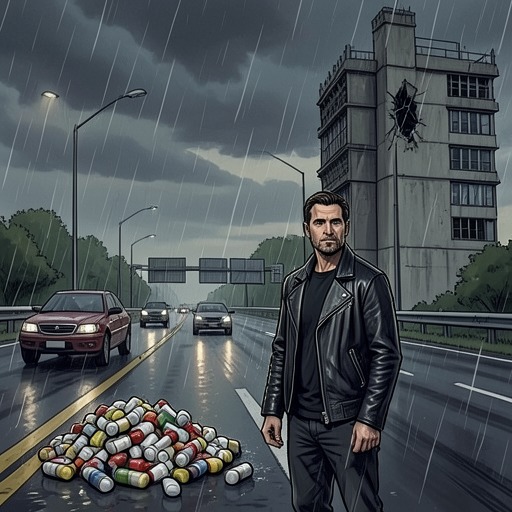
After the 2010 reformulation of OxyContin, one small-town route ran directly to Baltimore. Young men from the region drove the roughly two hours, buying enough heroin for themselves and extra to sell to friends; the proceeds helped pay for both the drugs and the next trip. The scale of the destination’s market dwarfed any single local operation: heroin sales in Baltimore were estimated at $1.5 million a day. Baltimore’s port and Interstate 95 had long made the city an important staging point for drugs moving along the East Coast. The highway’s successive nicknames, from Reefer Express to Cocaine Lane to Heroin Highway, registered how the same corridor could be repurposed as the drug supply changed. The book also describes Baltimore as having the country’s highest per-capita heroin use rate and an opioid-overdose death rate six times the national average.
A changing supply network
The routes were not limited to regular commuter drives. Young people from Roanoke traveled past Woodstock toward Baltimore, Philadelphia, or Newark, or took a Chinatown bus to New York City. There they could buy fifty bags for $100 and resell them in Roanoke for six to eight times their investment. A regional high-school survey in fall 2012 found that 6.4 percent of students reported using heroin at least once, while nearly 10 percent had tried illicit prescription drugs. A local prevention counselor warned that the proportions were changing as heroin became cheaper and easier to obtain.
By spring 2013, investigators were piecing together another route without knowing the supplier’s real name or seeing his face. The suspected dealer, known as D.C., was believed to send heroin toward Virginia’s I-81 corridor in plastic Walmart bags, carried in snack containers by young women traveling from New York on the Chinatown bus. The heroin was packaged in Harlem as four-ounce, hockey-puck-shaped disks hidden in emptied Pringles cans. D.C. hired local dealers to divide the shipments into tenth-gram bags; the book reports that he was so afraid of the drug that he wore gloves, goggles, and a mask while they packaged it. A subordinate sent to sell one gram bought for $65 in Harlem returned with $800. D.C.’s shipments routinely contained 200 grams, compared with at most 20 grams in the Baltimore runs made by commuter-dealers.
The network’s human scale also appears in the fifteen thousand text messages recovered from Ashlyn Kessler’s phone. By 2014, federal investigators could use the messages to map a pyramid running from a New Jersey source to dozens of young people in Cave Spring and at Hidden Valley High School. Their exchanges record ordinary logistics—meeting places, quantities, credit—alongside the desperation of a trade in which supply moved through friendships and local contacts as well as across state lines.
Why the highway continued
The Jones–Shaw ring’s closure did not end the traffic. Dennis Painter and his friends returned to the Baltimore route; meanwhile, heroin was available in nearby Winchester for $20 a bag, compared with $30 when brought by a runner to Woodstock. Dennis described the profits as too great for task forces to stop the flow and warned that heroin was getting closer. His account links the highway to the shrinking economic options of small-town working people: where factory employment had contracted, drug transport could appear to offer extraordinary returns. A reported investment of $4,000 in 50 grams could bring as much as $60,000 in a week, while a shorter trip to Martinsburg offered a less lucrative nearby market.
The book sets this persistent circulation against a treatment system that struggled to create a reliable route out. Roanoke’s Hope Initiative paired trained volunteers with people seeking help, but in its first month 22 people approached the program, none entered residential treatment, and only a handful obtained outpatient medication-assisted treatment. Hospital-to-treatment handoffs were impeded by shortages of providers and beds, as well as bureaucratic, financial, and legal barriers. The contrast is central to the metaphor: supply could travel through established routes and adaptable local networks, while a person revived from overdose might still face a fragmented, difficult path to care. Enforcement could disrupt a supplier or a ring, but the book’s recurring pattern is that demand, withdrawal, and the capacity to reorganize kept the Heroin Highway open.