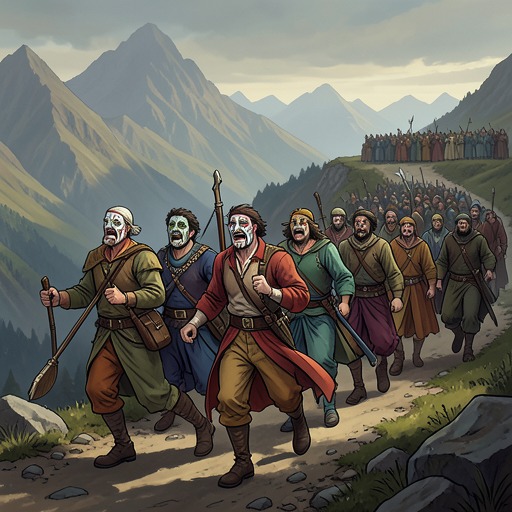
Proktophantasmist
FaustThe Proktophantasmist is a self-assured skeptic who arrives at the Walpurgis-Night gathering determined to deny the reality of spirits. His insistence that ghosts cannot stand on ordinary ground, delivered while spirits dance around him, makes him an embodiment of reason that cannot recognize what is directly before it—and a comic interruption in the revels.
Identity and Introduction
The Proktophantasmist appears during the Walpurgis-Night scene in the Hartz Mountains, in the district of Schierke and Elend. He addresses the assembled supernatural beings as an intruder in their celebration, calling them accursed and challenging their presence. His name and conduct mark him as an observer who claims special authority over apparitions, but the scene immediately places that authority under pressure: he has entered a gathering in which spirits are visibly dancing.
Claims and Contradictions
He argues that ghosts cannot stand on ordinary ground, invoking what he calls an earlier demonstration. The claim is not presented as a considered inquiry; it is a rule he treats as decisive, even as the performance around him contradicts it. He then rebukes the spirits for dancing like ordinary people and orders them to vanish, repeating that they have already been given the enlightening word.
His appeal to rational certainty becomes especially unstable when he notes that Tegel is haunted despite the efforts to clear away the supposed folly. The admission does not soften his position. Instead, he continues to insist on his authority, declaring that he gives no place to spirit despotism and that his own spirit cannot practice it. His words turn skepticism into an assertion of personal control rather than an explanation of the evidence before him.
Conflict at the Revels
The Proktophantasmist's commands do not stop the dance. A fair one tells him to stop boring the revelers, and the stage direction confirms that the dance continues. His presence therefore supplies a counterpoint to the carnival's movement: while the gathering proceeds through dance, he tries to impose rules and halt it with declarations.
Faust mocks this habit in a dance-song, portraying him as someone who weighs every step and objects when others move forward, yet might show goodwill if they followed his own dull, regular gyration and listened to his exhortations. The ridicule links his skepticism to a broader rigidity: he would accept movement only when it obeyed his prescribed pattern. The scene turns his insistence on orderly explanation into part of the entertainment he hopes to suppress.
Narrative Role and Significance
The Proktophantasmist ends without persuading the spirits or bringing the revels to a close. He complains that nothing will succeed amid such celebrations, yet claims he always takes something away from a tour and hopes, before his last step to the grave, to overcome poets and devils. That closing ambition sharpens the joke: even in the face of a supernatural spectacle that ignores his rules, he imagines the conflict as one he may eventually win through continued argument.
His episode places confident denial inside a scene that makes denial look less like insight than a failure of perception. The spirits' dance, the fair one's dismissal, Faust's caricature, and the Proktophantasmist's own unresolved declaration all preserve the same contrast: he can name and command the supernatural, but cannot make it conform to his account of what is possible.