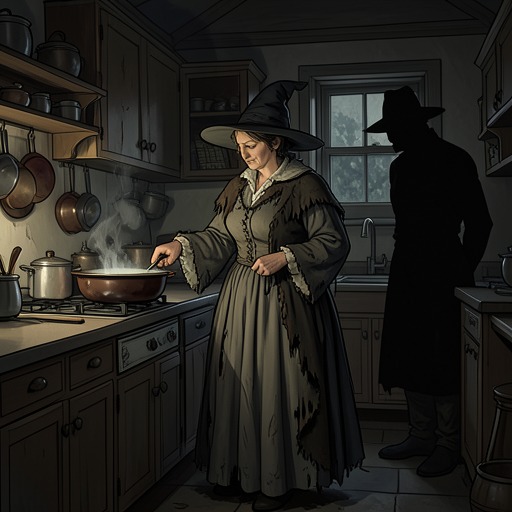
The Witch
FaustThe Witch is a practitioner of magic whose brief appearance in the Witch’s Kitchen supplies the means for Faust’s rejuvenation. She first arrives amid disorder, summoned by the boiling cauldron’s flare; once Mephistopheles establishes his authority over her, she prepares the potion that Faust drinks. Her scene combines comic confusion and ritual procedure, making her less a sustained antagonist than the indispensable operator of a consequential transformation.
Identity and Introduction
The Witch enters after the neglected cauldron boils over and a great flame blazes up the chimney. She comes down through it with cries of alarm, reacting to the mishap and to the damage caused by the unattended brew. Her entrance is therefore not a composed arrival but a disruption that exposes the unruliness of the magical household. The scene gives her authority over its tools and preparations while also making her vulnerable to the consequences of her own inattention.
Her first exchange with Mephistopheles is marked by recognition and a reversal in status. He asks whether she knows him and asserts that he is her lord and master; she apologizes for her rough greeting, but notes that she sees neither a cloven foot nor the ravens she associates with him. The exchange presents identity as something the scene must establish through recognizable signs: Mephistopheles is not immediately identified by appearance, and the Witch’s response registers the gap between his familiar reputation and the figure before her.
Work in the Witch’s Kitchen
Once the encounter is settled, Mephistopheles asks for the well-known juice and specifies that he wants the oldest brew, whose strength has increased with age. The Witch agrees to serve it, describing the bottle as one she sometimes drinks from herself. Her ready response makes her both host and specialist: the potion is available in her kitchen, but its preparation requires the ritual actions that follow.
She draws a circle, arranges mysterious objects inside it, and uses the apes as a reading desk and as holders of the torches while she brings out a great book. Glasses ring and the cauldron sounds during the ceremony. These elements turn the preparation into a theatrical performance as well as a practical operation; the apparatus is strange enough to draw Faust’s explicit dislike, while Mephistopheles treats the procedure as something to be managed rather than feared.
The Witch then declaims a nonsensical-sounding numerical formula from the book. Mephistopheles interrupts the incantation and urges her to bring the drink, presenting the ritual’s verbal display as sufficient for the task at hand. She pours the beverage into a cup, and a light flame appears as Faust raises it to his lips. Mephistopheles tells him to drink quickly and reassures him that the drink will do no harm; the Witch offers her own good wishes for its effect. The transformation thus depends on a small sequence of distinct actions: the Witch supplies the potion, performs its ceremonial preparation, and serves it, while Mephistopheles directs the encounter and Faust takes the drink.
Relationship with Mephistopheles and Faust
The Witch’s deference to Mephistopheles follows his declaration that she is beneath his authority. Although her initial greeting is rough, she apologizes once she recognizes him. He then manages the exchange, explaining to Faust how to deal with witches and specifying what the Witch should provide. The relationship shown here is practical as well as hierarchical: Mephistopheles has the authority to command, and the Witch carries out the magical service he requires.
Faust, by contrast, responds to her work with skepticism. He finds the creatures, gestures, and proceedings repulsive, and complains that the incantation sounds absurd. Mephistopheles persuades him to enter the circle and treats the performance as a means to an end. The Witch does not persuade Faust herself; she contributes the potion and its ritual setting, while Mephistopheles bridges the distance between Faust’s distrust and his eventual participation.
Change and Narrative Role
The Witch’s most consequential action is the preparation and delivery of the drink that Faust consumes. The play does not develop her beyond this episode in the supplied scenes, but the consequences of her service extend into the larger story: the potion enables Faust’s renewed youth and the new phase of his pursuit of experience. Her limited presence is thus sharply functional without being merely incidental; the transformation rests on her craft, even as the scene places its immediate direction in Mephistopheles’ hands.
The later appearance of the Witch’s name in the Walpurgis-Night stage heading situates the kitchen episode within a broader supernatural setting, but the cited passage does not describe her actions at that gathering. In the encounter with Faust, her defining contrast is between comic disorder and effective ritual: the cauldron boils over, the spell sounds deliberately baffling, and yet the potion is made and drunk. The episode uses that contrast to let a grotesque, comic scene carry a serious consequence for Faust’s subsequent life.