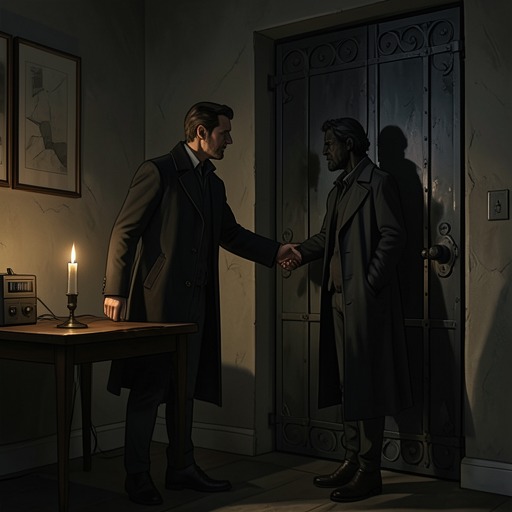
Mephistopheles
FaustMephistopheles is the Devil as tempter, servant, and self-declared force of negation: a figure who seeks to lead Faust astray, yet whose destructive intentions operate within a wager that leaves room for human aspiration to find the right way. He derides humanity, enters a pact with Faust, and carries him through episodes in which mockery and practical assistance coexist. His power is consequential but not unlimited, and his own account of his nature contains the paradox that evil may help bring about good.
Identity and Introduction
Mephistopheles first addresses the Lord as one of the divine household, apologizing that he cannot match the angels’ elevated speech. His subject is not the suns and worlds but human beings, whom he sees tormenting themselves. In his account, humanity’s divinely granted reason only makes people more beastlike: the human being becomes a long-legged grasshopper, springing about and returning to the same old song. The comic insult turns philosophical criticism into a burlesque portrait of restless, repetitive life.
That mockery is also the ground of his challenge. Mephistopheles asks the Lord for leave to train Faust along his own road, promising that there is still a chance to win him. The Lord permits the attempt for as long as Faust lives, reasoning that a person whose desires and aspirations remain active cannot help but err. The permission is not a declaration that Faust is already lost: the Lord insists that even through obscure aspiration a good person retains an instinct for the one true way. Mephistopheles accepts the wager with confidence, imagining Faust brought low and relishing degradation as a victor’s proof.
The Spirit That Denies
When Faust demands to know who stands before him, Mephistopheles answers with a definition that makes him more than a conventional tempter: he is part of a power that wills the bad but works the good. He then names himself the Spirit that Denies. Because everything brought forth from nothing, in his view, deserves destruction, he regards negation as his proper element and treats sin, destruction, and whatever is mixed with evil as expressions of that work.
The definition does not resolve into a simple claim that Mephistopheles can control the consequences of his actions. Instead, it establishes the contradiction at the center of his role: he wills destruction, while the larger order described by the Lord allows human striving and error to remain within a movement toward the good. Mephistopheles speaks as though denial were the final truth; the wager places that certainty under examination. His identity is therefore both an explicit creed and an irony of dramatic function: the adversary’s designs may become part of a process he does not direct.
The Pact with Faust
Mephistopheles’s service to Faust is set out as an exchange across two worlds. He offers to be an unwearied slave on earth, obedient to Faust’s every nod; when the two meet again in the afterlife, Faust is to serve him in turn. Faust accepts the future consequence without allowing it to distract him from present life. His pleasures and sorrows belong to this earth, he says in effect, and he refuses to settle in advance what love, hate, or rank might mean beyond it.
The bargain turns the wager’s abstract contest into a relationship of service and risk. Mephistopheles is neither merely an external enemy nor an unconstrained master: in the earthly term of the pact he has promised obedience, while the promised reversal makes the afterlife the stake. That structure lets him accompany Faust as a servant while continuing to work as tempter. The comedy of the obedient attendant thus carries a serious pressure: every present service is shadowed by the claim each has made on the other’s future.
Masks, Mockery, and Assistance
Mephistopheles’s identity is theatrical as well as philosophical. When the Witch mistakes or fails to recognize him, he confronts her in his scarlet coat and tall cock’s feather, demanding to know whether she recognizes her lord and master. Her apology turns on the visible discrepancy: she cannot see a cloven foot, and his ravens are absent. The exchange makes recognition depend on costume and expected signs, while Mephistopheles asserts authority through performance rather than accepting the disguise as a limit.
His dealings with Faust repeatedly mix assistance with contempt. When Faust declares that he wants possession of a girl, Mephistopheles’s immediate response is to ask which one, a brisk question that treats Faust’s desire as a practical assignment. Later, during the Walpurgis revels, he calls himself Squire Voland and tells Faust to hold to him so they can leap out of the crowd into a more open space. He claims the right of a householder to clear a path, but admits that even he finds the crowd too much. The grand title and sudden admission of discomfort give his authority a comic edge.
At the revel, Faust points to a red mouse that has sprung from a figure’s mouth and calls it reason for alarm. Mephistopheles dismisses the detail as nothing, noting that the mouse was not gray and asking who would dwell on such a thing in the season of love. The exchange shows how his wit works: he takes an uncanny sign and reduces it to a joke, trying to turn Faust’s disturbance aside rather than share it. His skepticism can be a method of control, but it also exposes the difference between his appetite for spectacle and Faust’s capacity to be unsettled by what he sees.
Power and Limits
At the close of the supplied action, Faust demands that Mephistopheles take him to the prison and liberate Margaret. Mephistopheles agrees to convey him, but qualifies the rescue by specifying what he can actually do: cloud the jailer’s senses, obtain the key, lead Margaret out by human hand, keep watch, and carry the fugitives away with magic steeds. He expressly denies having all power in Heaven and Earth. The list is at once a plan and a boundary: his supernatural means can make escape possible, but the act of leading Margaret out is described as human action, and the rescue still depends on the two of them going together.
This limit sharpens the contrast between Mephistopheles’s earlier confidence in the wager and the practical terms of his service. He can deceive, arrange, and transport; he cannot simply erase the moral and human stakes of the situation. His readiness to help Faust does not cancel his role as tempter, any more than his boast of mastery makes him omnipotent. The character’s dramatic force rests on that unstable combination: the mocking antagonist who claims destruction as his element remains bound to a contest whose outcome cannot be guaranteed by his own will.