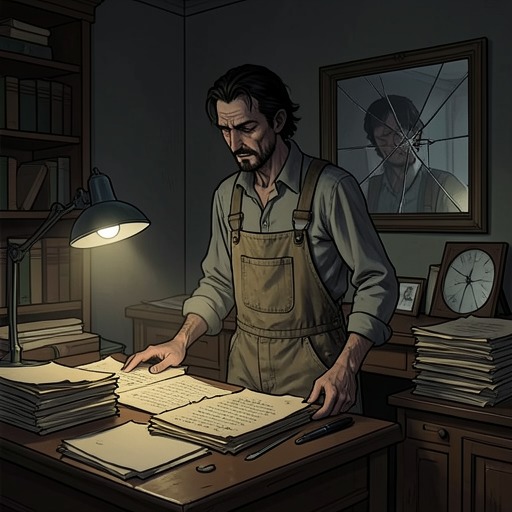
Faust summons and encounters the Earth-Spirit
FaustFaust summons and encounters the Earth-Spirit in a scene where visionary confidence gives way to humiliation. Reading the spirit’s sign, he feels newly powerful and ready to meet the world; when the apparition appears, however, it rejects his claim to kinship and disappears, leaving him to ask what he is if he is not even like the being he invoked. The episode turns a bid for transcendence into an exposure of the distance between human aspiration and spiritual reality.
Setting and the Sign
Before the encounter, Faust contemplates a sign in a book. Its vision of a whole whose parts give substance to one another, and of forces moving between heaven and earth, offers an image of reciprocal life and harmony. Yet the sight remains a spectacle rather than a possession: Faust longs to make boundless Nature his own and to reach the sources of being. His dissatisfaction establishes the pressure behind the invocation. He does not merely want knowledge of a symbol; he wants a direct relation to what it represents.
Invocation and Transformation
Turning the leaves impatiently, Faust perceives the sign of the Earth-Spirit and feels its effect at once. He describes his powers as loftier and clearer, and his renewed strength as an invitation to encounter both earthly suffering and earthly bliss. Even the prospect of storms seems unable to frighten him. This confidence gives the invocation the character of a threshold crossing: he moves from interpreting a sign to attempting contact with the power named by it.
The atmosphere then shifts sharply. Clouds gather, the moon is hidden, the lamp goes out, and mists and angry rays surround Faust. He feels a presence, calls upon the spirit to reveal itself, and experiences the encounter as a convulsion that draws upon and exhausts him. He nevertheless insists that the spirit must come, even at the cost of his life. Seizing the book, he pronounces the sign; a ruddy flame flashes, and the Spirit appears within it. The book is thus both the source of the sign and the instrument through which Faust attempts to make its power present.
The Spirit’s Rebuke
The Spirit asks who has called it. It recognizes Faust’s yearning to see and hear it, but treats his physical and spiritual disturbance as a contradiction of the elevated calling he claims. Its rebuke recalls Faust as a figure who seemed to create and nurture a world within himself, and asks where that expansive being has gone. The contrast is pointed: the aspirant who wanted to stand alongside the spirits is now described as a trembling, terror-stricken creature.
Faust answers by naming himself and asserting that he is the Spirit’s peer. The declaration briefly preserves his claim to equality, but the Spirit immediately denies it. Faust is like the spirit he can comprehend, it says, not like the Earth-Spirit itself. The distinction makes comprehension a limit rather than a guarantee of access: imagining or interpreting a power does not make the interpreter its equal.
Disappearance and Consequence
The Spirit disappears, and Faust is overwhelmed. His response turns the rebuke inward: he had imagined himself in the image of the divine, yet now concludes that he is not even like the Spirit. The encounter therefore ends not with mastery or instruction but with a collapse in his estimate of himself. His aspiration remains visible, but its confidence has been broken by the very presence he sought.
A knock interrupts the aftermath. Faust recognizes it as his Famulus and laments that his vision has borne no fruit because it has been disturbed. The ordinary interruption returns him from the extraordinary encounter to his human surroundings, while his language preserves the sense of frustrated expectation. The episode’s reversal is complete: contact with the superhuman does not confirm Faust’s imagined stature; it exposes the gap between yearning and attainment.
Dramatic Significance
The scene is structured around contrasts between sign and presence, comprehension and reality, and self-assertion and exposure. First the sign gives Faust an image of harmonious universal relations; then its invocation produces an encounter that refuses the relationship he hoped to establish. The Spirit’s reply is not simply a rejection of Faust’s courage. It distinguishes the power he can understand from the power he has called, making the limits of understanding part of the dramatic action.
The event also gives concrete form to Faust’s restless striving. He seeks to pass beyond contemplation into direct experience, but the transition does not yield possession of Nature or fellowship with the Spirit. Instead, the apparition measures his ambition against his vulnerability. Its brief appearance and abrupt disappearance leave no settled reconciliation: Faust is confronted with a limit, and the knock that follows cuts short the vision before it can become a new source of knowledge.