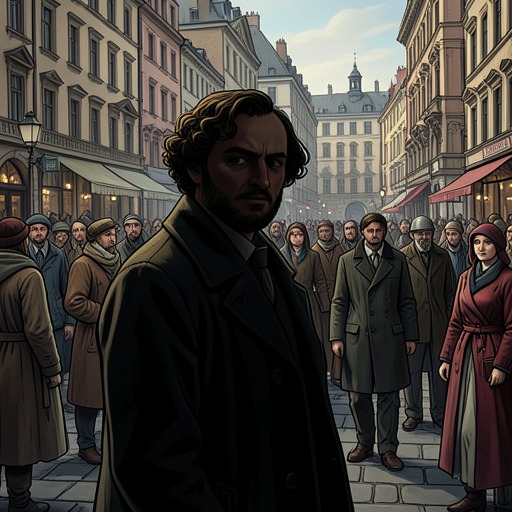
Faust and Mephistopheles make a pact
FaustFaust and Mephistopheles make a pact by joining a promise of service to a wager about the moment Faust might cease striving. Mephistopheles will serve Faust in this world and receive the same service from him in the next; if Faust ever welcomes a passing moment as perfect and asks it to remain, Mephistopheles may claim him. Faust agrees to seal the terms in blood, making the agreement the organizing condition of their relationship and the measure against which its ending is judged.
The Offer and Its Terms
Mephistopheles first offers to guide Faust through life, walk beside him, and serve him, even as a slave, if Faust entrusts him with his steps. Faust does not treat the offer as disinterested assistance. He asks what service will be required in return and warns that the Devil is an egotist, not one who helps others without cause. His questions establish the bargain’s essential imbalance: the promised service may begin in the present, but its counterpayment is deferred until the two meet again.
Mephistopheles states that he will be an unwearied slave, obedient to Faust’s every command, while in the next world Faust will do the same for him. Faust accepts the deferred consequence without settling what the afterlife contains. His attention is fixed on earthly experience: pleasure and sorrow belong here, under the sun, while questions about what comes after death seem to him fruitless to ponder. The pact therefore rests not on a settled account of the hereafter but on an agreement to postpone its claims.
The Wager on Contentment
Mephistopheles offers to show Faust things no one has seen, but Faust’s counterproposal defines the wager more precisely. The decisive test will not be whether Mephistopheles can provide pleasure, success, or novelty. It will be whether any experience can make Faust lie idle, satisfied with himself, or willing to stop. If Mephistopheles can bring him to that state, Faust says, his record may end and the Devil may win.
Faust makes the test explicit: if he ever greets a passing moment as beautiful enough to delay, Mephistopheles may bind him and declare his ruin. The clock’s stopping and time’s ending furnish the image of what such satisfaction would mean: not simply pleasure, but a halt to the onward movement that defines Faust’s ambition. The pact thus puts striving and contentment in direct opposition. Its dramatic tension depends on the possibility that an apparently triumphant experience might also become the condition of Faust’s loss.
Blood, Promise, and Obligation
Before accepting the written form, Faust challenges the need for a document. He doubts that parchment can bind a person whose being changes with time, and points to the fragility of words committed to a page. Yet he does not withdraw his promise. Mephistopheles answers that any sheet will do, provided Faust signs with a drop of blood; Faust agrees to this form, and Mephistopheles calls blood a substance of rare quality.
That exchange turns the pact from a verbal proposal into a physical commitment. Faust calls the formalization a farce, but the wording does not cancel the obligation he accepts. Instead, the contrast between his distrust of documents and his willingness to sign in blood gives the scene its edge: he questions the capacity of a written mark to contain a changing self, then supplies a bodily token that makes the agreement unmistakable. The pact binds the speaker to a future test he cannot yet know how he will meet.
Restless Striving and the Pact’s Consequences
Faust’s willingness to enter the bargain follows from a crisis of knowledge. He describes himself as having inflated his own powers, unable to receive a reply from the Mighty Spirit, shut out by Nature, and left disgusted by knowledge. He seeks instead to plunge into the tumult of time and circumstance, where delight and distress, worry and success may alternate. He identifies restless activity as proof of human life. In that light, the wager does not merely tempt him with pleasure: it gives a formal shape to his refusal to accept an ending in contentment.
The later conclusion makes the pact’s stakes visible without undoing its terms. In the Dungeon, Faust arrives before an iron door carrying keys and a lamp, attempting to reach Margaret. She refuses escape and gives herself to divine judgment. Mephistopheles declares that she is judged, but a voice from above answers that she is saved. The contrast between Mephistopheles’s claim and the voice’s verdict separates Margaret’s fate from the Devil’s immediate control, while Faust remains subject to the pact that has governed their partnership. The scene closes the story’s action around the bargain’s unresolved wager: Margaret’s salvation is declared, but the pact’s test is not the same as her judgment.
Narrative and Thematic Significance
The pact makes a future condition into a present dramatic engine. Mephistopheles’s service and Faust’s promised counter-service link the two characters across the boundary between this world and the next; the wager gives that relationship a specific measure, the moment when striving might cease. Faust’s distrust of fixed language is therefore set against the binding force of an agreement he accepts, while his commitment to restless activity is tested by the possibility of satisfaction.
The ending’s two verdicts sharpen the distinction between the pact and salvation. Mephistopheles announces judgment, yet the voice from above declares Margaret saved. That reversal reveals that his assertion does not settle the final spiritual outcome. The bargain remains essential to Faust’s story, but the closing scene places its claims beside a higher judgment that it cannot simply speak for.