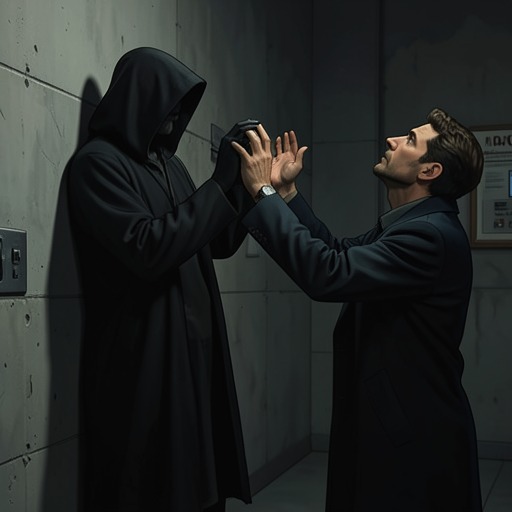
The wager between the Lord and Mephistopheles
FaustThe wager between the Lord and Mephistopheles is the Prologue in Heaven’s defining contest: the Lord permits Mephistopheles to lead Faust astray, yet argues that a person’s striving preserves an instinct for the right path. The agreement makes Faust’s earthly life the field of a test whose terms connect temptation, error, and the possibility of salvation.
Terms of the Wager
Mephistopheles asks for full leave to guide Faust along his own road, believing there remains a chance to win him. The Lord grants permission for as long as Faust lives. His allowance is not an endorsement of Mephistopheles’ purpose; it establishes the conditions under which the tempter may act, and places the burden of the contest on Faust’s life and choices.
The Lord’s account of human nature supplies the wager’s counterclaim: while human desires and aspirations remain active, people cannot help making mistakes. Error is therefore part of the condition under test, not conclusive proof that Faust has been irretrievably lost. The Lord asks Mephistopheles to set his snares and lead Faust downward, confident that even through obscure aspiration a good person retains an instinct toward the one true way.
The Contestants’ Different Measures
Mephistopheles accepts the permission without hesitation. He says the dead offer him no acquisition and prefers the living, whose vitality makes them worth pursuing. His confidence rests on the prospect of making Faust spiritually fall, while the Lord’s terms keep the test open for as long as Faust remains alive.
The Lord, in turn, characterizes Mephistopheles as one of the bold, denying spirits, but not one who moves him to hatred. His account broadens the wager beyond a private contest: human beings, he says, grow tired of activity and too readily seek a level of unqualified repose. He therefore describes the Devil as a companion who works and excites, an adversarial force that prevents passive rest from becoming the final condition of human life. The tempter’s opposition is permitted within a larger order that remains creative and enduring.
How the Wager Frames the Tragedy
The bargain makes the difference between a downward course and a final spiritual judgment essential. The Lord does not promise that Faust will avoid error; he predicts that striving, even when obscure, retains a direction that Mephistopheles cannot simply erase. The wager thus turns the gap between Faust’s immediate desires and his ultimate destination into the story’s governing tension.
Later scenes involving Margaret give that tension a human and religious consequence. In the cathedral, the evil spirit connects Margaret’s distress to her mother’s death, blood at her threshold, and the troubling presence within her. At the end, in the dungeon, Margaret gives herself to God’s judgment. Mephistopheles declares her judged, but a voice from above answers that she is saved. These moments bring the play’s language of judgment and salvation into view; they do not, by themselves, report the final resolution of the wager concerning Faust.
Dramatic Significance
The wager’s force lies in its refusal to equate temptation with a settled outcome. Mephistopheles is granted real latitude to pursue Faust, but the Lord’s confidence rests on striving rather than innocence: the human tendency to err coexists with an instinct for the right way. The contest can therefore generate the tragedy’s choices and consequences without making the tempter’s apparent successes the last word.
That structure also makes the opening agreement more than a preliminary challenge between supernatural figures. It establishes the terms by which the later movement between aspiration, wrongdoing, and salvation can be read, while preserving a distinction between what happens within human lives and what the final judgment declares. Margaret’s salvation at the close of her story offers a sharp instance of that distinction; it is a consequence in the drama, not a stated verdict on Faust’s wager.