Walpurgis Night on the Brocken
FaustWalpurgis Night on the Brocken brings Faust and Mephistopheles into a vast, unruly gathering of witches, where spectacle and danger occupy the same ground. Mephistopheles presents its fires, dancing, drinking, and courtship as entertainment, but steers Faust away from the multitude; the revel then turns sharply personal when Faust sees a pale apparition he associates with Margaret.
The Ascent and the Gathering
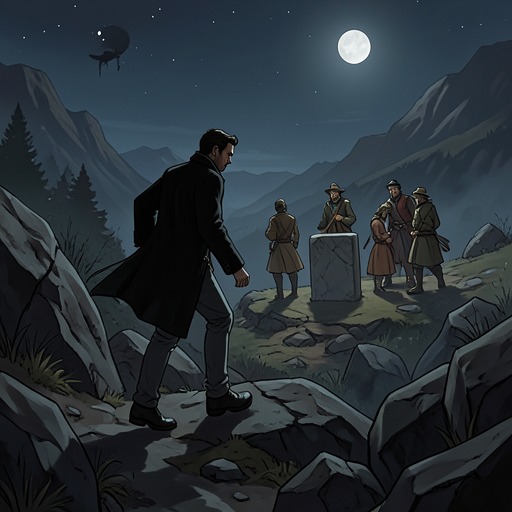
Faust and Mephistopheles climb the Brocken during Walpurgis Night. Faust recognizes the practical purpose of their ascent: they are choosing to separate themselves from the crowd. From above, they see scattered fires and circles of revelers, while smoke and flame mark a livelier gathering on the summit. The mountain offers both a public spectacle and the possibility of withdrawal from it.
Mephistopheles favors the smaller, quieter setting over the summit’s tumult. He describes witches gathering in the heather, with young witches exposed to view and older ones concealed, and says that he will introduce Faust to them. He calls the gathering a traditional trade and observes that little worlds form within the greater world. Yet the scale is anything but intimate: a hundred fires line the ranks, and the participants dance, talk, cook, drink, and court. His welcome makes the supernatural assembly sound at once ordinary and strange, a social world whose customs he knows how to navigate.
Mephistopheles as Guide
The gathering is not simply a backdrop to the journey. Mephistopheles controls how Faust encounters it, distinguishing the noisy multitude from the quieter circles and offering to act as their introducer. He describes the crowds as seeking the Evil One in confusion, while warning that riddles also persist among those who would leave the throng. The scene therefore makes spectacle and uncertainty coexist: the witches’ fires promise diversion, but no gathering guarantees understanding.
His brisk catalogue of ordinary activities—dancing, conversation, cooking, drinking, courtship—turns the witches’ assembly into a distorted counterpart of communal life. The supernatural is not kept apart from familiar social behavior; it gathers around fires and organizes itself into circles. That mixture gives the scene its carnival character without making it safe. Mephistopheles can promise sport, but he cannot make the mountain’s enigmas disappear.
The Apparition of Margaret
In the midst of the revel, Faust notices a girl alone at a distance. She appears pale and fair, falters as if unsure of her way, and seems to him to resemble Margaret. The sight interrupts the scene’s communal bustle: instead of attending to the witches’ entertainment, Faust fixes on a figure that recalls his earlier attachment. His response is immediate and emotionally absorbing; he cannot tear his gaze away.
A narrow scarlet mark around the figure’s throat intensifies the recognition. Mephistopheles confirms that he sees the mark too, then explains that the apparition is a lifeless magical image and warns that such encounters are dangerous. He identifies it with the Medusa story, saying that Perseus once cut off its head. The figure is thus at once a seeming likeness of Margaret and an uncanny illusion, not an actual reunion. The scene provides no evidence that Margaret herself has appeared on the Brocken.
Consequences and Significance
Mephistopheles tries to break the spell of Faust’s attention by directing him toward a nearby hill, where he thinks he sees a theatre. The encounter does not resolve Faust’s attachment; it shows that the image of Margaret can reassert itself even amid a crowded supernatural celebration. The transition from witches’ revelry to a solitary, unsettling likeness changes the scene’s emphasis from diversion to disturbance.
The episode holds its two registers together. The witches’ gathering is expansive and social, measured in circles, ranks, and a hundred fires; the apparition is isolated, pale, and fixed in Faust’s gaze. Mephistopheles’ confident explanations offer a way to classify the vision as illusion, but do not remove its hold on Faust. Walpurgis Night therefore makes the mountain’s spectacle more than a festive interlude: within its public carnival, Faust encounters a private reminder of Margaret that the revel cannot absorb.