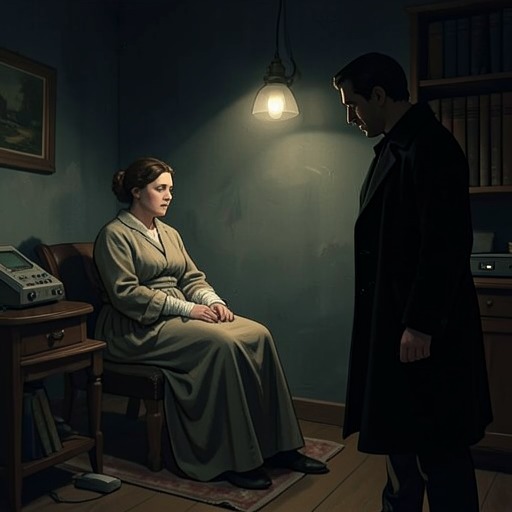
Faust attempts to rescue Margaret
FaustFaust attempts to rescue Margaret is the final prison episode of the tragedy, turning Faust’s discovery of her imprisonment into an urgent but ultimately unsuccessful effort to free her. The rescue plot brings together his guilt, Mephistopheles’ limited assistance, and Margaret’s decisive refusal of escape; its final judgment comes not from the men who enter the dungeon but from a voice from above.
Discovery and the Demand to Act
Faust learns that Margaret is imprisoned only after a period in which, as he charges Mephistopheles, he has been lulled by distractions and kept ignorant of her increasing misery. He describes her as a once-gracious, ill-fated creature now confined as a criminal and exposed to fearful torments. His language makes the discovery a reversal: the suffering he had not faced is suddenly immediate, and his first response is to blame Mephistopheles for concealing it and allowing her to go helplessly to ruin.
Mephistopheles answers that Margaret is not the first person to suffer in this way. The brief reply refuses Faust’s attempt to treat her case as an exceptional grievance and sharpens the difference between Faust’s alarm and Mephistopheles’ detachment. Faust nevertheless insists that they go to the prison and declares that Margaret will be free. When Mephistopheles warns him of the danger, Faust answers that the deaths and their consequences are also Mephistopheles’ responsibility, and repeats his demand to liberate her.
The Price and Practical Limits of Rescue
Mephistopheles identifies a specific obstacle: Faust’s bloodguilt still lies upon the town, and avenging spirits wait where the victim fell for the murderer’s return. The proposed rescue therefore carries danger for Faust, not merely difficulty in reaching Margaret. His insistence does not undo the earlier violence or remove its consequences; he chooses to proceed while knowing that the place he must revisit is watched by forces associated with his crime.
Mephistopheles agrees to help, but defines the limits of what he can do. He cannot claim unlimited power in Heaven and on Earth. Instead, he will cloud the jailer’s senses, obtain the key, and lead Margaret out by human means; he will keep watch while the magic steeds stand ready to carry Faust and Margaret away. Faust accepts the offer with an immediate command to depart. The plan combines supernatural assistance with practical actions—a dulled jailer, a key, a guarded escape, and a vehicle for flight—yet it depends on Margaret agreeing to leave once they reach her.
At the Dungeon Door
The scene shifts to the dungeon, where Faust appears before an iron door holding a bunch of keys and a lamp. The physical setup gives the rescue attempt a concrete threshold: Faust has reached the place of confinement and is equipped to open its locked entrance. But access to the cell is not the same as securing Margaret’s freedom. The earlier plan has brought him to her; it cannot decide for her what freedom should mean or whether she will accept the escape being offered.
The staging also sets the prison’s closed space against Mephistopheles’ promise of departure by magic steeds. The key and door make release seem like an immediate, manageable act, while the warning about bloodguilt and Margaret’s final appeal place the effort within consequences that cannot be unlocked or simply left behind. The attempted escape thus reaches its practical point of possibility without becoming a successful flight.
Margaret’s Choice and the Final Judgment
At the end, Margaret gives herself to the judgment of God. Mephistopheles presses Faust to come away, threatening to leave both her and Faust behind. Margaret calls on God as Father and asks the angels to guard her against evil; she also shudders at the thought of Henry, the name by which she addresses Faust. Her response turns the scene away from the rescue plan: she does not join the departing pair, but entrusts herself to divine judgment.
Mephistopheles announces that she is judged, and a voice from above answers that she is saved. The two declarations place opposing claims beside one another, but the final word belongs to the voice above. Mephistopheles then disappears with Faust, while Margaret’s call to Henry dies away from within. The rescue attempt ends with Faust leaving the dungeon without her: physical escape has failed, yet Margaret’s spiritual fate is affirmed as salvation.
Dramatic Significance
The episode resolves the immediate question of whether Faust can recover Margaret from prison by separating bodily release from the judgment that determines her ending. Faust’s urgency is real, but his plan is directed toward taking her away; Margaret’s final act is instead to give herself to God. Mephistopheles can manipulate the jailer, provide a key, and arrange flight, but the scene’s decisive verdict comes from beyond his power.
The sequence also brings the history of violence into the attempted rescue rather than letting it remain in the past. Mephistopheles’ warning recalls the bloodguilt waiting for Faust at the place of the victim’s death, even as Faust insists on going to Margaret. At the dungeon, however, the conclusion does not absolve Faust or grant him the reunion he seeks. It closes Margaret’s story with a distinction between condemnation and salvation, leaving her in the prison while Faust departs with Mephistopheles.